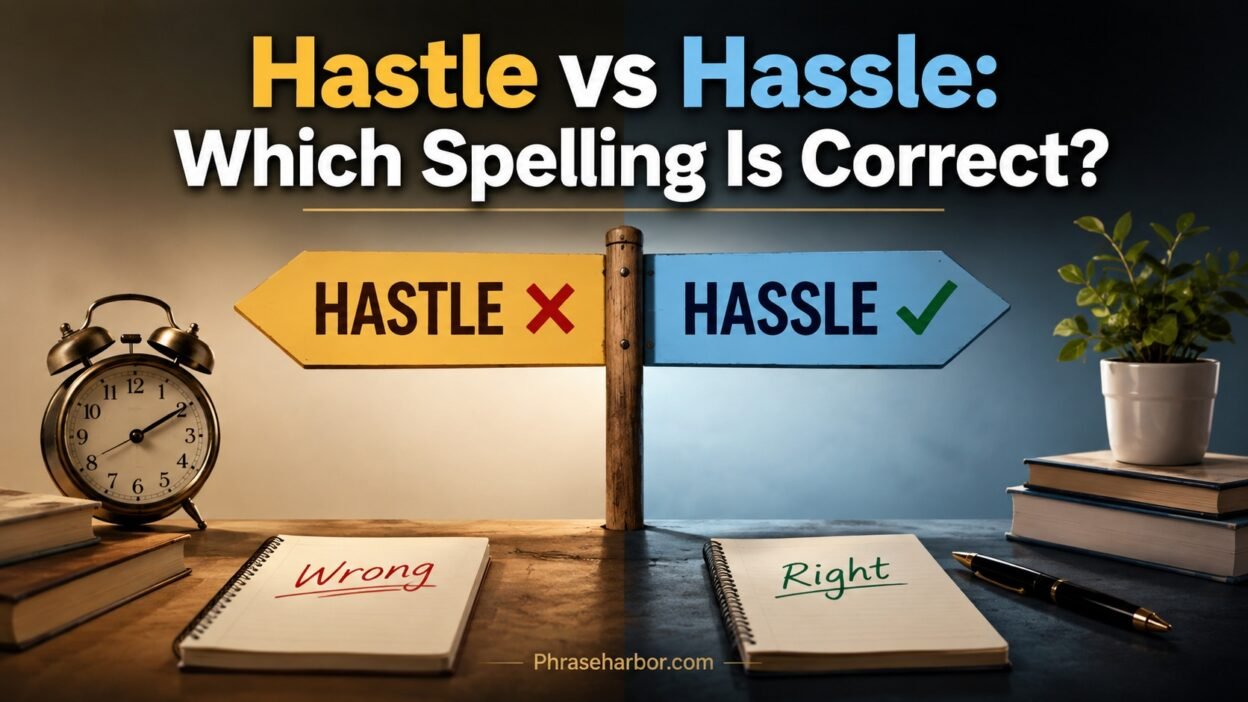
If you’ve ever typed hastle and wondered whether it looks right, you’re not alone. The words hastle vs hassle can cause confusion because they look and sound similar at first glance. However, there’s a simple answer: hassle is the correct standard spelling when you mean an annoying situation, an inconvenience, or the act of bothering someone. Hastle is generally a misspelling of hassle.
The confusion often comes from the way we hear words rather than the way we spell them. When someone says, “What a hassle!” the word can sound quick and compressed. That makes it easy to imagine an extra t in the middle. Once you know the correct form, though, the distinction becomes much easier. This guide explains hastle vs hassle, their meanings, pronunciation, grammar, common mistakes, and practical examples so you can use the right word with confidence.
Quick Answer
Hassle is the correct spelling. Hastle is not the standard spelling of the English word that means an annoying difficulty, inconvenience, or troublesome situation.
Here’s the easiest way to remember it:
- Correct: hassle
- Incorrect: hastle
- Meaning: An annoying difficulty, inconvenience, or troublesome situation
- As a noun: “Getting a refund was a hassle.”
- As a verb: “Don’t hassle me while I’m working.”
- Correct spelling: H-A-S-S-L-E
The key difference is the middle of the word. Hassle contains a double S and has no T.
Merriam-Webster lists hassle as both a noun and a verb. Its definitions cover an annoying or troublesome concern as a noun and the act of annoying or bothering someone as a verb.
Comparison Overview
The comparison between hastle vs hassle is straightforward once you focus on standard spelling and meaning.
| Word | Standard Spelling? | Meaning | Part of Speech | Example |
| Hassle | Yes | An annoying difficulty or inconvenience | Noun | “Parking here is a hassle.” |
| Hassle | Yes | To annoy, bother, or pressure someone | Verb | “Please don’t hassle me.” |
| Hastle | No | Usually an incorrect spelling of hassle | — | “It was a hastle.” |
So, if you’re writing an email, article, school assignment, text message, or professional document, choose hassle.
There’s no need to add a t.
Main Differences Between Hastle vs Hassle
The biggest difference between hastle vs hassle is that only hassle is the established standard spelling for the meaning most people intend.
Hassle Is the Correct Word
Hassle refers to something that causes annoyance, inconvenience, difficulty, or unnecessary trouble. It can describe a situation, task, process, or interaction that makes life more difficult than it needs to be.
For example:
“Dealing with all that paperwork was a hassle.”
Here, hassle functions as a noun. The paperwork created an irritating or inconvenient situation.
The word can also function as a verb:
“The salesperson kept hassling me.”
In this sentence, hassling means repeatedly bothering or pressuring someone.
Hastle Is Usually a Spelling Error
When someone writes hastle, they usually intend to write hassle.
For example:
“Getting a replacement was such a hastle.”
The corrected version is:
“Getting a replacement was such a hassle.”
The incorrect version can still be understood because readers recognize the intended word. However, understanding the meaning doesn’t make the spelling correct.
This distinction matters in formal writing. A spelling mistake may look minor, but repeated errors can make otherwise strong content appear careless.
What Does Hassle Mean?
The word hassle has a few closely related meanings. At its heart, the word describes annoyance, inconvenience, trouble, or unwanted effort.
As a noun, it can refer to something that causes frustration or difficulty.
For example:
- “Returning the shoes was a hassle.”
- “Finding a parking space is always a hassle.”
- “I don’t want the hassle of changing hotels.”
- “Getting through airport security can be a hassle.”
In each example, the word describes something that requires effort or creates irritation.
As a verb, hassle means to annoy, bother, or repeatedly pressure someone.
For example:
- “The kids kept hassling their brother.”
- “The customer said the salesperson was hassling him.”
- “Don’t hassle her while she’s studying.”
Cambridge Dictionary also defines hassle around the ideas of difficulty and trouble and identifies the noun as informal.
How to Use Hassle as a Noun
One of the most common uses of hassle is as a noun. In this form, it describes an irritating problem or inconvenience.
Consider this sentence:
“Moving to a new apartment can be a hassle.”
The word doesn’t mean that moving is impossible. It means the process can involve many annoying details such as packing, transportation, paperwork, cleaning, and scheduling.
That subtle difference is important.
Common Noun Patterns
You’ll often see hassle used in these expressions:
- a hassle
- a real hassle
- such a hassle
- too much hassle
- the hassle of
- without the hassle
- avoid the hassle
- not worth the hassle
- deal with the hassle
Examples in Everyday English
A hassle:
“Getting a parking permit is a hassle.”
A real hassle:
“The broken printer has become a real hassle.”
The hassle of:
“I don’t want to deal with the hassle of moving everything again.”
Without the hassle:
“Online booking lets you reserve a room without the hassle of calling.”
Not worth the hassle:
“The small discount wasn’t worth the hassle.”
These patterns show why hassle works so naturally in everyday American English.
How to Use Hassle as a Verb
Hassle also works as a verb when someone annoys, bothers, or pressures another person.
For example:
“Stop hassling me about the report.”
Here, the speaker doesn’t mean that the report itself is inconvenient. Instead, someone keeps bothering the speaker about it.
Common Verb Forms
| Form | Example |
| Hassle | “Don’t hassle me.” |
| Hassles | “He constantly hassles his coworkers.” |
| Hassled | “She was hassled about the payment.” |
| Hassling | “They kept hassling customers.” |
Notice something important: these forms keep the double S.
The correct forms are:
- hassle
- hassles
- hassled
- hassling
You shouldn’t introduce a t into any of them.
How Do You Spell Hassle Correctly?
The correct spelling is:
H-A-S-S-L-E
The easiest visual detail to remember is the double S.
Compare the two:
- Hastle
- Hassle
The incorrect version has a t. The correct version has ss.
If you’re writing quickly, stop for a second when the word comes to mind. Ask yourself, “Does this word have a t?” It doesn’t.
A Simple Memory Trick
Think:
Hassle = annoying stress
Both words can remind you of a frustrating situation. More importantly, you can remember that hassle has the double s.
Another useful trick is to break the spelling visually into:
has + sle
That isn’t the word’s actual linguistic structure. It’s simply a visual reminder that helps you avoid inserting the unwanted t.
Hastle vs Hassle Pronunciation
Pronunciation can partly explain why people make this spelling mistake.
Hassle is generally pronounced approximately like:
HAS-uhl
Cambridge Dictionary gives the pronunciation as /ˈhæs.əl/.
The word doesn’t contain a pronounced t. If you hear someone say it quickly, however, your brain may attempt to match the sound with a familiar spelling pattern.
That’s one reason hastle can seem plausible even though it isn’t the standard spelling.
A useful approach is to learn the word visually as well as phonetically. When you see hassle repeatedly in books, articles, emails, and everyday writing, the correct spelling becomes automatic.
Why Do People Spell Hassle as Hastle?
The error isn’t mysterious. Several common factors can lead people toward hastle.
Pronunciation Confusion
People often spell unfamiliar words according to how they think those words sound.
Because hassle is pronounced quickly, some writers may imagine a t between the sounds.
Typing Quickly
Fast typing creates plenty of accidental spelling errors. A writer may know the correct spelling but type hastle without noticing.
This is especially common when someone is writing informally.
Visual Pattern Confusion
English contains many words with letter combinations that look similar. When you’re unsure, your brain may substitute a familiar pattern.
The result can be hastle instead of hassle.
Memory Gaps
Sometimes you simply remember a word incorrectly.
That happens even to strong writers. English spelling contains enough irregularities to trip up almost anyone from time to time.
The important thing is to recognize the correct form once you encounter it.
Common Spelling Mistakes With Hassle
Hastle isn’t the only incorrect version people may type. The double s can also cause mistakes.
| Incorrect Form | Correct Form |
| hastle | hassle |
| hasle | hassle |
| hassel | hassle |
| hasslle | hassle |
| hassel | hassle |
The standard spelling remains hassle.
When you’re checking your writing, look for two details: double S and no T.
Correct and Incorrect Sentences
Seeing the word in context often makes the difference clearer than a definition alone.
| Incorrect Sentence | Correct Sentence |
| “Getting there was a hastle.” | “Getting there was a hassle.” |
| “I hate the hastle of paperwork.” | “I hate the hassle of paperwork.” |
| “Don’t hastle me about it.” | “Don’t hassle me about it.” |
| “She was hastling the customer.” | “She was hassling the customer.” |
| “It isn’t worth the hastle.” | “It isn’t worth the hassle.” |
These examples demonstrate both major grammatical roles.
Hassle can describe an irritating thing or situation. It can also describe the act of bothering someone.
Hassle vs Trouble
The words hassle and trouble overlap, but they aren’t always interchangeable.
Trouble is broader. It can describe anything from a minor difficulty to a serious problem.
Hassle usually focuses more strongly on annoyance and inconvenience.
Compare these sentences:
“My car is having trouble starting.”
This describes a mechanical problem.
Now consider:
“Taking the car to the repair shop was a hassle.”
The second sentence focuses on the inconvenience involved in dealing with the situation.
Quick Comparison
| Word | Main Idea | Example |
| Trouble | Difficulty or problem | “We had trouble finding the address.” |
| Hassle | Annoying inconvenience | “Finding parking was a hassle.” |
The choice depends on what you want to emphasize.
Hassle vs Problem
Problem is another broader word.
A problem can be serious, minor, technical, personal, financial, or practical. It doesn’t necessarily involve annoyance.
For example:
“The computer has a problem.”
That sentence simply states that something is wrong.
By contrast:
“Fixing the computer is becoming a hassle.”
Now the focus shifts toward the inconvenience of dealing with it.
That’s an important distinction. Hassle often describes the experience surrounding a problem rather than the problem itself.
Hassle vs Inconvenience
Inconvenience is close to hassle, but the tone differs.
Inconvenience sounds more formal:
“We apologize for the inconvenience.”
Hassle sounds more conversational:
“Sorry for the hassle.”
Both sentences can communicate a similar idea. However, the second sounds more relaxed and personal.
For everyday conversations, texts, blogs, and casual communication, hassle often feels more natural.
Hassle vs Harassment
These words shouldn’t be treated as exact synonyms.
Hassle can mean to bother or annoy someone. Harassment, however, generally describes more serious or persistent unwanted behavior.
For example:
“The salesperson kept hassling me.”
This suggests repeated annoyance or pressure.
However:
“The employee reported harassment.”
That statement carries a much more serious meaning.
When the situation involves serious unwanted conduct, harassment may be the more accurate word. Don’t use hassle simply because the two words share the idea of bothering someone.
Hassle vs Hustle
Here’s another useful distinction.
Hassle and hustle look similar, but they have different meanings.
| Word | Meaning | Example |
| Hassle | Annoyance or inconvenience | “Returning it was a hassle.” |
| Hustle | Move quickly, work energetically, or engage in certain forms of aggressive activity | “We need to hustle if we want to catch the train.” |
| Hastle | Common misspelling of hassle | “It was a hastle.” |
If you’re trying to describe something annoying, choose hassle.
If you’re describing quick movement or energetic effort, hustle may be the right choice.
Read More: Comma Before or After “Or”: Complete Grammar Guide
Common Phrases With Hassle
The word hassle appears in many everyday expressions.
“A real hassle”
This emphasizes that something is particularly annoying.
“Dealing with the insurance company was a real hassle.”
“Too much hassle”
This suggests that something requires more effort than it’s worth.
“Cooking for two people felt like too much hassle.”
“Without the hassle”
This phrase highlights convenience.
“You can order online without the hassle of waiting in line.”
“Avoid the hassle”
This means taking action to prevent an inconvenience.
“Book ahead to avoid the hassle of finding a seat.”
“Not worth the hassle”
This means the result isn’t valuable enough to justify the effort.
“The tiny discount isn’t worth the hassle.”
“Give someone hassle”
This can mean bothering or criticizing someone.
“My friends gave me hassle about being late.”
The exact meaning depends on context, but the central idea remains annoyance or unwanted difficulty.
Hassle in Everyday American English
You’ll hear hassle in ordinary conversations because it describes a very familiar experience: something isn’t necessarily disastrous, but it makes life harder than it needs to be.
Think about everyday situations such as:
- Returning an online purchase
- Waiting in a long line
- Finding parking
- Filling out complicated paperwork
- Changing travel plans
- Dealing with a broken appliance
- Canceling a service
- Moving to a new home
- Fixing a billing mistake
- Navigating a complicated website
For example:
“Changing my flight was such a hassle.”
The speaker isn’t necessarily saying the flight change was impossible. They’re emphasizing the frustration and effort involved.
That’s what gives hassle its conversational flavor.
Case Study: Choosing Hassle in a Real Sentence
Imagine someone has purchased a jacket online. The wrong size arrives, so they need to print a return label, package the jacket, drive to a shipping center, and wait for the refund.
They might say:
“Returning the jacket was a hassle.”
Why does hassle work so well here?
Because the problem isn’t just the wrong jacket. The hassle describes everything the customer must do to fix the problem.
Now compare:
“The jacket was a problem.”
That sentence focuses on the issue itself.
Or:
“Returning the jacket was an inconvenience.”
That’s correct but somewhat more formal.
The word hassle captures the everyday frustration naturally.
When Should You Use Hassle?
Use hassle when you want to communicate that something is irritating, inconvenient, troublesome, or unnecessarily difficult.
It works especially well when:
- A task requires too much effort.
- A process contains annoying steps.
- Someone keeps bothering you.
- A situation creates frustration.
- Something isn’t worth the effort involved.
- You want a casual, conversational tone.
However, choose a more precise word when the situation demands one.
For example, danger, failure, conflict, problem, harassment, and emergency can describe situations that are more serious or specific than a simple hassle.
FAQs:
1. Is “hastle” a correct English word?
No. Hastle is generally considered a misspelling of hassle. When you mean trouble, difficulty, or annoyance, use hassle.
2. What does “hassle” mean?
Hassle means a situation that causes difficulty, inconvenience, or annoyance. For example: “Getting a refund was a real hassle.”
3. Is “hastle” ever correct?
In standard modern English, hastle isn’t the correct spelling for the meaning of inconvenience or annoyance. Use hassle instead.
4. How do you remember the spelling of “hassle”?
Remember that hassle contains ss in the middle: H-A-S-S-L-E. Thinking of the double “s” can help you avoid writing “hastle.”
5. What is the difference between “hastle” and “hassle”?
Hassle is the standard English word meaning trouble, inconvenience, or annoyance. Hastle is a misspelling and should generally be avoided.
Conclusion:
When choosing between hastle vs hassle, hassle is the correct spelling in standard English. Use it when describing something troublesome, inconvenient, or annoying. Although hastle may appear as a spelling mistake, it isn’t the standard form. Remember hassle with its double “s,” and you’ll have the correct spelling every time.