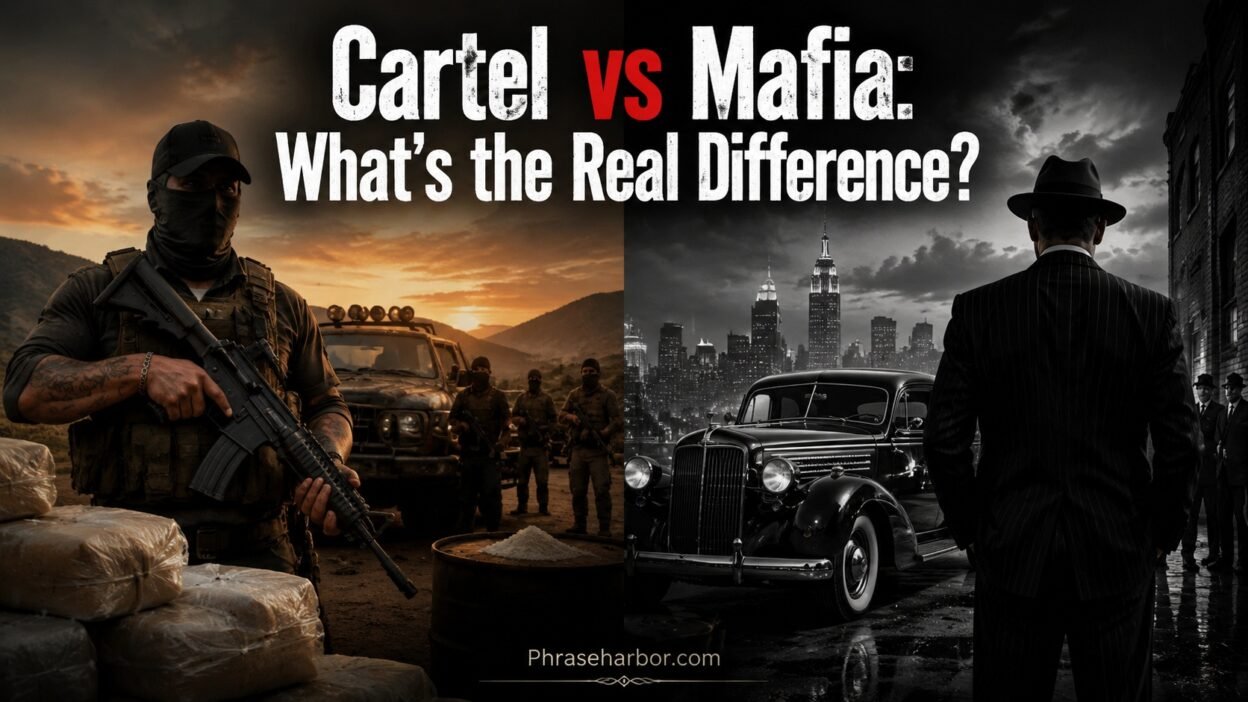
Cartel vs Mafia can confuse many people because these words are used interchangeably, even though they are not the same in English. When I edit English articles, I often see learners mix these terms. A good guide should teach the meaning, definitions, grammar, terminology, proper usage, and word usage of each term in simple English.
This vocabulary lesson works as a topic explainer and language learning lesson, giving understanding through examples, real sentences, communication, writing, class, and education. It helps you use the correct word correctly with confidence, while it explains the difference, differences, and how the terms differ.
You also gain knowledge, context, culture, and cultural background to explain the topic clearly. If you are curious, this deep guide covers everything needed for a complete comparison.From a real-world point of view, both belong to organized crime, but they are not the same criminal organization.
Quick Answer
The main difference between a cartel and a mafia lies in their origins, structure, and primary activities.
- A cartel is an organized criminal group that typically controls illegal markets, especially drug trafficking, across regions or international borders.
- A mafia is a family-based organized crime syndicate that originated in Italy and traditionally profits through extortion, racketeering, illegal gambling, financial crimes, and influence over businesses and politics.
Although both organizations use violence, intimidation, corruption, and money laundering, a cartel usually focuses on controlling illegal supply chains while a mafia often embeds itself within local communities and legitimate businesses.
Read More: Who to Contact or Whom to Contact: Which One Is Correct?
Comparison Overview
| Feature | Cartel | Mafia |
| Primary Goal | Control illegal markets and maximize profits | Build long-term criminal influence and generate profits |
| Historical Origin | Modern Latin America, especially Mexico and Colombia | Sicily, Italy |
| Organizational Structure | Corporate-like hierarchy with regional cells | Family-based hierarchy with formal ranks |
| Main Criminal Activities | Drug trafficking, smuggling, arms trafficking | Extortion, racketeering, gambling, fraud, loan sharking |
| Recruitment | Based on skills, loyalty, or opportunity | Traditionally family ties and trusted associates |
| Geographic Reach | Often international | Local roots with international expansion |
| Leadership | Centralized leadership with regional commanders | Boss, underboss, consigliere, capos, soldiers |
| Relationship With Communities | Territorial control for business purposes | Often seeks social, political, and economic influence |
| Typical Revenue Sources | Narcotics, smuggling, trafficking | Protection rackets, extortion, gambling, fraud, investments |
Main Differences Between Cartel vs Mafia
Although cartels and mafia organizations share several characteristics, their differences are significant.
Purpose
Cartels primarily exist to control illegal markets, particularly narcotics. Their success depends on maintaining supply chains and distribution networks.
Mafia organizations seek long-term control over territories, businesses, and political influence while generating income through multiple criminal enterprises.
Structure
Cartels often resemble multinational corporations with specialized divisions handling logistics, security, transportation, finances, and enforcement.
Mafia organizations traditionally follow a strict family hierarchy where authority flows through clearly defined ranks.
Membership
Many cartels recruit members based on operational skills, military experience, or loyalty.
Traditional mafia groups often emphasize blood relationships, family connections, or long-standing trust before granting full membership.
Income Sources
Cartels earn much of their income through:
- Drug production
- Drug trafficking
- Human trafficking
- Weapons smuggling
- Fuel theft
- Illegal mining
Mafia organizations often profit from:
- Extortion
- Protection rackets
- Loan sharking
- Illegal gambling
- Fraud
- Construction corruption
- Business infiltration
Geographic Focus
Cartels frequently operate across multiple countries because international trafficking forms the foundation of their business.
Mafia groups generally establish strong local control before expanding internationally.
What Is a Cartel?
A cartel is a highly organized criminal enterprise that controls the production, transportation, and sale of illegal goods. Today, the word most commonly refers to drug trafficking organizations operating across national borders.
Unlike loosely connected gangs, cartels coordinate sophisticated logistics, financial operations, intelligence gathering, and enforcement activities.
Origin of the Term
The word cartel originally described an alliance or agreement between independent groups. In economics, it refers to businesses working together to control prices or markets.
Law enforcement later adopted the term to describe criminal organizations that cooperate to dominate illegal industries.
Common Characteristics of Cartels
Most cartels share several traits.
- Sophisticated supply chains
- International smuggling routes
- Armed enforcement units
- Corruption of public officials
- Money laundering operations
- Intelligence gathering
- Territorial disputes
- Large financial resources
Rather than relying on a single illegal activity, many modern cartels diversify their operations to reduce financial risk.
What Is a Mafia?
The mafia refers to organized criminal societies that originated in Sicily during the nineteenth century. Over time, similar organizations developed elsewhere in Italy and later expanded internationally through migration.
Unlike many cartels, mafia organizations traditionally build influence by embedding themselves within communities, businesses, and political systems.
Historical Origins
During periods of weak government authority in Sicily, private groups offered protection in exchange for payment. Over time, many evolved into criminal organizations that used intimidation, violence, and corruption to maintain control.
The concept eventually spread beyond Italy, leading to the development of organized crime families in countries such as the United States.
Common Characteristics
Traditional mafia organizations often feature:
- Family loyalty
- Formal initiation rituals
- Strict internal discipline
- Codes of secrecy
- Long-term planning
- Business infiltration
- Political corruption
- Protection rackets
Many mafia groups maintain elaborate internal rules that regulate member behavior and resolve disputes.
Cartel vs Mafia: Key Differences Explained
Organizational Structure
Cartels usually divide operations into specialized departments.
For example:
- Leadership
- Security
- Logistics
- Finance
- Intelligence
- Enforcement
- Transportation
This structure allows them to coordinate complex international trafficking operations.
Mafia organizations typically follow a hierarchical chain of command.
| Traditional Mafia Rank | Role |
| Boss | Ultimate decision-maker |
| Underboss | Second-in-command |
| Consigliere | Senior advisor |
| Caporegime | Crew leader |
| Soldier | Full member |
| Associate | Trusted non-member |
Leadership Style
Cartel leadership often changes rapidly because arrests, internal conflicts, and rival groups frequently disrupt command structures.
Mafia leadership usually emphasizes stability, succession planning, and long-term organizational continuity.
Violence
Both organizations use violence, though often for different reasons.
Cartels frequently engage in violent territorial conflicts because control of transportation routes directly affects profits.
Mafia organizations more commonly use violence selectively to enforce discipline, intimidate rivals, or protect criminal interests.
Community Relationships
Many mafia groups attempt to build influence within local communities through economic control and political connections.
Cartels usually prioritize strategic control over transportation corridors and production regions.
Similarities Between Cartels and the Mafia
Despite their differences, both organizations share several defining features.
- Organized leadership
- Illegal profit motives
- Money laundering
- Corruption
- Secrecy
- Intimidation
- Violence
- International financial networks
Both also adapt quickly to changing law enforcement tactics.
Types of Criminal Activities
Common Cartel Activities
- Drug cultivation
- Drug manufacturing
- International trafficking
- Weapons smuggling
- Human trafficking
- Fuel theft
- Illegal mining
- Money laundering
Common Mafia Activities
- Extortion
- Racketeering
- Illegal gambling
- Loan sharking
- Tax fraud
- Construction fraud
- Public contract corruption
- Counterfeiting
- Money laundering
Although these activities sometimes overlap, their primary business models differ.
How Cartels and the Mafia Make Money
Criminal organizations rarely depend on a single income stream.
Cartel Revenue
- Wholesale narcotics
- Cross-border smuggling
- Chemical production
- Human trafficking
- Illegal mining
- Fuel theft
- Financial laundering
Mafia Revenue
- Protection payments
- Gambling
- Fraud
- Corrupt contracts
- Loan sharking
- Real estate investments
- Legitimate businesses used for laundering
Diversification helps reduce financial risk when authorities target one source of income.
Organizational Structure Comparison
Famous Cartels
Several organizations have had a major impact on international law enforcement.
| Cartel | Country | Primary Activity |
| Medellín Cartel | Colombia | Cocaine trafficking |
| Cali Cartel | Colombia | Cocaine trafficking |
| Sinaloa Cartel | Mexico | International drug trafficking |
| Jalisco New Generation Cartel (CJNG) | Mexico | Drug trafficking and organized crime |
These organizations became known for sophisticated logistics and international operations.
Famous Mafia Organizations
| Organization | Country of Origin | Known For |
| Sicilian Cosa Nostra | Italy | Traditional mafia hierarchy |
| American Mafia | United States | Organized crime families |
| Camorra | Italy | Regional criminal networks |
| ‘Ndrangheta | Italy | International cocaine trafficking and financial crimes |
Each developed under different historical circumstances and operates differently.
Why People Confuse Cartels and the Mafia
Several factors contribute to public confusion.
- News headlines often simplify terminology.
- Movies use the terms interchangeably.
- Both organizations engage in organized crime.
- Both use violence and intimidation.
- Both operate internationally.
Despite these similarities, their structures and historical origins remain distinct.
Read More: My Father and I or My Father and Me: Which Is Grammatically Correct?
Which Is More Powerful?
There is no universal answer.
Power depends on several factors.
- Financial resources
- Geographic reach
- Political influence
- Membership size
- Access to illegal markets
- Ability to avoid law enforcement
Some cartels possess enormous financial resources because of global narcotics markets.
Certain mafia organizations, however, maintain decades of political influence and deep economic connections that are difficult to measure.
Comparing them directly oversimplifies complex criminal organizations that operate under different models.
Common Misconceptions
Is every drug trafficking group a cartel?
No.
Many drug trafficking groups lack the scale, coordination, or market control required to be considered cartels.
Is every organized crime family part of the mafia?
No.
Many criminal organizations resemble mafia groups without sharing the historical origins or traditions associated with Italian organized crime.
Can the mafia operate outside Italy?
Yes.
Several mafia organizations established operations in countries including the United States, Canada, Australia, and parts of Europe.
Are all cartels based in Latin America?
No.
Although the term commonly refers to Latin American drug trafficking organizations, criminal cartels have operated in other regions as well.
Cartel vs Mafia: Real-World Comparison
| Situation | Cartel | Mafia |
| Controls international drug supply chains | ✔ | Sometimes |
| Operates through family hierarchy | Rarely | ✔ |
| Uses extortion as a primary income source | Sometimes | ✔ |
| Launders money | ✔ | ✔ |
| Influences politics through corruption | ✔ | ✔ |
| Controls trafficking routes | ✔ | Sometimes |
| Invests in legal businesses | ✔ | ✔ |
When Should You Use “Cartel” or “Mafia”?
Choosing the correct term depends on the organization you are describing.
Use cartel when referring to groups that primarily control illegal markets through production, transportation, and large-scale distribution.
Use mafia when discussing criminal organizations rooted in family structures, protection rackets, extortion, or Italian organized crime traditions.
Using the right word improves clarity and avoids confusing two distinct forms of organized crime.
FAQs:
Is a cartel the same as a mafia?
No. A cartel usually focuses on controlling illegal markets, especially drug trafficking and making money. A mafia is a broader criminal organization that often depends on family ties, extortion, corruption, and many different illegal activities.
Which word should I use: cartel or mafia?
Use cartel when talking about organized groups that control illegal trade or markets. Use mafia when referring to family-based or long-established criminal organizations. Choosing the right word makes your writing more accurate.
Why do people confuse cartel and mafia?
Many news reports, movies, books, and TV shows use the two terms loosely. Because of this, people often think they have the same meaning, even though they describe different types of organized crime.
Can a mafia be involved in drug trafficking?
Yes. A mafia can take part in drug trafficking, but it is not limited to it. Mafia organizations may also engage in extortion, corruption, illegal businesses, money laundering, gambling, and other criminal activities.
Why is it important to understand the difference between Cartel vs Mafia?
Knowing the difference helps you use the correct term in conversations, school assignments, news discussions, and professional writing. It also improves your English vocabulary and gives you a better understanding of organized crime and its impact on society.
Conclusion:
Understanding Cartel vs Mafia is about more than learning two vocabulary words. It helps you recognize how different criminal organizations are structured, how they operate, and why they are often confused. A cartel mainly controls illegal markets and profits from trafficking, while a mafia is usually built around family connections, long-term influence, and a wider range of criminal activities. Once you know these differences, you can choose the correct term with confidence, communicate more clearly, and better understand the way these organizations are discussed in history, the media, and current events.