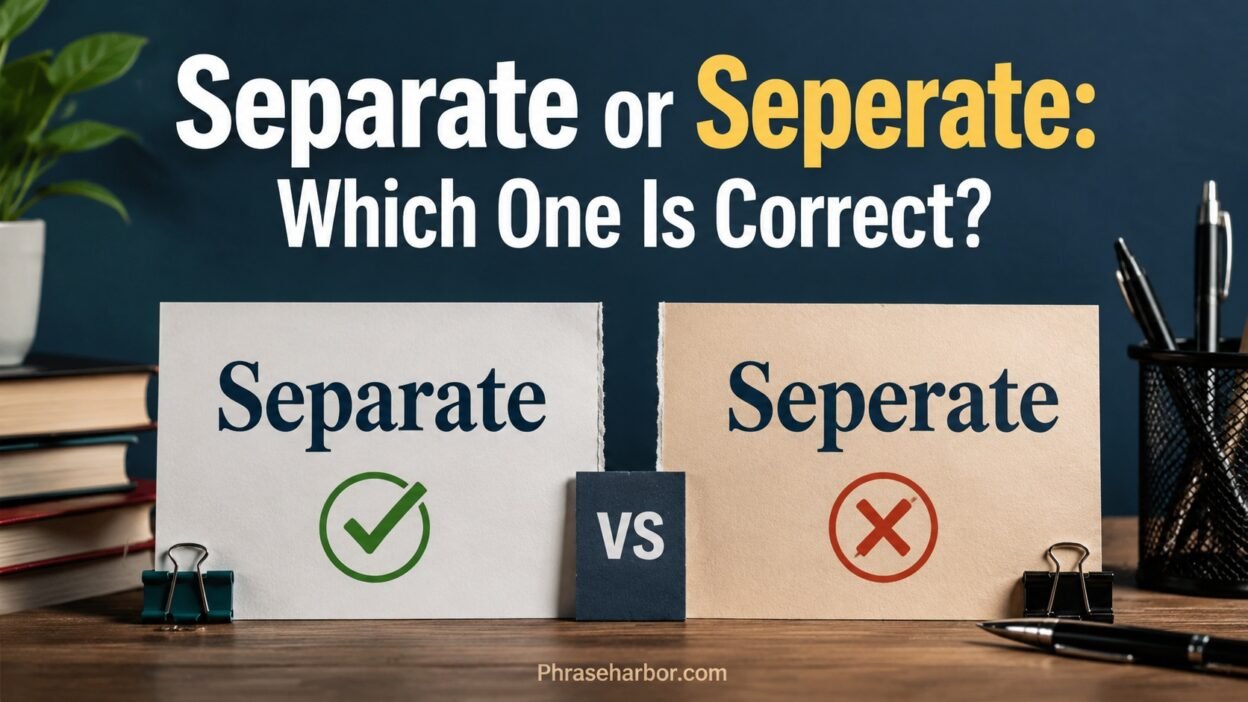
The Separate or Seperate debate creates spelling hesitation for English writers because one vowel mistake can change trust, clarity, and usage. Many people wonder why this confusion happens because the pronunciation of the middle vowel sound feels unclear, leading them to type the wrong version.
The good news is simple: Separate is the correct modern spelling, while Seperate is an incorrect misspelling. A proper dictionary confirms this standard form, and learning the word through grammar, language rules, and correct usage helps writers avoid a common error.
I learned in school that small mistakes in emails, formal memos, business documents, reports, papers, and social media posts can affect credibility, trust, and the impression created in professional environments. A practical guide with examples, tables, and comparisons gives readers an easy-to-read, research-backed explanation of the distinction.
Quick Answer
The correct spelling is separate.
Seperate is always incorrect in modern English. Every major English dictionary recognizes separate as the standard spelling, whether you use it as a verb or an adjective.
| Word | Correct? | Meaning |
| Separate | Yes | To divide something or keep things apart. Also describes things that are distinct from one another. |
| Seperate | No | A common misspelling of separate. |
If you’re writing an essay, email, report, or social media post, always choose separate.
Comparison Overview
| Feature | Separate | Seperate |
| Correct spelling | Yes | No |
| Found in English dictionaries | Yes | No |
| Accepted in academic writing | Yes | No |
| Appropriate for professional communication | Yes | No |
| Used in books and newspapers | Yes | No |
| Common typing mistake | No | Yes |
| Recognized by spell check | Yes | Usually flagged as an error |
Main Differences Between Separate or Seperate
Although these spellings differ by only one letter, the difference matters.
Separate Is the Correct English Word
Separate is the accepted spelling in both American and British English. You can use it as both a verb and an adjective.
Examples:
- Please separate the white clothes from the colored ones.
- We booked separate hotel rooms.
- The teacher asked students to separate into groups.
Seperate Is a Misspelling
Seperate is not accepted in standard English.
Using it in formal writing can:
- Reduce your credibility
- Cause spelling errors in academic work
- Make professional emails look less polished
- Lower writing quality
Modern spell-check software usually highlights seperate because it is not recognized as a correct English word.
What Does “Separate” Mean?
The word separate has more than one grammatical function. Understanding both helps you use it correctly.
Separate as a Verb
As a verb, separate means to divide, split, disconnect, or move things apart.
Examples:
- Separate the files into different folders.
- The referee separated the players.
- Oil and water naturally separate over time.
- We decided to separate personal expenses from business expenses.
Separate as an Adjective
As an adjective, separate describes things that are distinct or not joined together.
Examples:
- They live in separate houses.
- Each applicant received a separate interview.
- The company has separate departments for sales and marketing.
Is “Seperate” Ever Correct?
The simple answer is no.
There are no modern dictionaries, grammar guides, or style manuals that accept seperate as a correct spelling.
Whether you’re writing:
- Academic papers
- Business reports
- Legal documents
- Blog posts
- Emails
- Books
…the correct spelling is always separate.
Even grammar-checking tools automatically suggest replacing seperate with separate.
Why Do People Spell “Separate” as “Seperate”?
This mistake has several causes.
Pronunciation Can Be Misleading
Many English speakers pronounce the middle syllable softly, making it difficult to hear whether the vowel is a or e.
That’s why your ears sometimes trick your brain.
The Brain Prefers Familiar Patterns
English contains many words ending in -erate or -perate, which makes your brain guess instead of remembering the exact spelling.
Fast Typing
Typing quickly increases spelling mistakes.
When you’re focused on ideas rather than spelling, your fingers may automatically produce seperate.
Childhood Learning Habits
Some people learned the incorrect spelling years ago and never corrected it.
Old habits can stick until you intentionally replace them.
Easy Ways to Remember the Correct Spelling
A simple memory trick can save you from making the same mistake again.
Remember the Hidden Word “A RAT”
Look closely:
sepARate
You can see the letters A RAT hidden inside.
Many students remember it like this:
There is “A RAT” inside sepARate.
It may sound funny, but memorable tricks often work because they create a strong mental image.
Think About “PAR”
Another trick is to notice PAR inside the word.
sePARate
If you play golf, remembering par makes the spelling easier.
How to Pronounce “Separate”
American pronunciation:
SEP-uh-rate
IPA:
/ˈsepəreɪt/
British pronunciation is almost identical, with only a slight variation in accent.
Because the middle vowel sounds weak, many writers mistakenly replace a with e.
When Should You Use “Separate”?
Everyday Conversations
People use separate constantly in daily life.
Examples:
- Separate the groceries.
- Keep the receipts separate.
- We traveled in separate cars.
- The children sleep in separate bedrooms.
School and Education
Teachers frequently use this word.
Examples:
- Write your answers on a separate sheet.
- Separate the nouns from the verbs.
- Students worked in separate groups.
Workplace Communication
Businesses rely on clear organization.
Examples:
- Create separate folders.
- Use separate invoices.
- Keep client records separate.
- Separate confidential files.
Technology
Technology also uses this word regularly.
Examples:
- Separate columns in Excel.
- Separate databases.
- Separate user accounts.
- Separate backup files.
Common Phrases That Use “Separate”
These expressions appear frequently in English.
| Phrase | Meaning |
| Separate ways | People stop traveling or living together. |
| Separate issue | A different problem altogether. |
| Separate room | A room that isn’t shared. |
| Separate account | An independent financial account. |
| Separate entrance | A different way into a building. |
| Separate identity | An independent personality or character. |
| Separate entity | Something legally or conceptually independent. |
| Separate category | A distinct classification. |
| Separate file | An individual document. |
| Separate line | An individual row or sentence. |
Learning phrases instead of isolated words makes your vocabulary grow naturally.
Separate vs Similar Words
Although these words share related meanings, they aren’t interchangeable in every sentence.
| Word | Meaning | Example |
| Separate | Divide or distinct | Separate the documents. |
| Apart | At a distance | The houses stand far apart. |
| Divide | Split into parts | Divide the cake equally. |
| Distinct | Clearly different | Their ideas are distinct. |
| Isolate | Keep away from others | Doctors isolated the patient. |
| Individual | Single or personal | Each individual received instructions. |
Choosing the right word depends on the context.
Common Mistakes to Avoid
Many spelling errors stem from the same root.
| Incorrect | Correct |
| Seperate | Separate |
| Seperated | Separated |
| Seperating | Separating |
| Seperation | Separation |
Notice that every correct form keeps the “a” after sep.
Examples of “Separate” in Sentences
Everyday Life
- Please separate the recycling from the trash.
- We bought separate gifts for each child.
- They entered through separate doors.
School
- Use a separate notebook for science.
- Separate the facts from the opinions.
- The teacher asked each group to work separately.
Business
- Keep company and personal finances separate.
- Create separate reports for each department.
- The project has separate budgets.
Technology
- Store backups on separate drives.
- Separate user permissions improve security.
- Use separate passwords for important accounts.
Legal Writing
- The judge considered the two cases separately.
- Each contract contains separate conditions.
- Separate agreements were signed.
Read More: Bespeckled vs. Bespectacled: What’s the Difference?
Grammar Tips for Using “Separate”
Using Separate as a Verb
Structure:
Subject + separate + object
Examples:
- We separate recyclable materials.
- Scientists separate chemicals during testing.
- Parents separate toys by age.
Using Separate as an Adjective
Structure:
Separate + noun
Examples:
- Separate entrances
- Separate invoices
- Separate classrooms
It can also follow linking verbs.
Examples:
- The two companies remain separate.
- Their opinions are separate.
Separate vs Separately
These words have different grammatical roles.
| Word | Part of Speech | Example |
| Separate | Verb or adjective | We need separate accounts. |
| Separately | Adverb | Please submit them separately. |
Examples:
- Correct: Submit each application separately.
- Correct: Use separate applications.
Real-World Case Study: One Letter Can Change First Impressions
Imagine a hiring manager reviewing two nearly identical resumes.
One applicant writes:
“Managed seperate project teams.”
The other writes:
“Managed separate project teams.”
The experience may be the same, but the spelling error immediately stands out. Small mistakes can distract readers and create the impression that the document wasn’t carefully reviewed.
While a single typo won’t always cost someone an opportunity, consistent spelling accuracy strengthens credibility in school, business, and professional communication.
Interesting Facts About the Word “Separate”
- Separate comes from the Latin word separatus, meaning “set apart.”
- English has used the word for hundreds of years.
- It functions as both a verb and an adjective.
- It appears frequently in academic, legal, scientific, and business writing.
- Separate ranks among the most commonly misspelled English words.
FAQs:
1. Is Separate or Seperate the correct spelling?
The correct spelling is Separate. The word Seperate is a common misspelling that happens because the pronunciation of the middle vowel sound can make people confused. Using the correct spelling helps maintain accuracy in English writing.
2. Why do people often spell Separate incorrectly?
Many people write Seperate because they hear the second vowel sound differently. This confusion is understandable, especially when typing quickly in emails, messages, or digital content. Remembering that Separate contains an “a” in the middle can help avoid this common mistake.
3. How can I remember the spelling of Separate?
A simple memory trick is to connect Separate with the word apart, because both relate to keeping things divided or distinct. You can also practice writing the word in sentences until the correct form becomes natural.
4. Does using Seperate affect professional writing?
Yes, using Seperate instead of Separate can create a negative impression in professional environments. Small spelling errors in documents, reports, emails, or public-facing content may affect credibility and how readers judge your attention to detail.
5. What does Separate mean in English?
Separate means to divide, keep apart, or make something distinct from another thing. It can describe physical objects, ideas, groups, or situations that are not combined. For example, separate documents are kept apart from each other for better organization.
Conclusion:
Understanding the difference between Separate or Seperate is important for clear and accurate communication. Although both forms may look similar and sound alike, only Separate is accepted as the correct spelling in modern English. By improving spelling habits, using proofreading techniques, and remembering simple tricks, writers can avoid this common error and communicate with more confidence.