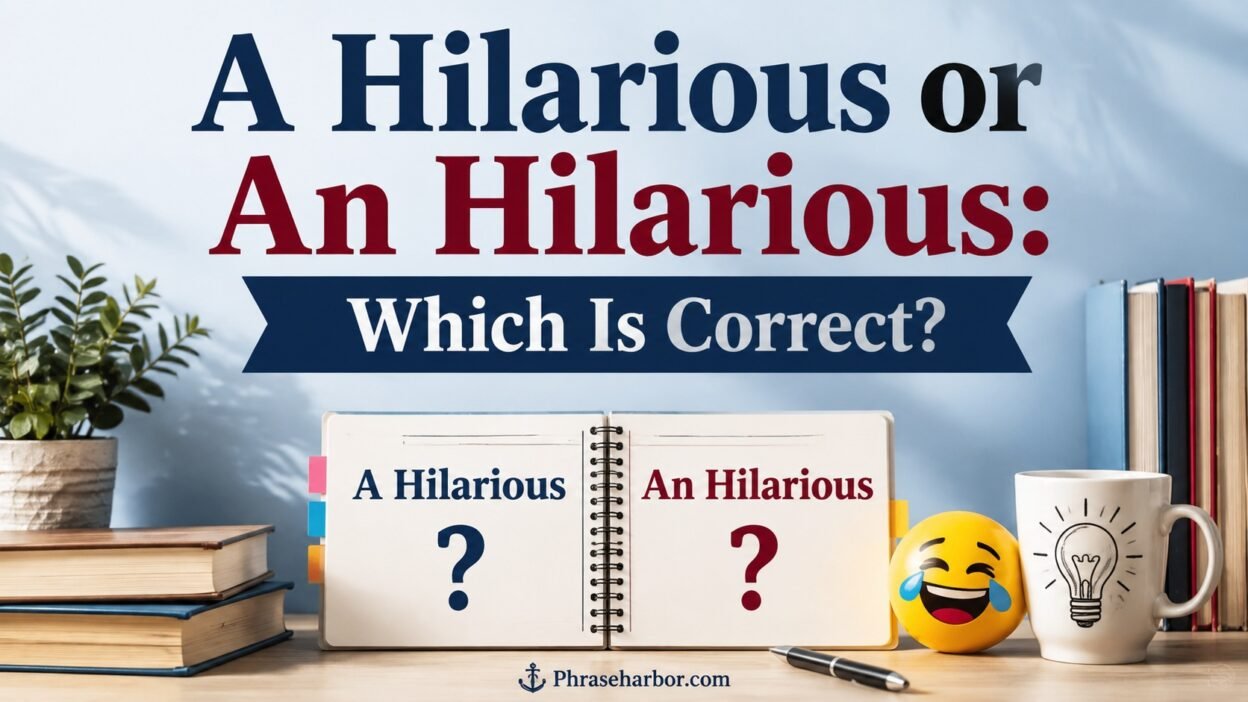
A Hilarious or An Hilarious is a common grammar question that many English learners ask because article choice follows pronunciation, not spelling. The debate over A Hilarious, An Hilarious, and a hilarious vs an hilarious often confuses learners, native speakers, and other people interested in English.
From my experience teaching, I have noticed that many grammar mistakes happen when we assume the first letter decides the correct article. The real answer is based on the grammar rule, grammar rules, and the idea that the article depends on pronunciation.
In modern English, standard English, standard modern English, modern American English, American English, and most British English, the correct choice, correct form, and correct phrase are A Hilarious because hilarious begins with a clearly pronounced H sound.
Quick Answer
If you’re looking for the short answer, here it is:
A hilarious — Correct
An hilarious — Incorrect in standard modern American English
Correct Examples
- A hilarious joke made everyone laugh.
- We watched a hilarious movie last night.
- She told a hilarious story during dinner.
- That was a hilarious moment I’ll never forget.
- He shared a hilarious meme with the group.
Why Is “A Hilarious” Correct?
The choice between a and an depends on the first sound of the next word, not its first letter.
The word hilarious begins with a pronounced H sound:
hilarious → /hɪˈleriəs/
Because the first sound is a consonant sound, you should always use a.
Think of it this way:
- a house
- a hero
- a history lesson
- a holiday
- a hilarious joke
Each word begins with a clearly spoken H sound, so a is the natural choice.
By contrast, words like hour and honest have a silent H. Their first spoken sound is a vowel, so they take an instead.
- an hour
- an honest mistake
- an honor
- an heir
A simple rule can save you from almost every mistake:
Listen to the first sound, not the first letter.
Comparison Overview
The table below highlights the difference between a hilarious and an hilarious.
| Phrase | Correct in Modern US English? | Reason |
| A hilarious joke | Yes | Hilarious begins with a pronounced H sound. |
| An hilarious joke | No | The H isn’t silent, so an is unnecessary. |
| An honest person | Yes | The H is silent. |
| An hour | Yes | The word starts with a vowel sound. |
| A hero | Yes | The H is pronounced. |
| A hotel | Yes | Modern American English pronounces the H. |
| A history book | Yes | Begins with a consonant sound. |
| An heir | Yes | The H is silent. |
At a Glance
| Rule | Use |
| A | Before words that begin with a consonant sound |
| An | Before words that begin with a vowel sound |
This rule applies to thousands of English words. It isn’t unique to hilarious. Once you understand the pronunciation rule, you’ll find it much easier to choose the correct article every time.
Main Differences Between A Hilarious or An Hilarious
Many people believe the first letter determines whether to use a or an. In reality, English grammar relies on the sound you hear when you say the word aloud.
Here’s what separates the two phrases.
| Feature | A Hilarious | An Hilarious |
| Standard American English | Correct | Incorrect |
| Begins with pronounced H | Yes | No |
| Follows modern grammar rules | Yes | No |
| Common in writing and speech | Yes | Rare |
| Recommended in schools and style guides | Yes | No |
“A Hilarious” Follows Modern English Pronunciation
Say the word slowly:
Hilarious
The very first sound you hear is /h/.
Because the word starts with a consonant sound, the article a naturally fits before it.
For example:
- It was a hilarious performance.
- She shared a hilarious memory.
- We had a hilarious conversation.
- That’s a hilarious idea.
- He made a hilarious comment during the meeting.
Every one of these sentences sounds natural because the grammar matches the pronunciation.
Why Some People Write “An Hilarious”
Although an hilarious occasionally appears in older books or certain British contexts, it isn’t the standard choice today.
Several factors explain the confusion.
- Some older British writers preferred an before words beginning with an unstressed H.
- Many learners assume every word starting with a vowel letter or certain consonants follows the same pattern.
- Silent-H words such as hour, honest, and honor often influence people to overapply the rule.
Modern dictionaries and grammar references overwhelmingly recommend a hilarious because the H is fully pronounced.
The Golden Rule
Whenever you’re unsure, don’t look at the spelling first.
Instead, ask yourself one question:
What sound do I hear first?
If the first sound is a consonant, use a.
If the first sound is a vowel, use an.
That single habit will help you choose the correct article in almost every situation.
Why “A Hilarious” Is Correct
The phrase a hilarious follows one of the most important rules in English grammar: indefinite articles depend on pronunciation, not spelling. Once you understand this principle, choosing between a and an becomes much easier.
Many learners memorize lists of words that use a or an, but you don’t need to rely on memorization alone. Instead, focus on the sound that begins the next word.
English Articles Depend on Sound, Not Spelling
One of the biggest misconceptions about English grammar is that a always comes before consonants and an always comes before vowels. That rule isn’t entirely accurate.
The real rule is this:
- Use “a” before a consonant sound.
- Use “an” before a vowel sound.
Notice that the rule mentions sounds, not letters.
For example:
| Word | First Letter | First Sound | Correct Article |
| hilarious | H | /h/ | a hilarious |
| house | H | /h/ | a house |
| hero | H | /h/ | a hero |
| honest | H | Silent H | an honest |
| hour | H | Silent H | an hour |
| heir | H | Silent H | an heir |
This simple distinction explains why two words beginning with the same letter can use different articles.
How “Hilarious” Is Pronounced
The pronunciation of hilarious is:
/hɪˈleriəs/
The very first sound is the voiced H sound.
Say the word aloud:
Hilarious.
You naturally begin with “h”, just as you do in words like:
- happy
- history
- holiday
- hero
- human
Since the first sound is a consonant, a is the only article that fits naturally in modern American English.
Examples include:
- That’s a hilarious movie.
- We heard a hilarious joke.
- She had a hilarious reaction.
- He gave a hilarious speech.
- It became a hilarious misunderstanding.
Each sentence sounds smooth because the article matches the word’s pronunciation.
Why Pronunciation Matters More Than the First Letter
English developed over centuries by borrowing words from Latin, French, Germanic languages, and many others. As pronunciation evolved, spelling often stayed the same.
That’s why several words beginning with H no longer pronounce the letter.
Consider these examples:
| Word | Pronounced As | Correct Usage |
| honest | on-est | an honest answer |
| honor | on-er | an honor |
| hour | our | an hour |
| heir | air | an heir |
Now compare those with:
| Word | Pronounced As | Correct Usage |
| hilarious | hih-LAIR-ee-us | a hilarious joke |
| house | house | a house |
| hero | heer-oh | a hero |
| holiday | hol-uh-day | a holiday |
The spelling may look similar, but the pronunciation changes everything.
A Quick Listening Test
If you’re unsure which article to use, try this quick exercise.
- Say the word aloud.
- Listen carefully to the first sound.
- Ignore the first letter.
- Choose the article that matches the sound.
For example:
- Hilarious → hear the H → a hilarious
- Hour → hear ow → an hour
- University → hear you → a university
- Umbrella → hear uh → an umbrella
This trick works far better than memorizing long lists of exceptions.
Read More: Team That, Team Who, or Team Which: The Complete Grammar Guide
Why Some People Say “An Hilarious”
If a hilarious is correct, why do you sometimes see or hear an hilarious?
The answer lies in the history of English pronunciation and regional speech patterns.
While an hilarious isn’t considered standard in modern American English, its occasional appearance has historical reasons.
Historical English Usage
Centuries ago, many English speakers pronounced certain words beginning with H differently than they do today.
In some dialects, the H sound was weak or nearly silent. Because speakers didn’t strongly pronounce the consonant, they naturally used an instead of a.
This pattern appeared in older literature and formal writing.
As pronunciation changed over time, most of these expressions disappeared from everyday English.
Today, standard American English clearly pronounces the H in hilarious, making a hilarious the accepted form.
Influence of British English
Some varieties of British English have historically preferred an before words that begin with an unstressed H.
For example, older publications occasionally included phrases like:
- an historic occasion
- an hotel
- an heroic act
Modern British English has also shifted toward:
- a historic occasion
- a hotel
- a heroic act
As a result, an hilarious has become increasingly uncommon on both sides of the Atlantic.
Hypercorrection
Another reason people write an hilarious is something linguists call hypercorrection.
Hypercorrection happens when someone tries so hard to sound grammatically correct that they accidentally create an incorrect form.
For instance, a writer might think:
“Since H can be silent in some words, maybe I should use an before every H-word.”
Unfortunately, that assumption leads to mistakes.
Correct examples include:
- a hilarious story
- a happy child
- a helpful guide
- a historic building (modern US English)
Incorrect examples include:
- an hilarious story
- an happy child
- an helpful guide
The spoken sound—not the spelling—always determines the article.
Does “An Hilarious” Ever Appear Today?
Yes, but it’s rare.
You might encounter an hilarious in:
- older novels
- historical documents
- quotations from earlier centuries
- discussions about grammar history
- isolated examples in British publications
However, if you’re writing for a modern audience, especially in American English, you should use:
a hilarious
Doing so matches current grammar standards, dictionaries, educational materials, and professional writing.
Here are the final sections of your article.
FAQs:
What is correct: A Hilarious or An Hilarious?
The correct choice in modern English is A Hilarious because hilarious starts with a clearly pronounced H sound. English articles depend on pronunciation rather than the first letter of a word.
Why do some people write An Hilarious?
You may find An Hilarious in older texts, historical writing, or some traditional British styles. In today’s standard English, however, it is considered uncommon because the H in hilarious is pronounced.
Why do we say an hour but a hilarious?
The word hour begins with a silent H, so it takes an. The word hilarious begins with a pronounced H sound, so it takes a. The rule is based on sound, not spelling.
Does this rule apply to all words that begin with H?
No. Words with a pronounced H, such as house, history, and hilarious, usually take a. Words with a silent H, such as hour, honest, and heir, usually take an.
Is A Hilarious accepted in both American and British English?
Yes. A Hilarious is the standard and widely accepted form in modern American English and most modern British English. While you may occasionally see An Hilarious in older or highly formal writing, it is rare in everyday usage.
Conclusion:
When deciding between A Hilarious and An Hilarious, remember one simple rule: listen to the sound, not the spelling. Since hilarious begins with a clearly pronounced H sound, A Hilarious is the correct choice in modern English. Understanding this pronunciation rule will also help you choose the correct article for many other H words, making your writing and speaking sound more natural, accurate, and confident.