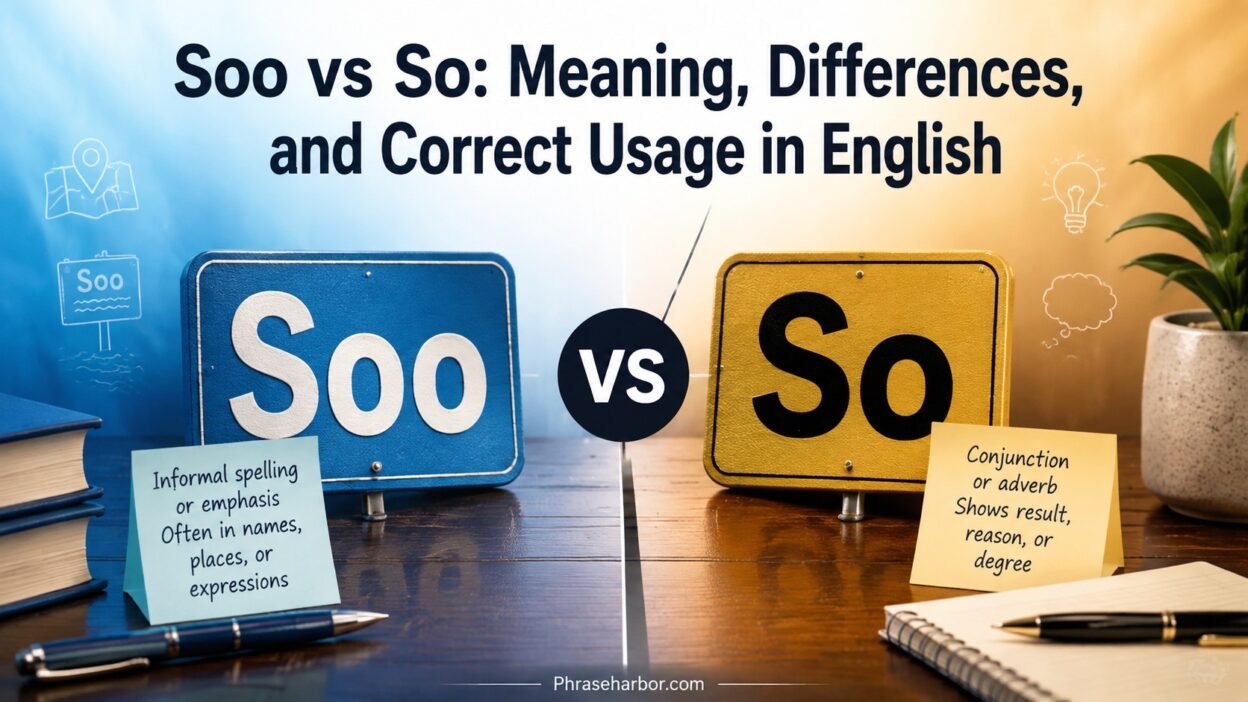
Soo vs So often confuses writers because both look alike, yet only one fits standard English in most situations. Many people join the debate because so and soo look similar, but they have different roles in English.
From my editing experience, I have found this issue commonly appears among English learners, native speakers, learners, and speakers during daily conversation, texting, social media, online writing, casual writing, and digital writing.
The real difference is that so is the standard word with standard spelling in standard English, while soo is a nonstandard informal spelling often seen in informal English and internet culture. People use it to express emotion, mood, tone, emphasis, or exaggeration, making a message feel more natural in a relaxed context, but it is not the correct choice for formal writing or formal English.
Quick Answer: Soo vs So
“So” is the correct standard English spelling. It works in formal writing, professional communication, and everyday conversations.
“Soo” is usually not a standard English word. People mainly use it online or in text messages to stretch the word “so” and create extra emotion.
Examples:
| Usage | Example | Correct? |
| Standard English | The movie was so good. | Yes |
| Formal writing | She was so excited about the opportunity. | Yes |
| Casual texting | That was soo funny! | Acceptable informally |
| Professional email | The results were soo impressive. | No |
The simple rule is:
Use “so” when you want correct English. Use “soo” only when you intentionally want a casual, emotional texting style.
What Does So Mean?
The word “so” is one of the most common words in the English language. It has existed in English for centuries and comes from Old English roots connected with ideas like “in this way” or “to that extent.”
Because “so” has multiple grammatical functions, its meaning changes depending on the sentence.
For example:
- “The weather is so beautiful today.”
- “I was tired, so I went home.”
- “I think so.”
In each sentence, “so” performs a different job.
So as an Adverb
One of the most common uses of “so” is as an adverb. In this role, it describes the degree or intensity of something.
It often appears before adjectives and adverbs to show a strong feeling or high level.
Examples:
- “The baby is so cute.”
- “That restaurant was so expensive.”
- “She sings so beautifully.”
Here, “so” increases the strength of the word that follows.
Compare these sentences:
- “The book was interesting.”
- “The book was so interesting.”
The second sentence creates a stronger emotional reaction. It tells the reader that the book was not just interesting but extremely interesting.
So as a Conjunction
The word “so” can also connect two ideas by showing a cause-and-effect relationship.
In these sentences, “so” means “therefore” or “because of that.”
Examples:
- “It started raining, so we stayed inside.”
- “I forgot my wallet, so I couldn’t buy lunch.”
- “She practiced every day, so she improved quickly.”
The first part explains the situation. The second part explains the result.
A useful way to remember this use:
Something happened → so → something happened because of it.
So as a Substitute Word
Sometimes “so” replaces information that has already been mentioned. This keeps sentences shorter and avoids repetition.
Examples:
- “Will you attend the meeting?”
- “I think so.”
The second person does not repeat the entire sentence: “I think I will attend the meeting.”
Other examples:
- “Is he coming today?”
- “I hope so.”
- “Do you believe that story?”
- “I don’t think so.”
In these examples, “so” acts as a replacement for an idea.
So as an Interjection
People also use “so” at the beginning of sentences to introduce a topic, create a transition, or express a reaction.
Examples:
- “So, what happened next?”
- “So, you finally finished the project.”
- “So! You decided to join us.”
This use appears frequently in conversations because it helps speakers move naturally from one thought to another.
What Does Soo Mean?
Unlike “so,” “soo” does not have an official meaning in standard English when it replaces the word “so.”
Most dictionaries do not recognize “soo” as a normal English spelling of “so.” Instead, people create it by adding extra letters.
This happens frequently in digital communication because written text cannot always show emotions the way spoken language can.
When someone says:
“I am so happy!”
Their voice might rise to show excitement. Online, they may write:
“I am soo happy!”
The extra “o” tries to copy that emotional emphasis.
Soo in Text Messages and Social Media
The internet has changed the way people write. Online conversations often include creative spelling choices that reflect personality and emotion.
Common examples include:
- “Soo cute!”
- “Sooo excited!”
- “I’m sooo tired.”
- “That was sooo funny.”
The repeated letters do not change the dictionary meaning. Instead, they change the tone.
Compare:
“I am so happy.”
This sounds normal and neutral.
“I am sooo happy!”
This sounds more energetic and emotional.
The extra letters act almost like a person raising their voice or adding excitement while speaking.
Why Do People Write Soo Instead of So?
People use “soo” for several reasons:
| Reason | Explanation | Example |
| Emotion | Adds excitement or intensity | “That gift was soo amazing!” |
| Humor | Creates a dramatic effect | “I am soo ready for this.” |
| Casual style | Makes messages feel relaxed | “That’s soo cool.” |
| Personality | Shows individual writing style | “I’m sooo happy today!” |
This type of spelling is common in informal digital language. Similar examples include:
- “Nooo” instead of “No.”
- “Yesss” instead of “Yes.”
- “Pleeease” instead of “Please.”
These forms are not grammar mistakes in casual conversations. They are intentional style choices.
Soo vs So: Key Differences
| Feature | So | Soo |
| Standard English spelling | Yes | No |
| Used in dictionaries | Yes | Usually no |
| Appropriate for formal writing | Yes | No |
| Common in texting | Yes | Yes |
| Adds emotional emphasis | Sometimes | Usually |
| Changes pronunciation | No | Often suggests stretching the sound |
The biggest difference is simple:
“So” communicates meaning. “Soo” communicates meaning plus emotion.
Is Soo a Misspelling of So?
The answer depends on context.
If someone writes “soo” in a formal essay, business report, or academic paper, it is considered a spelling mistake.
Example:
Incorrect:
“The research findings were soo important.”
Correct:
“The research findings were so important.”
However, if someone writes “soo” in a private message to a friend, it usually is not an accidental mistake.
Example:
“That puppy is soo adorable!”
The writer intentionally uses extra letters to create a friendly tone.
Language often changes depending on where and how people use it. A spelling choice that feels natural in a text message may look inappropriate in professional writing.
When Should You Use So?
You should use “so” in almost every standard writing situation.
Use “so” in:
- School assignments
- Research papers
- Business emails
- Workplace documents
- Articles
- Formal conversations
- Professional messages
Examples:
- “The company grew so quickly because of strong customer demand.”
- “The results were so impressive that investors increased funding.”
- “The weather was cold, so we stayed indoors.”
Using “so” keeps your writing clear and grammatically correct.
When Is It Acceptable to Use Soo?
The spelling “soo” works best in casual situations where emotional expression matters more than formal accuracy.
You may see it in:
- Text messages
- Social media comments
- Friendly chats
- Informal captions
- Creative writing with conversational characters
Examples:
- “That dress is soo pretty!”
- “I’m soo happy you came.”
- “This dessert is sooo delicious.”
However, avoid using “soo” in situations where readers expect professional communication.
Avoid:
- Job applications
- Cover letters
- School essays
- Business proposals
- Official documents
Common Mistakes With Soo and So
Many people confuse these two words because online writing habits influence everyday communication.
Common mistakes include:
Using Soo in Formal Writing
A casual spelling style does not belong in professional documents.
Incorrect:
“The presentation was soo successful.”
Better:
“The presentation was so successful.”
Thinking Soo Has a Different Meaning
“Soo” usually does not create a new meaning. It only adds emphasis.
Compare:
- “She is so talented.”
- “She is soo talented!”
The meaning stays almost the same. The second sentence simply sounds more excited.
Overusing Extra Letters
Although “sooo” can show emotion, too many repeated letters can make writing look childish or unclear.
For example:
- “That was sooo amazinggggg.”
This may work in a playful message but not in most situations.
Read More: Invision or Envision: Which Spelling Is Correct?
Examples of Soo vs So in Sentences
Standard English Examples
- “The restaurant was so crowded.”
- “She was so kind to everyone.”
- “I was tired, so I went home.”
- “I think so.”
Casual Texting Examples
- “That movie was soo good!”
- “Your dog is sooo adorable.”
- “I’m soo excited for the weekend.”
- “That joke was soo funny.”
Formal Writing Corrections
Incorrect:
“The results were soo impressive.”
Correct:
“The results were so impressive.”
Incorrect:
“The product is soo effective.”
Correct:
“The product is so effective.”
How to Remember the Difference Between Soo and So
A simple memory trick works:
“So” is for correct English. “Soo” is for extra emotion.
Think of the extra “o” as extra energy.
The word itself does not become stronger grammatically. Instead, the writer adds personality.
For example:
- “I am so excited.” → normal statement.
- “I am soo excited!” → emotional reaction.
When writing for a general audience, always choose “so” unless you intentionally want a casual internet style.
Related Online Spelling Trends Similar to Soo
Digital communication has created many informal spelling patterns.
Examples include:
| Standard Word | Informal Version | Purpose |
| So | Soo/Sooo | Extra excitement |
| No | Nooo | Strong reaction |
| Yes | Yesss | Enthusiasm |
| Please | Pleeease | Emotional request |
These spellings are part of online expression. They help people show tone when they cannot use voice, facial expressions, or body language.
However, knowing when to switch back to standard English remains important.
FAQs:
1. Is soo a real English word?
Soo is not accepted as a standard English word. It is an informal spelling of so that people often use in texting, social media, and other forms of casual communication to add emphasis or show emotion.
2. Should I use soo in formal writing?
No. In formal writing, always use so because it follows English grammar, grammar rules, and standard spelling. Using soo can make your writing look unprofessional.
3. Why do people write sooo or soo instead of so?
People often lengthen the word to express mood, tone, excitement, emotion, or exaggeration. It is a common habit in digital communication and internet culture, but it is not considered correct in academic or professional writing.
4. How can I remember the difference between so and soo?
Think of so as the correct choice for every formal situation. Use soo only when chatting with friends or posting casually online if you want extra emphasis. When in doubt, choose so.
5. Can using soo affect my English writing?
Yes. Frequent use of soo in school, business, or professional documents may create a poor impression. Using so with proper word choice, punctuation, and sentence structure helps your writing stay clear and natural.
Conclusion:
Understanding Soo vs So is easier once you know that so is the correct, standard form, while soo is an informal variation mainly used for emphasis in casual online conversations. By following English grammar, paying attention to context, and choosing the right form for your audience, you can write with greater confidence. Whether you’re sending a text message or preparing a professional document, using so appropriately will keep your communication accurate, natural, and effective.