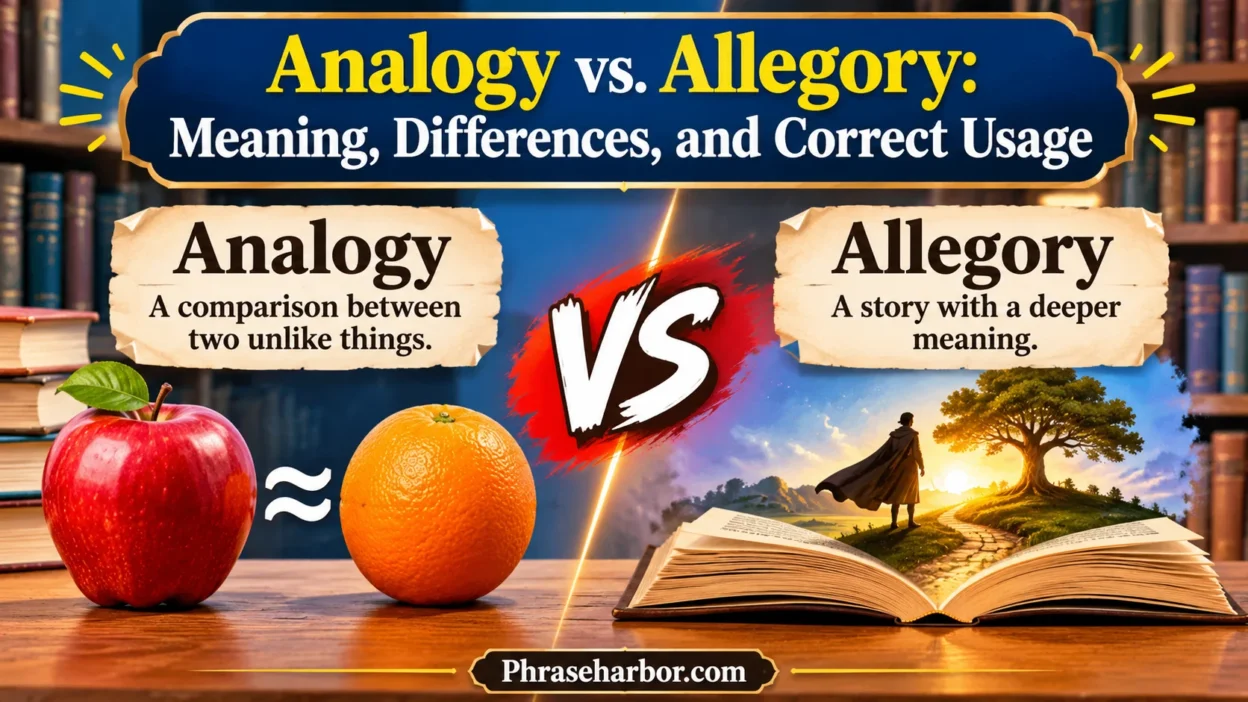
Analogy vs. Allegory explains two literary devices: one compares ideas, while the other uses a symbolic story to express a deeper message clearly. Both have different purposes in writing, literature, and everyday communication. An analogy uses a comparison to explain a difficult idea, complex ideas, or complicated ideas through a familiar and useful way of connecting two things.
It highlights their similarity and helps readers understand how different things are alike. For example, comparing the human brain to a computer creates a meaningful comparison and a useful conceptual connection. Such analogy examples make explanations easier through simple comparisons and real-life examples.
You can use analogies in an essay, email, or other forms of written expression to clarify ideas and improve your communication skills. Understanding their definition, meaning, and usage can also strengthen your writing skills, essay writing skills, and ability to produce effective educational writing.
Quick Answer:
Analogy is a comparison between two different things that share a similar feature, function, or relationship. Writers use it to explain unfamiliar ideas through familiar examples.
Allegory is a story, poem, artwork, or narrative that communicates a deeper meaning through symbolic characters, events, objects, and settings.
Consider these simple examples:
- Analogy: Learning a new language is like building a house. You need a strong foundation before adding more advanced elements.
- Allegory: A story about a kingdom ruled by a greedy king can represent corruption, oppression, and the abuse of political power.
The main difference is that an analogy explains through comparison, while an allegory communicates through symbolic representation.
| Feature | Analogy | Allegory |
| Meaning | Comparison between two things | Narrative with a deeper symbolic meaning |
| Main purpose | Explain or clarify an idea | Communicate a broader message |
| Structure | Short or extended comparison | Usually a developed story or artistic work |
| Focus | Similarities and relationships | Symbolic characters, events, and settings |
| Common use | Education, communication, arguments | Literature, politics, religion, and social commentary |
| Interpretation | Understand the comparison | Discover the underlying message |
| Example | The brain works like a computer | Animal Farm by George Orwell |
Comparison Overview
Analogy and allegory both help communicate ideas beyond straightforward descriptions. However, they approach this goal differently.
An analogy connects two subjects through a recognizable similarity. It gives readers a familiar reference point so they can understand something less familiar.
An allegory takes a different approach. Instead of directly explaining an idea through comparison, it develops a narrative in which the characters, situations, and events represent broader concepts.
For example, a teacher might compare the immune system to a security team protecting a building. This analogy makes the body’s defense system easier to understand.
Meanwhile, a story about a kingdom where citizens gradually lose their freedom under an authoritarian ruler could represent political oppression. That narrative may function as an allegory.
| Comparison point | Analogy | Allegory |
| Basic technique | Comparison | Symbolic storytelling |
| Primary objective | Improve understanding | Communicate deeper meanings |
| Subject matter | Two related or comparable subjects | Literal narrative and abstract ideas |
| Length | One sentence to several paragraphs | Often an extended work |
| Characters | Not required | Commonly present in narrative forms |
| Symbolism | Optional | Central to its structure |
| Literal meaning | Supports the comparison | Coexists with symbolic meaning |
| Typical example | A business is like an ecosystem | A fictional society represents real political conditions |
Remember: An analogy doesn’t need a story, and an allegory doesn’t need to explain a direct similarity between two subjects. Their methods and purposes make them distinct.
What Is an Analogy?
Definition of Analogy
An analogy is a comparison between two different things that share a similar feature, function, pattern, or relationship. It helps explain an idea by connecting it with something readers already understand.
The word analogy comes from the Greek word analogia, which relates to proportion or correspondence. This connection reflects how analogies identify relationships between seemingly different subjects.
For example, consider this statement:
“An experienced manager is like a conductor leading an orchestra.”
A manager and a conductor work in different environments. However, both coordinate individuals, manage responsibilities, maintain timing, and guide a group toward a shared goal.
The comparison helps readers understand leadership without requiring a lengthy explanation.
Analogies appear in everyday conversations, educational materials, scientific explanations, business presentations, and persuasive writing. They’re especially useful when an idea feels too abstract or technical.
Examples of Analogy in Everyday Language
People use analogies regularly without even realizing it. These comparisons make conversations more engaging and help explain complicated situations.
Here are several examples:
Learning is like planting a seed. You need patience, consistent effort, and the right conditions before knowledge develops.
The brain works like a computer. Both receive information, process it, store it, and retrieve it when needed. However, the human brain is much more complex than a conventional computer.
A strong friendship is like a sturdy bridge. Both depend on trust, reliability, and regular maintenance to remain strong.
Managing money is like maintaining a garden. Careful planning, regular attention, and controlled spending help your resources grow.
A business operates like an ecosystem. Employees, customers, suppliers, and competitors interact in ways that affect the entire organization.
Each example connects an unfamiliar or abstract idea with a familiar experience. That’s what makes an analogy effective.
Read More: Flavor vs. Flavour: Meaning, Differences, and Correct Usage
Examples of Analogy in Writing and Communication
Writers use analogies to make information easier to understand. The best comparisons explain relationships without distracting readers from the main point.
Here are four common applications:
- Educational writing: Teachers compare electrical circuits to water flowing through pipes to explain current and resistance.
- Scientific explanations: Scientists and educators use comparisons to introduce complex processes, such as describing atoms as miniature solar systems. This model is useful for basic visualization but doesn’t accurately represent modern atomic structure.
- Business communication: A manager might describe a company’s departments as parts of a machine that must work together.
- Persuasive writing: An author might compare regular exercise to maintaining a vehicle, explaining why consistent care prevents problems.
Analogies also help when you need to explain something to an audience with limited background knowledge.
However, every comparison has limits. A good writer explains the relevant similarities without suggesting that two different things are identical.
Types of Analogies
Analogies can take several forms depending on the relationship between the subjects.
Literal analogy: Compares things that share practical or observable similarities.
Example: A bicycle and a motorcycle both use wheels and steering systems to transport people.
Figurative analogy: Uses imaginative or nonliteral comparisons to explain an idea.
Example: A difficult decision can feel like standing at a crossroads without a map.
Functional analogy: Compares things that perform similar roles.
Example: A school principal is like a captain because both guide a group and make important decisions.
Structural analogy: Highlights similarities in the organization or arrangement of two systems.
Example: The branches of a government can be compared to separate departments within an organization, each with distinct responsibilities.
Relational analogy: Focuses on the relationship between two pairs of things.
Example: A teacher is to a student as a coach is to an athlete. Both relationships involve guidance, instruction, and development.
These categories describe useful ways of understanding analogies. They aren’t necessarily mutually exclusive. A single comparison may fit more than one category.
Characteristics of an Analogy
An effective analogy usually has several recognizable features:
- Two distinct subjects: It connects different things rather than simply repeating the same idea.
- A meaningful similarity: The comparison highlights a shared feature, function, or relationship.
- An explanatory purpose: It helps readers understand something more clearly.
- A recognizable connection: Readers should be able to follow the comparison without excessive explanation.
- Flexible length: An analogy can appear in a single sentence or develop across several paragraphs.
- Practical relevance: The comparison should support the point rather than introduce unnecessary confusion.
The strongest analogies also acknowledge important differences. For instance, comparing the brain to a computer helps explain information processing, but it doesn’t capture the full complexity of human thought, emotion, and consciousness.
What Is an Allegory?
Definition of Allegory
An allegory is a literary or artistic device that uses characters, events, objects, and settings to represent deeper meanings beyond their literal descriptions.
An allegory typically communicates abstract ideas through a concrete narrative. These ideas may involve morality, religion, politics, power, freedom, justice, or human behavior.
The term comes from the Greek word allegoria, meaning speaking in a different way. This origin reflects the central feature of allegory: expressing one meaning through another.
For example, imagine a story about a kingdom where a powerful ruler gradually takes away citizens’ rights. At first, the narrative appears to describe an ordinary fictional kingdom. However, the ruler may represent authoritarian leadership, while the citizens represent people struggling against oppression.
The story operates on two levels:
- Literal level: A fictional ruler controls a kingdom and its population.
- Symbolic level: The narrative explores political power, oppression, and the loss of freedom.
Unlike a simple comparison, an allegory develops its message through interconnected narrative elements.
Examples of Allegory in Literature
Some of the most recognizable literary works use allegory to explore complicated moral, political, and religious subjects.
Animal Farm by George Orwell
Animal Farm is one of the most famous political allegories in English literature. Orwell tells the story of farm animals who overthrow their human owner and establish their own government.
Initially, the animals seek equality and freedom. However, the pigs gradually gain control and establish an oppressive system.
The story represents the Russian Revolution and the development of Stalinist authoritarianism. Napoleon, the pig who becomes the farm’s dominant leader, reflects the abuse of political power associated with Joseph Stalin.
The farm’s changing rules and unequal treatment reveal how revolutionary ideals can become corrupted.
The Pilgrim’s Progress by John Bunyan
John Bunyan’s The Pilgrim’s Progress follows a character named Christian as he travels toward the Celestial City.
His journey represents the Christian spiritual journey toward salvation. Along the way, he encounters obstacles and characters representing temptation, despair, faith, and other spiritual experiences.
The protagonist’s physical journey carries a religious meaning throughout the narrative.
The Faerie Queene by Edmund Spenser
First three books published in 1590
Edmund Spenser’s The Faerie Queene uses knights, quests, and fictional kingdoms to explore moral and religious ideas.
Different characters represent virtues such as holiness, temperance, and chastity. Their adventures demonstrate conflicts between virtue and vice.
The work combines imaginative storytelling with moral and political symbolism.
Examples of Allegory in Everyday Life and Popular Culture
Allegory isn’t limited to classic books. Modern films, stories, and creative works frequently use symbolic narratives to explore real-world issues.
Consider these examples:
A fictional city divided by wealth: A story about wealthy citizens living behind protected walls while poor residents struggle outside may represent economic inequality and class divisions.
A kingdom controlled by fear: A narrative about a ruler who uses surveillance and punishment to control citizens may represent authoritarianism and the loss of personal freedom.
A journey through a dark forest: A character’s struggle through dangerous woods may represent personal growth, uncertainty, or the challenges of overcoming hardship.
A conflict between light and darkness: A story that consistently associates light with truth and darkness with deception may develop a broader moral allegory.
However, not every fictional story containing symbolic objects qualifies as a complete allegory. The symbolic elements must work together to communicate a broader meaning.
Types of Allegory
Allegories can explore different subjects depending on the message an author wants to communicate.
Religious allegory: Uses characters and events to represent spiritual beliefs, religious struggles, or journeys toward salvation.
Example: The Pilgrim’s Progress represents the Christian journey toward spiritual fulfillment.
Political allegory: Uses fictional governments, characters, or conflicts to examine political systems and power structures.
Example: Animal Farm explores revolution, dictatorship, and political corruption.
Moral allegory: Presents characters and events that represent virtues, vices, ethical choices, or moral conflicts.
Example: A story in which a character must choose between honesty and personal gain can develop an allegorical message about integrity.
Historical allegory: Uses fictional characters and events to represent historical people, movements, or circumstances.
Example: A fictional uprising may reflect the struggles and consequences of a particular historical revolution.
These categories can overlap. A political allegory may also contain religious or moral themes.
Frequently Asked Questions
What Is the Main Difference Between Analogy and Allegory?
The main difference between analogy and allegory is their purpose. An analogy compares two different things to explain an idea more clearly. An allegory uses a story, characters, and events to communicate a deeper meaning or hidden message. In simple terms, an analogy explains through comparison, while an allegory teaches or expresses an idea through storytelling.
Is an Analogy a Type of Allegory?
No, an analogy is not a type of allegory. Both are literary devices, but they work differently. An analogy highlights similarities between two things to make an explanation easier. An allegory presents symbolic meanings through a story or extended narrative. Although they can sometimes appear together, they are separate techniques.
What Is an Example of an Analogy?
An easy example of an analogy is saying, “The human brain is like a computer.” This comparison helps explain how the brain processes and stores information. Another example is, “Learning a language is like building a house.” Both comparisons connect an unfamiliar or complex idea to something familiar.
What Is an Example of an Allegory?
A famous example of an allegory is Animal Farm by George Orwell. The novel uses farm animals and their experiences to represent political power, corruption, and social inequality. Its characters and events communicate ideas beyond the literal story. This makes it an example of political and social allegory.
How Can You Identify an Analogy or an Allegory?
You can identify an analogy by looking for a comparison that explains how two things are similar. An allegory usually contains characters, events, or settings that represent deeper ideas. Ask yourself whether the writer is explaining something through comparison or communicating a hidden message through a story. This simple approach makes both literary devices easier to recognize.
Conclusion:
Understanding Analogy vs. Allegory helps you recognize two important literary devices and use them correctly in different situations. An analogy makes complicated ideas easier to understand by comparing familiar things. An allegory communicates deeper messages through symbolic characters, events, and storytelling. Although both techniques add meaning to writing, they serve different purposes. Once you understand their differences, you can improve your writing skills, strengthen your literary analysis, and avoid confusing these terms. Whether you’re writing an essay, reading a novel, or explaining an everyday idea, choosing the right technique makes your communication clearer and more effective.