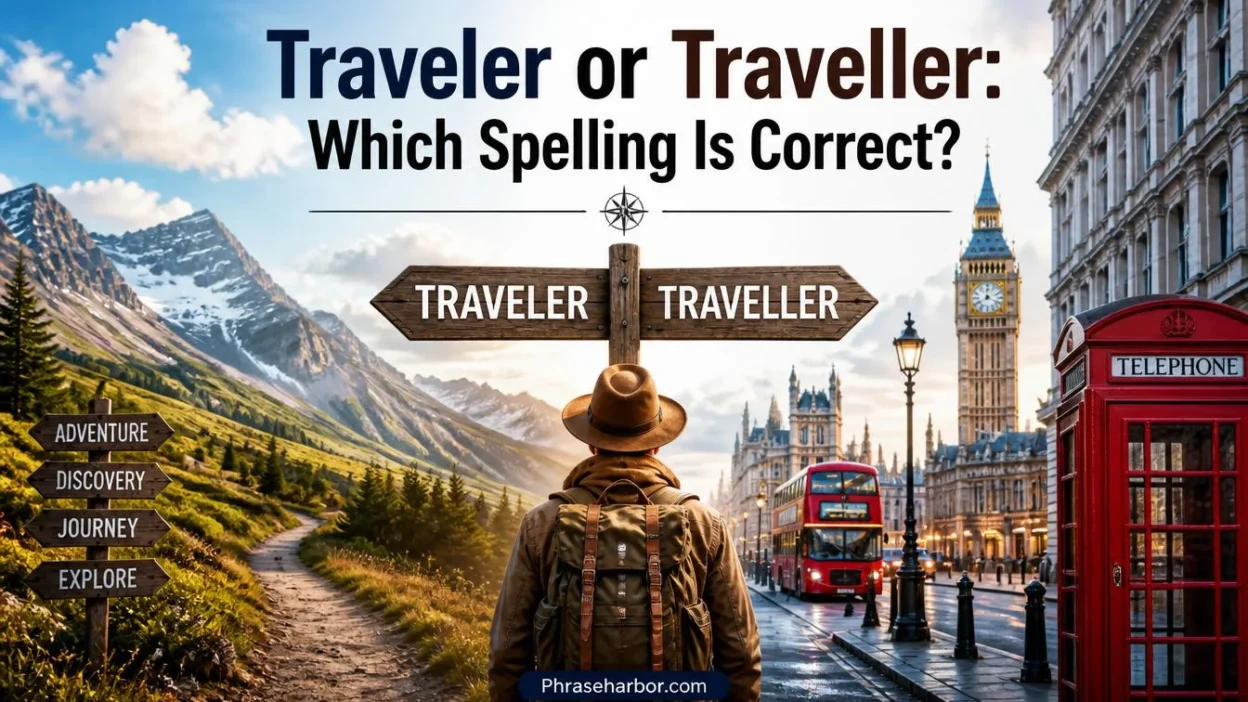
Have you ever wondered whether to write traveler or traveller? Both spellings look right, and neither is a mistake. The difference comes down to regional spelling conventions, particularly the differences between American and British English.
If you’re writing a travel blog, preparing a school assignment, or editing website content, choosing the right spelling can help your writing look polished and consistent. American English generally favors traveler, with one l, while British English typically uses traveller, with two ls. Canadian and Australian English also generally favor traveller.
Although the spellings differ, their meanings remain exactly the same. Both words describe someone who travels from one place to another, whether for business, vacation, adventure, or personal reasons.
Understanding this small spelling difference will help you choose the appropriate form for your audience. Let’s explore the definitions, regional preferences, examples, and related spelling rules so you can use traveler and traveller confidently.
Quick Answer
Traveler is the preferred spelling in American English, while traveller is generally preferred in British, Canadian, and Australian English.
Both spellings are correct. Neither changes the word’s meaning or pronunciation.
- Traveler: Preferred in the United States.
- Traveller: Preferred in the United Kingdom, Canada, and Australia.
- Travelers: The American English plural.
- Travellers: The British English plural.
Examples:
- American English: The traveler checked into the hotel after a long flight.
- British English: The traveller checked into the hotel after a long flight.
Both sentences are grammatically correct. The only difference is the spelling of traveler.
Comparison Overview
The following table summarizes the main differences between traveler and traveller.
| Feature | Traveler | Traveller |
| Preferred variety | American English | British English |
| Number of letters l | One | Two |
| Meaning | A person who travels | A person who travels |
| Pronunciation | Same standard pronunciation | Same standard pronunciation |
| Plural form | Travelers | Travellers |
| Related present participle | Traveling | Travelling |
| Related past tense | Traveled | Travelled |
| Common regional use | United States | United Kingdom, Canada, Australia |
| Grammatical status | Correct | Correct |
The most important point is that regional preference determines the spelling, not the meaning. If you’re writing for an American audience, use traveler. If your readers primarily use British English, traveller is usually the better choice.
However, these are general conventions rather than absolute rules for every publication. An organization may follow a particular style guide, so its established spelling preferences should take priority.
What Does Traveler Mean?
Definition of Traveler
A traveler is a person who travels from one place to another. The word can describe someone taking a short trip, exploring another country, commuting for work, or moving between destinations for an extended period.
In American English, traveler is the standard spelling. It can refer to almost anyone who journeys, regardless of the distance, purpose, or length of the trip.
For example, consider these situations:
- Someone flying from New York to Los Angeles for a business meeting is a traveler.
- A family driving across the United States during summer vacation consists of travelers.
- A person exploring several countries with a backpack can also be called a traveler.
- Someone who regularly visits different cities for work is a frequent traveler.
The word doesn’t necessarily describe a tourist. A tourist usually travels for leisure or sightseeing, whereas traveler has a broader meaning that includes business trips, family visits, adventures, and other journeys.
Examples of Traveler in Sentences
Here are several examples showing how to use traveler naturally in American English.
- The traveler arrived at the airport two hours before departure.
- Every traveler should check the airline’s baggage restrictions before packing.
- The experienced traveler knew how to navigate unfamiliar streets.
- Our hotel offers free Wi-Fi for every registered traveler.
- The solo traveler explored national parks across the western United States.
- A frequent traveler may benefit from joining an airline loyalty program.
- The weary traveler stopped at a roadside café for coffee.
- Each traveler must present valid identification at the security checkpoint.
Notice that traveler functions as a noun in every sentence. It identifies the person taking the journey rather than describing the act of traveling.
You can also use the word before another noun to provide more information. For example, traveler information, traveler safety, and traveler assistance appear in travel-related contexts.
When to Use Traveler
Choose traveler when you’re following American English spelling conventions. This is especially important when your audience primarily lives in the United States.
Common situations include:
- American blog posts: Use traveler in articles written for US readers.
- School assignments: Follow American spelling conventions when your school or teacher requires them.
- Business documents: Use the spelling established by your organization’s style guide.
- US travel publications: Follow the publication’s preferred spelling.
- American marketing materials: Keep the spelling consistent across advertisements, landing pages, and promotional emails.
For example, an American travel website might publish an article titled Essential Tips for Every Traveler. A British publication covering the same subject would generally use Essential Tips for Every Traveller.
Neither title is inherently better. Each matches a different audience.
What Does Traveller Mean?
Definition of Traveller
A traveller is a person who travels from one place to another. The definition is identical to that of traveler. The extra l reflects a different spelling convention rather than a difference in meaning.
British English generally uses traveller. The spelling is also common in Canadian and Australian English, although individual publications and organizations may establish their own preferences.
You might encounter traveller in British newspapers, Australian travel guides, Canadian tourism websites, and other publications that follow these conventions.
For example, a British travel magazine could describe someone exploring Scotland as an experienced traveller. An American magazine would typically describe the same person as an experienced traveler.
Both versions communicate precisely the same idea.
Examples of Traveller in Sentences
These sentences demonstrate how traveller appears in British-style English.
- The traveller arrived at the railway station shortly before noon.
- Every traveller should carry the necessary travel documents.
- The experienced traveller knew which roads led to the village.
- The hotel welcomed travellers from several different countries.
- A solo traveller can discover new places at their own pace.
- The weary traveller stopped at a small café for lunch.
- Each traveller received a map of the surrounding area.
- The railway company introduced new services for daily travellers.
These examples use traveller in the same ways that American English uses traveler. You can use it as a subject, an object, or a noun modifier when the sentence calls for it.
When to Use Traveller
Use traveller when your writing follows British English spelling conventions or a style guide that prefers the double-l form.
This spelling is appropriate for many types of content:
- British publications: Follow the spelling used by the publication.
- Australian websites: Use the locally preferred spelling unless the site’s style guide says otherwise.
- Canadian content: Traveller is generally the preferred form in Canadian English.
- Travel guides: Match the spelling convention of the intended readership.
- Regional business communications: Use the form that fits your organization’s language standards.
For instance, a British tourism website might say, “Every traveller deserves a comfortable journey.” An American website would normally write, “Every traveler deserves a comfortable journey.”
The message stays the same. Only the regional spelling changes.
Main Differences Between Traveler and Traveller
American English vs. British English
The most important difference between traveler and traveller is regional spelling preference.
American English generally favors a single l in traveler, while British English usually doubles the l to produce traveller. This difference also appears in related forms of the verb travel.
Compare the following examples:
| American English | British English |
| Traveler | Traveller |
| Travelers | Travellers |
| Traveling | Travelling |
| Traveled | Travelled |
| Traveling abroad | Travelling abroad |
| A well-traveled road | A well-travelled road |
These differences follow established spelling conventions. They aren’t separate grammatical rules for each word.
However, English spelling varies across regions and publications. Canadian and Australian English generally use the double-l forms, but specific house styles can differ.
The easiest rule to remember: American English usually uses one l in these forms of travel, while British English generally uses two.
Read More: Lead or LEED: Meaning, Differences, and Correct Usage
Why Does Traveler Have One L While Traveller Has Two?
The difference becomes easier to understand when you look at how English handles certain words before adding endings.
In British English, verbs that end in a vowel followed by l often double the final l before endings such as -ed and -ing. American English usually doesn’t double that l in the same circumstances when the final syllable isn’t stressed.
The verb travel illustrates this regional difference:
- American English: travel, traveled, traveling.
- British English: travel, travelled, travelling.
The noun follows the same familiar pattern:
- American English: traveler.
- British English: traveller.
This is part of a broader difference between the two spelling systems. Consider cancel and label.
| Base word | American English | British English |
| Cancel | Canceled | Cancelled |
| Cancel | Canceling | Cancelling |
| Label | Labeled | Labelled |
| Label | Labeling | Labelling |
| Travel | Traveled | Travelled |
| Travel | Traveling | Travelling |
The table shows a common pattern, but English spelling isn’t entirely uniform. Some words follow different conventions, and particular style guides may prescribe forms that differ from general regional preferences.
For example, American English commonly uses canceled and canceling, but traveller can still appear in American writing when it forms part of an official name, a quotation, or a title that preserves its original spelling.
A Brief History of the Spelling Difference
The single-l and double-l forms developed through broader differences in British and American spelling conventions.
During the eighteenth and nineteenth centuries, dictionaries and spelling guides helped establish more consistent written forms on both sides of the Atlantic. American lexicographer Noah Webster played a major role in promoting distinctive American spellings, although not every modern spelling difference originated with him.
The spelling traveler became standard in American English, while traveller remained common in British English. The same regional pattern appears in words such as traveled/travelled and traveling/travelling.
This history explains why both spellings exist today. Neither version is a recent internet invention, and neither is an accidental misspelling.
Do Traveler and Traveller Have Different Meanings?
No. Traveler and traveller mean exactly the same thing.
Both words refer to someone who travels. Neither spelling suggests a particular destination, travel style, nationality, or reason for taking a trip.
Consider these examples:
- The traveler visited three countries in one month.
- The traveller visited three countries in one month.
Both sentences describe the same situation. The spelling alone doesn’t change the meaning.
You may sometimes see traveler associated with American publications and traveller associated with British publications. That association reflects regional usage rather than a difference in definition.
It’s also important not to confuse traveler with tourist. A tourist usually travels for recreation or sightseeing, while a traveler can journey for business, education, family responsibilities, or almost any other purpose.
How Do You Pronounce Traveler and Traveller?
Both spellings have the same standard pronunciation. The additional l in traveller doesn’t create another syllable or change the word’s sound.
In American English, the word is commonly pronounced with three syllables, with the stress on the first syllable.
The British form also has three syllables and generally follows the same stress pattern, although vowel sounds can vary slightly by accent.
For practical writing purposes, you don’t need to learn separate pronunciations for the two spellings. If you know how to say traveler, you already know how to say traveller.
What Are the Plural Forms of Traveler and Traveller?
Both nouns form their plurals by adding s. The spelling convention remains unchanged.
| Singular | Plural | Example |
| Traveler | Travelers | The travelers boarded the bus. |
| Traveller | Travellers | The travellers boarded the bus. |
The same principle applies when the noun appears with descriptive words.
- American English: The international travelers visited several museums.
- British English: The international travellers visited several museums.
Both plurals are correct. Choose the version that matches the rest of your writing.
Traveler or Traveller: Which Spelling Should You Use?
Choosing between traveler and traveller becomes straightforward once you identify your audience. You don’t need to memorize two definitions because the words mean the same thing.
For American English Writing
Use traveler when writing for an American audience. This spelling is standard in US English and fits most American publications, websites, and professional documents.
For example:
- Correct for US English: The traveler booked a room near the airport.
- Standard American spelling: Travelers should arrive early for international flights.
- Standard American spelling: The company provides travel assistance to frequent travelers.
If you’re writing an American travel blog, use traveler, travelers, traveling, and traveled consistently.
Mixing American and British forms can make an otherwise polished article look inconsistent. Keeping one spelling system throughout your content helps readers focus on the message rather than the spelling.
For British English Writing
Use traveller when following standard British English conventions. The same applies to the related forms travellers, travelling, and travelled.
For example:
- Standard British spelling: The traveller booked a room near the airport.
- Standard British spelling: Travellers should arrive early for international flights.
- Standard British spelling: The company provides travel assistance to frequent travellers.
British English commonly doubles the final l in these forms. Following that pattern makes your writing more consistent with British publications and readers’ expectations.
If you’re writing for a British newspaper, tourism company, or educational audience, check its style guide before making a final decision.
FAQs:
Is Traveler or Traveller Correct?
Both spellings are correct. Traveler is the standard American English form, while traveller is generally preferred in British English and commonly used in Canadian and Australian English.
Is Traveler American or British English?
Traveler is the preferred American English spelling. It follows the American convention of using one l in this word.
For example: The traveler arrived at the airport early.
Is Traveller British or American English?
Traveller is the standard British English spelling. It is also generally preferred in Canadian and Australian English.
For example: The traveller arrived at the airport early.
Do Traveler and Traveller Mean the Same Thing?
Yes. Both words describe a person who travels from one place to another. Their spelling differs, but their meaning and standard pronunciation remain the same.
Is Traveling or Travelling Correct?
Both forms are correct, but regional preferences differ.
- Traveling is standard in American English.
- Travelling is generally preferred in British, Canadian, and Australian English.
Conclusion:
The difference between traveler and traveller comes down to regional spelling conventions, not meaning or pronunciation. Both words describe someone who travels, and both are correct English spellings. Use traveler when following American English conventions. Choose traveller when writing in British English or following a style guide that prefers the double-l form, as many Canadian and Australian publications do.