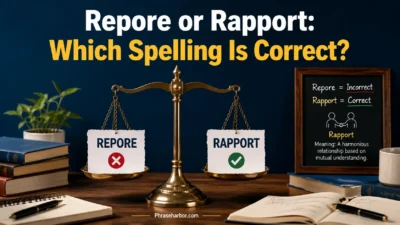
Have you ever written role call when you meant to check attendance? You’re not alone. These two expressions sound exactly alike, so it’s easy to mix them up in emails, school assignments, meeting notes, and everyday conversations. However, only one is the standard expression for calling names to see who’s present.
The correct spelling is roll call, not role call, when you refer to checking attendance or recording the presence of a group. The word roll can refer to a list of names, while role describes a person’s function, responsibility, or part in a particular situation. Although the two words share the same pronunciation, their meanings differ.
Understanding this distinction will help you choose the right spelling every time. Whether you’re writing about a classroom, a workplace meeting, a military formation, or a legislative vote, knowing when to use roll call will make your writing clearer and more accurate.
Quick Answer:
Roll call is the correct expression when you mean checking attendance by calling out names or confirming who’s present. Role call is generally incorrect when used with this meaning.
Here’s the easiest way to remember the difference:
- Roll call: A process used to check attendance or call names from a list.
- Role: A person’s function, responsibility, or part in a situation.
- Role call: Not the standard spelling for an attendance check.
Examples:
- Correct: The teacher took roll call before starting the lesson.
- Incorrect: The teacher took role call before starting the lesson.
- Correct: Her role in the project was to manage the budget.
- Correct: The director assigned each actor a different role.
Think of a roll as a list of names and a role as a responsibility. That simple distinction explains why roll call is the right choice when checking attendance.
Comparison Overview
The words roll and role sound alike, but they have different meanings and uses. Understanding how each word functions will help you avoid this common spelling mistake.
| Feature | Roll Call | Role |
| Meaning | The act of calling names to check attendance | A function, duty, or part someone performs |
| Part of speech | Noun in the expression roll call | Noun |
| Common contexts | Schools, meetings, government, military settings | Workplaces, organizations, theater, everyday life |
| Example | The coach conducted roll call before practice. | She played an important role in the project. |
| Pronunciation | Sounds like role call | Sounds like roll |
| Common mistake | Writing role call for attendance | Confusing a person’s function with an attendance list |
The central distinction is simple: roll call refers to checking attendance, while role refers to what someone does or the part they play.
It’s also worth noting that role call isn’t automatically an impossible sequence of words in every imaginable sentence. The words could appear together independently if a particular context gave them separate meanings. However, that doesn’t make role call an accepted alternative spelling of the attendance-related expression.
What Does Roll Call Mean?
Roll call is the process of calling out names from a list to determine who is present, absent, or otherwise accounted for. It commonly occurs in schools, workplaces, official meetings, military settings, and other organized groups.
During a typical roll call, someone reads names aloud. Each person responds when they hear their name, often by saying “here” or “present.” The person conducting the roll call then records attendance.
For example, a teacher might read a class list every morning. Students respond to their names, and the teacher marks the attendance record. That procedure is called taking roll call.
The expression can also refer to more formal procedures. In a legislative chamber, for instance, a roll-call vote records how individual members vote on a proposal. In that setting, the process serves a purpose beyond simple attendance.
Definition of Roll Call
The expression roll call is a noun that refers to the calling of names from an official or organized list, particularly to check attendance or identify participants.
The word roll has several meanings in English. It can describe a cylindrical movement, a small rounded piece of bread, or the act of moving something along a surface. In administrative contexts, however, roll can also refer to a list or register of names.
Historically, written rolls were used to record people, property, official information, and other important details. The word remains in expressions such as electoral roll and school roll, although the terminology varies by region and institution.
In roll call, the word connects to the idea of a register of names. Calling those names allows an organizer to determine who has arrived.
Consider this example:
“The meeting secretary conducted roll call and noted that three committee members were absent.”
Here, roll call identifies the attendance-checking procedure. It doesn’t describe the committee members’ responsibilities or positions.
Examples of Roll Call in Sentences
Seeing the expression in different situations makes its meaning easier to understand. Here are several examples of correct usage.
- School: The teacher completed roll call before handing out the exam papers.
- Workplace: The supervisor conducted roll call to confirm that every crew member had arrived.
- Team practice: The coach checked the players’ names during roll call.
- Official meeting: The secretary began the meeting with roll call.
- Military setting: The commanding officer ordered roll call at the scheduled time.
- Emergency response: The team leader used roll call to account for the responders after the evacuation.
- Government: The clerk recorded each legislator’s vote during the roll-call vote.
- Training session: The instructor used roll call to identify participants who had arrived late.
Notice that the expression stays the same even though the setting changes. Whether a teacher checks students or a supervisor checks employees, roll call refers to the process of calling names or accounting for members of a group.
Common Situations Where Roll Call Is Used
Roll call is especially useful when an organization needs a reliable record of attendance or participation.
Schools and classrooms: Teachers may take roll call at the beginning of the school day, during individual classes, or before an examination. Attendance records help schools track absences and follow their attendance policies.
Workplaces: Supervisors may use roll call to confirm that employees have reported for duty. This can be especially important when teams work in shifts or operate in settings where accountability matters.
Military organizations: Roll call may be used during formations, inspections, and personnel checks. The procedure helps leaders confirm that assigned personnel are present or identify anyone unaccounted for.
Government proceedings: A roll-call vote records individual votes rather than simply announcing an overall result. This creates a record of how each participating member voted.
Emergency situations: Following an evacuation or other incident, a team leader may use a roster and conduct a personnel check to identify missing people. The exact procedure depends on the organization and circumstances.
Although these examples involve different activities, they share one central idea: identifying people and confirming their presence or participation.
Read More: In-Person vs. In Person: Meaning, Differences, and Correct Usage
What Does Role Call Mean?
The expression role call is commonly a spelling mistake when someone intends to refer to checking attendance. The confusion arises because role and roll are pronounced identically in standard English.
To understand why the spelling matters, you need to look at the meaning of role.
A role is the function, responsibility, or part a person performs within a group, organization, relationship, or performance. For example, a teacher has a role in educating students, while a project manager has a role in coordinating a team’s work.
These meanings have nothing inherently to do with reading an attendance list.
For example:
- Correct: The manager explained everyone’s role in the new project.
- Correct: Her role in the play was the main character’s sister.
- Incorrect for attendance: The manager conducted role call before the meeting.
The last sentence should use roll call because it refers to checking attendance.
Is Role Call Ever Correct?
The important distinction is between a nonstandard spelling of an established expression and two words that happen to appear together in a particular context.
When you mean the established procedure for checking attendance, write roll call. Standard English doesn’t treat role call as an interchangeable spelling.
However, the words role and call can appear next to each other when they have their own meanings. For example, a sentence might discuss a character’s role and then mention a call made by someone else. A specialized context could also use the words in a particular way.
That possibility doesn’t establish role call as the standard name for an attendance check.
If you’re writing an article, school assignment, business email, meeting record, or other general text, use roll call whenever you mean calling names to determine who is present.
Examples of Role Used Correctly
The noun role appears in many everyday expressions. Learning these phrases will help you distinguish it from roll.
Role in a project: “Her role in the project involves reviewing the final report.”
Here, role means a responsibility or assigned function.
Role in a family: “Grandparents often play an important role in a child’s life.”
In this example, role refers to the part someone plays in a relationship.
Role in a performance: “The actor prepared carefully for his role in the film.”
Here, role means a character or part performed by an actor.
Role in a decision: “The research team played a key role in selecting the final design.”
The word refers to the team’s contribution to the decision.
Role in education: “A teacher’s role includes explaining concepts and helping students develop their skills.”
Again, role refers to a function or responsibility.
These examples share the same basic meaning. A role describes what someone does, contributes, or represents. A roll call, by contrast, identifies people on a list.
Main Differences Between Roll Call and Role Call
The main difference between roll call and role call comes down to spelling and meaning. Although the expressions sound alike, they don’t serve the same purpose in standard English.
Meaning and Usage
Roll call is an established expression used for attendance-taking and certain formal voting procedures.
For example:
“The department head conducted roll call before the safety briefing.”
The sentence tells you that the department head checked who was present.
Role, meanwhile, describes a person’s function or contribution.
For example:
“The department head explained each employee’s role during the safety briefing.”
This sentence concerns responsibilities rather than attendance.
The two examples involve the same general setting, yet the words communicate different information. One identifies who has arrived; the other explains what each person is expected to do.
Spelling and Pronunciation
Roll and role are homophones. Homophones are words that share the same pronunciation but have different meanings and often different spellings.
Other familiar examples include:
- Their, there, and they’re: These words sound alike but have different grammatical uses.
- To, too, and two: These words share a pronunciation but convey different meanings.
- Flour and flower: One refers to an ingredient used in baking, while the other refers to a plant’s bloom.
- Principal and principle: One can refer to a school leader, while the other refers to a fundamental rule or belief.
Because roll and role sound identical, listening to a sentence won’t usually tell you which spelling to choose. You must consider the meaning.
If the sentence concerns attendance, use roll call. If it concerns someone’s duties or function, use role.
Grammar and Sentence Structure
The expression roll call typically functions as a noun. It can serve as the object of a verb, appear after a preposition, or act as the subject of a sentence.
Examples include:
- The teacher took roll call.
- We waited for roll call to begin.
- Roll call started ten minutes late.
- The secretary prepared the list for roll call.
The word role also functions as a noun, but it fits into sentences that describe responsibilities, functions, or characters.
- She accepted a leadership role.
- His role was clearly defined.
- The actor prepared for his role.
- Everyone understood their role in the emergency plan.
The grammar doesn’t make the words interchangeable. Their meanings determine which one belongs in each sentence.
Why Do People Confuse Roll Call and Role Call?
The mistake is easy to understand. English contains many words that sound alike but have unrelated meanings, and roll and role are particularly easy to confuse.
Similar Pronunciation
In standard English pronunciation, roll and role are homophones. They sound the same even though their spellings and meanings differ.
That creates a problem when you hear an expression before you see it in writing. Someone might say, “The teacher is taking roll call,” and a listener unfamiliar with the spelling could reasonably assume that role is the correct word.
The same issue appears in other common spelling errors. A writer who understands the meaning of an expression but hasn’t seen it written often may choose the wrong homophone.
The solution isn’t to rely on pronunciation. Instead, ask what the sentence means.
If you’re referring to a list of people whose attendance must be checked, roll call is the correct expression.
FAQs:
Is It Roll Call or Role Call?
Roll call is correct when you mean calling names to check attendance or account for members of a group. Role call is not the standard spelling for this meaning.
Why Is It Called Roll Call?
The expression connects to roll, a word historically used for a list or register of names. During roll call, someone calls names from that list to determine who is present or to record participation.
Is Role Call Ever Correct?
Role call isn’t a standard alternative to roll call when referring to attendance. The words may appear together independently in a particular sentence or specialized context, but that doesn’t make the expression an accepted spelling for checking attendance.
Is Roll Call One Word or Two?
The standard noun form is two words: roll call.
Example: “The instructor conducted roll call before the workshop.”
When the expression modifies another noun, a hyphen may appear in a compound modifier such as roll-call vote. Follow the relevant style guide for formal writing.
What Is an Example of Roll Call in a Sentence?
“The teacher conducted roll call before beginning the lesson.”
In this sentence, roll call refers to the process of checking which students are present.
Conclusion:
The choice between roll call and role call becomes straightforward once you understand what each word means. Use roll call when checking attendance, calling names from a register, or referring to a formal roll-call vote. Use role when describing someone’s function, responsibility, or part in a group or performance. Remember this simple distinction: roll call is about a list of names, while a role is about a person’s responsibility. Both words sound alike, but their meanings determine the correct spelling.