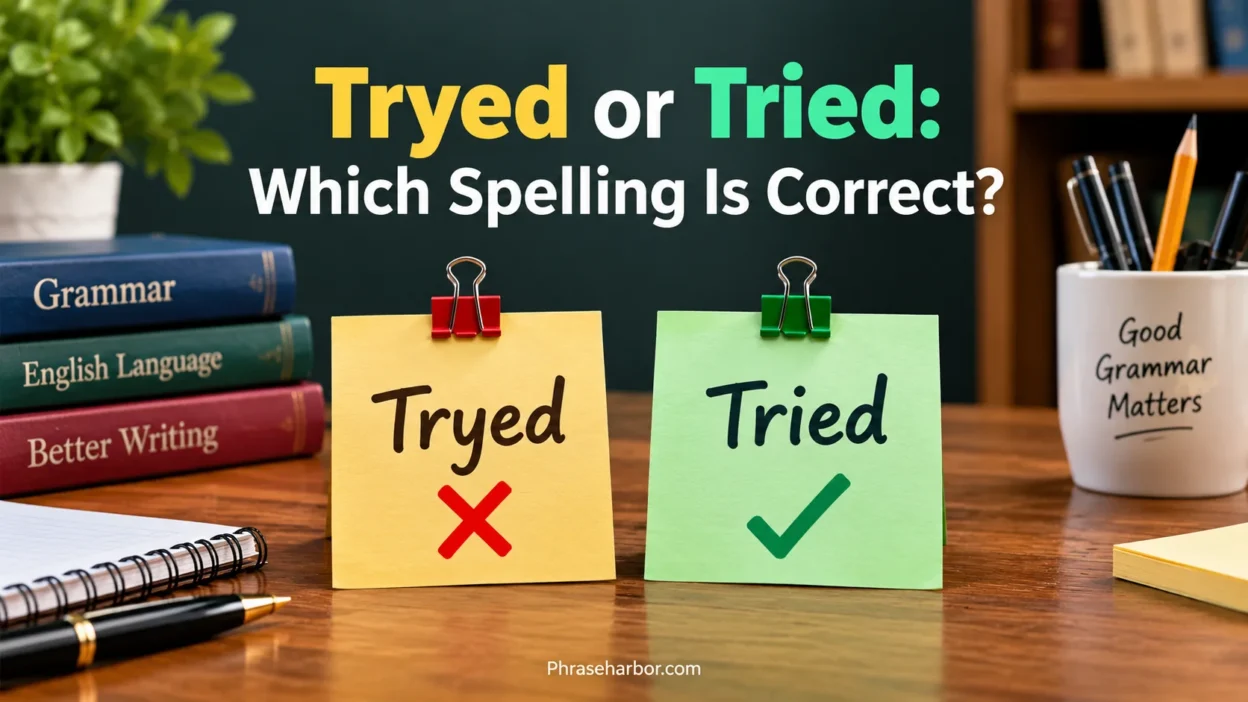
Tryed or Tried: tried is the correct spelling, while tryed is a common mistake caused by adding -ed without applying the English spelling rule. When I’ve written about this issue, I’ve noticed that English learners and writers often make the same mistake.
They simply add -ed to the base word try, but English spelling rules sometimes require a change before adding the past tense ending. The short answer is that tried is the correct form and the standard English spelling.
A quick search can also confirm that tryed is not a real word in modern standard usage. Once you understand this spelling rule, the difference becomes easier to remember, and you can use the correct spelling with confidence.
Quick Answer
Tried is the correct spelling. Tryed is not the standard spelling of the past tense or past participle of try.
The basic forms are:
- Try — base form
- Tries — third-person singular present
- Trying — present participle
- Tried — simple past
- Tried — past participle
For example:
I try new recipes whenever I have time.
I tried a new recipe yesterday.
She has tried several different recipes.
The important spelling change is:
try → tried
The final y changes to i before -ed because try ends in a consonant followed by y.
So if you’re writing a sentence such as “I tryed to call you,” the correct version is:
I tried to call you.
There isn’t a separate informal spelling called tryed. In standard English writing, use tried.
Comparison Overview
The difference between tryed or tried is straightforward once you look at their grammatical status.
| Word | Correct? | Grammatical role | Example |
| Try | Yes | Base verb | I want to try again. |
| Tries | Yes | Third-person singular present | She tries her best. |
| Trying | Yes | Present participle/gerund | He is trying again. |
| Tried | Yes | Simple past/past participle | They tried yesterday. |
| Tryed | No | Incorrect standard spelling | I tryed to help. |
Tried is the only standard past form of try. It works in both simple past sentences and perfect constructions.
For instance, “She tried the new software” uses tried as a simple past verb. In “She has tried the new software,” the same word functions as a past participle.
That makes tried especially useful because one spelling handles both grammatical roles.
Main Differences Between Tryed or Tried
The biggest difference is that tried is the standard English spelling while tryed is not.
There isn’t a meaningful difference in pronunciation or meaning because tryed isn’t a standard alternative form. The issue is simply one of spelling.
| Feature | Tried | Tryed |
| Standard English spelling | Yes | No |
| Past tense of try | Yes | No |
| Past participle of try | Yes | No |
| Used in formal writing | Yes | No |
| Used in standard dictionaries as the past form | Yes | No |
| Correct spelling in everyday writing | Yes | No |
If you remember only one thing from this article, remember this:
Try + -ed does not produce tryed. It produces tried.
Why Is It “Tried” Instead of “Tryed”?
The answer lies in the spelling rule for verbs ending in consonant + y.
When a regular verb ends in a consonant followed by y, English generally changes the y to i before adding -ed.
The pattern looks like this:
consonant + y → consonant + i + ed
That produces forms such as:
- try → tried
- cry → cried
- dry → dried
- fry → fried
- hurry → hurried
- carry → carried
- study → studied
- worry → worried
- marry → married
The rule prevents awkward-looking forms such as tryed or cryed.
English spelling contains plenty of exceptions and historical quirks. Still, this particular pattern is consistent across many common verbs.
The Important Vowel + Y Difference
Here’s where the rule gets interesting.
If a verb ends in a vowel + y, the y normally stays when you add -ed.
Consider these examples:
- play → played
- stay → stayed
- enjoy → enjoyed
- obey → obeyed
- destroy → destroyed
- employ → employed
Why?
Because the letter immediately before y is a vowel.
Compare the two groups:
| Verb ending | Past form |
| consonant + y | try → tried |
| consonant + y | cry → cried |
| consonant + y | study → studied |
| vowel + y | play → played |
| vowel + y | enjoy → enjoyed |
| vowel + y | stay → stayed |
This distinction is the key to understanding why tried is correct.
Tried: Meaning and Definition
Tried is the past tense and past participle of try.
The verb try has several related meanings. In general, it describes making an effort, attempting something, testing something, or experiencing something to see what happens.
For example:
She tried to open the locked door.
Here, tried means she made an attempt.
Now consider:
He tried the new restaurant.
Here, tried means he experienced or sampled something.
Another example:
We tried a different approach.
In this sentence, tried means the group tested another method.
So the word can describe both an attempt and an experiment depending on the context.
Common Meanings of “Tried”
You’ll often see tried used to describe:
- An effort: “I tried to finish the report.”
- An attempt: “She tried to solve the puzzle.”
- An experiment: “We tried a new method.”
- An experience: “He tried sushi for the first time.”
- A test: “They tried the updated system.”
- An unsuccessful attempt: “I tried to fix the printer, but it still failed.”
Notice that tried doesn’t automatically mean failure.
It simply tells you that someone made an attempt or tested something.
Tried as the Past Tense of Try
When tried describes an action that happened in the past, it functions as the simple past tense.
For example:
I tried to call you yesterday.
She tried the exercise last week.
They tried several solutions.
We tried to find the missing document.
The action happened in the past. That’s why tried fits naturally.
A useful clue is a past-time expression such as yesterday, last week, earlier, or two hours ago.
For example:
He tried to repair the computer yesterday.
The verb try changes to tried because the attempt took place in the past.
Does “Tried” Mean the Attempt Failed?
Not necessarily.
This is an important point because people sometimes connect tried with failure.
Consider:
Maria tried to learn Spanish and became fluent.
The sentence says she made an attempt. It doesn’t say the attempt failed.
Now compare:
Maria tried to open the window, but it was stuck.
Here, the sentence tells you that the attempt didn’t succeed.
The word tried itself doesn’t determine the result. The surrounding context does.
Tried as a Past Participle
Tried also serves as the past participle of try.
You’ll commonly see it after have, has, or had.
Examples include:
I have tried this method before.
She has tried every available option.
They had tried several times before calling for help.
The grammatical structure is:
have/has/had + tried
This construction usually connects a past attempt with another point in time or with the present situation.
For example:
I have tried that restaurant.
This can suggest that the experience matters now.
By contrast:
I tried that restaurant last Saturday.
The second sentence simply places the event in the past.
The spelling remains tried in both cases.
Tryed: Is It Ever Correct?
In standard modern English, tryed isn’t the correct spelling of the past tense or past participle of try.
You may occasionally encounter tryed online, in informal messages, in learner writing, or as a typing mistake. Its appearance doesn’t make it a standard English form.
The error is understandable.
A writer may reason:
try + ed = tryed
That approach works with some verbs. For example:
play + ed = played
But try follows a different spelling pattern because it ends in consonant + y.
Therefore:
try + ed → tried
not:
try + ed → tryed
When writing an email, essay, article, school assignment, résumé, or professional message, always choose tried.
Tried to vs. Tried -ing
There’s another useful distinction involving tried that goes beyond spelling.
The expressions tried to do something and tried doing something can communicate slightly different ideas.
Tried to Do Something
Tried to + verb usually means someone made an effort to perform an action.
I tried to open the window.
This means I made an effort to open it.
She tried to contact her manager.
She made an attempt to contact her manager.
Tried Doing Something
Tried + -ing often means someone experimented with an action as a possible solution.
I tried restarting the computer.
This suggests restarting the computer was tested as a solution.
Compare these:
I tried to restart the computer.
This emphasizes the attempt.
I tried restarting the computer.
This emphasizes the method that was tested.
The difference can be subtle. Context determines the exact meaning.
Still, knowing this distinction can make your writing more precise.
Read More: What Kind of vs What Kinds of: Which One Should You Use?
Common Mistakes With Tried
Even though tried is a short word, several mistakes appear regularly.
Mistake: Writing “Tryed”
Incorrect:
I tryed to reach him.
Correct:
I tried to reach him.
The y changes to i before -ed.
Mistake: Assuming Every “Y” Stays
A common overcorrection is changing play into plaied.
Incorrect:
We plaied outside.
Correct:
We played outside.
The difference depends on the letter before y.
Mistake: Using “Try” for a Completed Past Action
Incorrect:
Yesterday, I try to fix the problem.
Correct:
Yesterday, I tried to fix the problem.
Because the action happened yesterday, the simple past form tried is required.
Mistake: Confusing “Tried” With “Trying”
These forms don’t serve the same grammatical function.
She tried to help.
This describes a completed past attempt.
She is trying to help.
This describes an action in progress.
How to Remember the Correct Spelling
A simple memory trick can make tried vs. tryed almost effortless.
Look at the word immediately before the final y.
If the word ends in consonant + y, change y to i before adding -ed.
Think:
try → tried
Then connect it with familiar examples:
- cry → cried
- carry → carried
- study → studied
- worry → worried
- hurry → hurried
Now compare those with:
- play → played
- stay → stayed
- enjoy → enjoyed
The second group keeps the y because each word ends in a vowel + y.
A quick mental test helps:
Try has r before y.
R is a consonant.
Therefore, y → i before -ed.
That gives you tried.
Tried vs. Other Forms of Try
Understanding all the forms of try can prevent spelling mistakes.
| Grammatical form | Word | Example |
| Base form | try | I want to try again. |
| Third-person singular | tries | She tries every day. |
| Present participle | trying | He is trying again. |
| Simple past | tried | We tried yesterday. |
| Past participle | tried | We have tried before. |
Notice that tries follows another spelling pattern.
The y changes to ie before the -s ending:
try → tries
But when the verb takes -ing, the spelling becomes:
try → trying
The y stays.
That gives you a useful family of forms:
try → tries → trying → tried
Once you see the whole family, tryed starts to look obviously out of place.
Tried in Different Sentence Structures
Tried can appear in many sentence types.
Affirmative Statements
I tried the new recipe.
She tried to explain the problem.
They tried several different approaches.
Negative Statements
When you use didn’t, the main verb returns to its base form.
I didn’t try the new recipe.
Not:
I didn’t tried the new recipe.
That’s because did already carries the past tense.
Questions
The same rule applies to questions using did.
Did you try the new restaurant?
Not:
Did you tried the new restaurant?
But with have, you use the past participle:
Have you tried the new restaurant?
This distinction is useful because it explains why both try and tried can appear when talking about past events.
The helping verb controls the tense in structures using did.
FAQs:
Is “tryed” a correct spelling?
No. Tryed is not the standard spelling in modern English. The correct form is tried. When the verb try changes to the past tense or past participle, the final y changes to i before -ed is added.
Why does “try” become “tried”?
The spelling follows a common English rule. When a verb ends in a consonant + y, the y usually changes to i before -ed is added. Therefore, try becomes tried, just as cry becomes cried and study becomes studied.
Can I use “tryed” in informal writing?
It is best to avoid tryed, even in informal writing. Although people may understand what you mean, tried is the accepted standard form and is appropriate for emails, schoolwork, articles, professional writing, and everyday communication.
What is the difference between “tried” and “tryed”?
Tried is the correct past tense and past participle of try. Tryed is a spelling error rather than a standard English word. For example, you should write, “I tried to call you,” not “I tryed to call you.”
Do all verbs ending in “y” change to “i” before “-ed”?
No. The rule depends on the letter before y. If a verb ends in a consonant + y, the y usually changes to i, as in try → tried. If a vowel comes before y, the y normally stays, as in play → played and enjoy → enjoyed.
Conclusion:
The correct spelling is tried, not tryed. The key is to remember that try ends in a consonant followed by y, so the y changes to i when -ed is added. Once you remember this simple spelling rule, words such as tried, cried, carried, and studied become much easier to spell correctly.