When I’m teaching English, I often see everyday English create confusion around That’s or Thats, especially because these small words look almost the same. That’s or Thats becomes easy to understand once you know which form is the real English word and why the apostrophe matters.
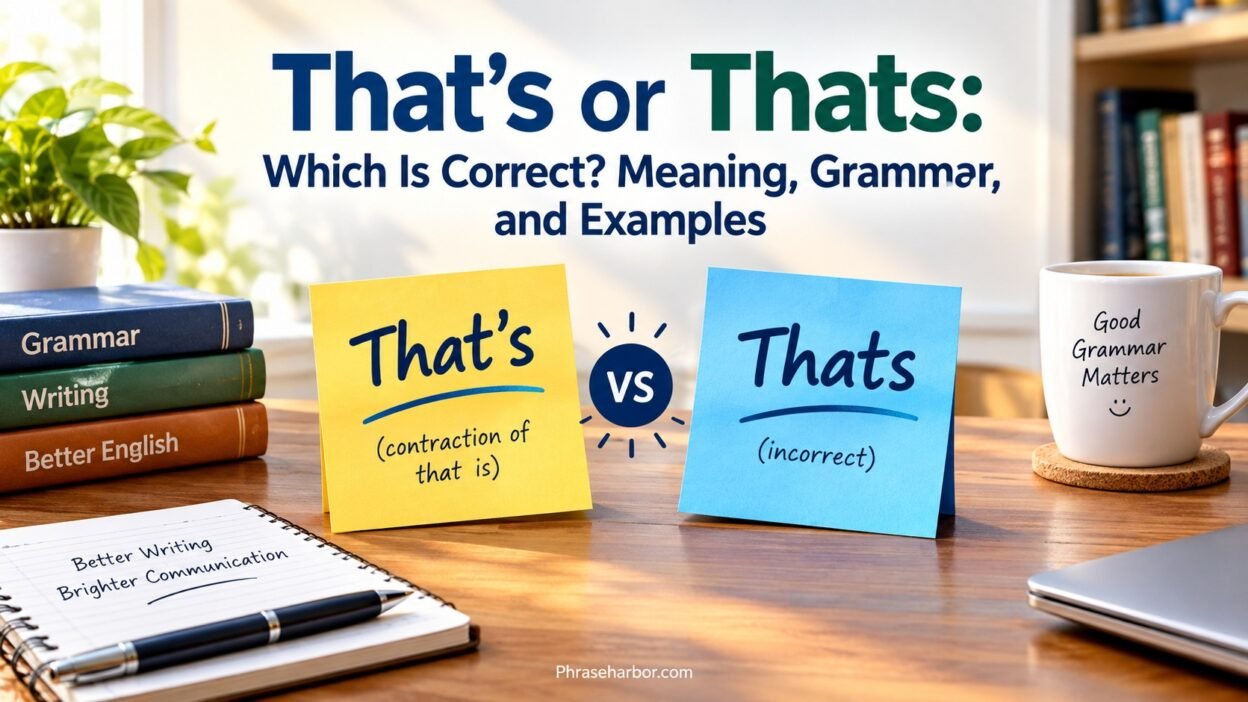
That’s is the correct form, while thats is the incorrect wrong form in standard English. The grammatical difference is simple: That’s is a contraction of that is or that has, and the apostrophe indicates the letters that were removed. A useful line is That’s a good point, which means That is a good point.
This grammar rule makes the meaning, spelling, punctuation, and apostrophe usage clear. There is no situation where thats is acceptable when a contraction needed is That’s. I encourage learners to Remember this underlying grammar rule, learn the right form, and choose it with confidence whenever the choice is not obvious.
Quick Answer
“That’s” is correct when you mean “that is” or “that has.”
“Thats” is generally incorrect in standard English when you’re trying to write that contraction.
Examples:
That’s my favorite restaurant.
= That is my favorite restaurant.
That’s been a difficult problem.
= That has been a difficult problem.
The apostrophe matters because “that’s” is a contraction. It combines two words into one shorter form.
| Form | Correct? | Meaning |
| that’s | Yes | that is / that has |
| thats | No, in standard contraction usage | Usually a missing apostrophe |
| that | Yes | A separate word with several grammatical functions |
So, if you’re choosing between “that’s or thats,” choose “that’s” when you mean that is or that has.
Comparison Overview
The easiest way to understand “that’s vs. thats” is to look at what each spelling actually does.
| Feature | That’s | Thats |
| Standard English spelling | Yes | No |
| Contains an apostrophe | Yes | No |
| Contraction | Yes | No |
| Can mean “that is” | Yes | No |
| Can mean “that has” | Yes | No |
| Appropriate in edited writing | Yes | Generally no |
| Example | “That’s interesting.” | “Thats interesting.” |
The distinction isn’t about pronunciation. In ordinary speech, both written forms would typically be pronounced the same if someone read them aloud.
The difference appears in written grammar and punctuation.
When you write “that’s,” readers understand that you’re shortening “that is” or “that has.” When you write “thats,” the missing apostrophe makes the contraction nonstandard.
Main Differences Between That’s or Thats
The most important difference between “that’s or thats” isn’t pronunciation or meaning. It’s grammatical structure.
“That’s” is a contraction. “Thats” isn’t the standard spelling of that contraction.
Consider this sentence:
That’s exactly what I wanted.
Expand the contraction:
That is exactly what I wanted.
The sentence still works perfectly.
Now consider:
That’s happened before.
Expand it another way:
That has happened before.
Again, the sentence works.
This gives you a reliable way to determine whether “that’s” belongs in your sentence.
“That’s” Is a Contraction
A contraction combines two words into a shorter form. English uses contractions constantly in everyday speech and writing.
Here are some familiar examples:
- I’m = I am
- you’re = you are
- they’re = they are
- isn’t = is not
- don’t = do not
- can’t = cannot
- we’ll = we will
- that’s = that is / that has
The apostrophe marks the place where letters have been omitted.
With “that’s,” the apostrophe appears before the s:
that + is → that’s
or
that + has → that’s
The apostrophe therefore isn’t optional decoration. It communicates the grammatical relationship between the two original words.
“That’s” Can Mean “That Is”
The most common meaning of “that’s” is “that is.”
For example:
That’s a beautiful house.
The expanded version is:
That is a beautiful house.
Both sentences are grammatically correct. The contraction simply sounds more natural in many everyday situations.
Here are more examples:
- That’s my phone. → That is my phone.
- That’s a difficult question. → That is a difficult question.
- That’s the problem. → That is the problem.
- That’s exactly right. → That is exactly right.
- I think that’s enough. → I think that is enough.
- That’s why I called you. → That is why I called you.
Notice how naturally “that’s” fits into conversational English.
If you can replace “that’s” with “that is” without changing the meaning, you’re dealing with this use.
“That’s” Can Also Mean “That Has”
Here’s where the grammar gets slightly more interesting.
“That’s” can also be a contraction of “that has.”
For example:
That’s been a problem for years.
Expand it:
That has been a problem for years.
Another example:
That’s happened before.
This means:
That has happened before.
The surrounding verb usually makes the meaning clear.
| Sentence | Expansion | Meaning |
| That’s my car. | That is my car. | “Is” |
| That’s difficult. | That is difficult. | “Is” |
| That’s changed a lot. | That has changed a lot. | “Has” |
| That’s happened before. | That has happened before. | “Has” |
| That’s been expensive. | That has been expensive. | “Has” |
The distinction becomes particularly useful when you’re analyzing verb forms.
Words such as been, changed, happened, improved, started, stopped, and become can follow “that’s” when it means “that has.”
Why Does “That’s” Have an Apostrophe?
The apostrophe signals that part of the original expression has been removed.
Think of it as a tiny grammatical marker.
When “that is” becomes “that’s,” the word “is” gets shortened. The apostrophe indicates the contraction.
The same principle appears throughout English:
- she is → she’s
- he is → he’s
- it is → it’s
- who is → who’s
- what is → what’s
- that is → that’s
The pattern is straightforward.
Two words → shortened form → apostrophe marks the contraction
Without the apostrophe, “thats” doesn’t communicate the standard contraction correctly.
Why “Thats” Looks Tempting
The error makes sense from a typing perspective.
When people write quickly, they often leave out punctuation. Text messages and casual online communication make this especially common. Once you see “thats” frequently enough, the spelling can begin to look normal.
There’s another reason the mistake is easy to make: “that’s” and “thats” sound identical in ordinary speech.
You can’t hear the apostrophe.
You can only see it.
That makes this a classic written-English problem. Similar issues occur with “your” and “you’re,” “its” and “it’s,” and “whose” and “who’s.”
Is “Thats” a Word?
In standard contemporary American English, “thats” isn’t the normal spelling of the contraction “that’s.”
If you mean:
That is a good point.
you should write:
That’s a good point.
Not:
Thats a good point.
The same applies when “that’s” means “that has.”
That’s been a long day.
not:
Thats been a long day.
Can “Thats” Appear Somewhere Anyway?
You might occasionally encounter “thats” without an apostrophe in a username, brand name, title, product name, stylized text, or other proper name.
That doesn’t change the standard grammar rule.
Names can use unusual spellings. A business might deliberately call itself something like “Thats…” as part of its branding. A username may omit punctuation because of platform restrictions.
Those are naming or stylistic choices.
They aren’t evidence that “thats” has become the standard contraction in edited American English.
How to Know When to Use “That’s”
You don’t need to memorize dozens of rules. One simple test handles most situations.
Use the “That Is” Test
Take your sentence and replace “that’s” with “that is.”
For example:
That’s the answer.
Change it:
That is the answer.
It works.
Therefore:
That’s the answer.
Another example:
I know that’s difficult.
Becomes:
I know that is difficult.
The sentence remains grammatical.
So “that’s” works.
Use the “That Has” Test
Sometimes “that is” won’t make sense. In those cases, try “that has.”
Consider:
That’s changed since last year.
Try the alternatives:
That is changed since last year.
That sounds wrong in this context.
Now try:
That has changed since last year.
Perfect.
Therefore:
That’s changed since last year.
means:
That has changed since last year.
This two-step test is remarkably effective.
That’s → that is
That’s → that has
If either expansion makes sense, the apostrophe belongs there.
Read More: Imitated vs. Intimated: What’s the Difference?
What If Neither Expansion Works?
That’s your signal to reconsider the sentence.
For example:
The movie that’s I watched was excellent.
You can’t sensibly expand “that’s” to either:
The movie that is I watched…
or:
The movie that has I watched…
Neither works.
The correct sentence is:
The movie that I watched was excellent.
Here, “that” functions as part of a relative clause. It doesn’t mean “that is” or “that has.”
That’s an important distinction.
“That” vs. “That’s”: Don’t Confuse Them
The word “that” has several grammatical jobs. It doesn’t always need a verb attached to it.
Consider:
That book belongs to me.
Here, “that” identifies a particular book.
You can’t replace it with “that’s.”
That’s book belongs to me.
That sentence doesn’t work.
Now look at:
That’s my book.
Here, “that’s” means:
That is my book.
The two forms may look similar at first glance. Grammatically, however, they do different jobs.
When to Use “That”
“That” can function in several ways, including as a determiner, pronoun, conjunction, and relative pronoun.
Examples:
That car is expensive.
Here, “that” determines which car you’re talking about.
I know that you’re busy.
Here, “that” introduces a clause.
The book that I bought was expensive.
Here, “that” introduces a relative clause.
None of these requires the apostrophe.
When to Use “That’s”
Use “that’s” when it represents “that is” or “that has.”
Compare these sentences:
That house looks expensive.
versus:
That’s expensive.
In the first sentence, “that” points to the house.
In the second, “that’s” means “that is.”
That small apostrophe therefore changes the grammatical structure.
Common Mistakes With “That’s” and “Thats”
The missing apostrophe isn’t the only problem that can occur. Writers sometimes confuse “that,” “that’s,” and possessive forms.
Leaving Out the Apostrophe
This is the most common mistake.
Incorrect:
Thats a really good question.
Correct:
That’s a really good question.
Why? Because “that’s” means “that is.”
The apostrophe signals the contraction.
Putting the Apostrophe in the Wrong Place
The correct spelling is:
that’s
Not:
thats’
The apostrophe comes before the s because it represents the shortened form of “that is” or “that has.”
Using “That’s” When “That” Is Needed
Consider:
The person that’s I met yesterday was friendly.
This construction is incorrect.
The correct version is:
The person that I met yesterday was friendly.
The word “that” introduces the relative clause “that I met yesterday.”
There isn’t an omitted “is” or “has.”
Treating “That’s” as a Possessive
This misconception often develops because apostrophes can also indicate possession.
But “that’s” isn’t a possessive form of “that.”
For example:
That’s Sarah’s notebook.
There are actually two different apostrophe constructions here.
- That’s = that is
- Sarah’s = belonging to Sarah
The sentence means:
That is Sarah’s notebook.
The first apostrophe belongs to a contraction. The second indicates possession.
FAQs:
1. Is “thats” a correct English word?
No. Thats without an apostrophe is not the standard English form. The correct spelling is that’s when you mean that is or that has.
2. What does “that’s” mean?
That’s is a contraction of that is or that has. For example, “That’s a great idea” means “That is a great idea.”
3. Why do people write “thats”?
People often leave out the apostrophe because of fast typing, phone keyboards, texting habits, or simple spelling mistakes. The missing apostrophe changes the standard form.
4. Is “that’s” acceptable in formal writing?
Yes. That’s is grammatically correct in formal and informal writing. However, in very formal contexts, you may sometimes choose that is instead of the contraction for a more formal tone.
5. How can I remember whether to use “that’s” or “thats”?
Remember that the apostrophe shows missing letters. If you can replace that’s with that is or that has, use that’s. Thats should be avoided.
Conclusion:
That’s is the correct form when you mean that is or that has, while thats is an incorrect spelling in standard English. The apostrophe is important because it shows that letters have been removed from the original words. Once you remember this simple rule, choosing the correct form becomes much easier. A quick proofreading check can also help you catch the missing apostrophe before it appears in an email, post, or other piece of writing.