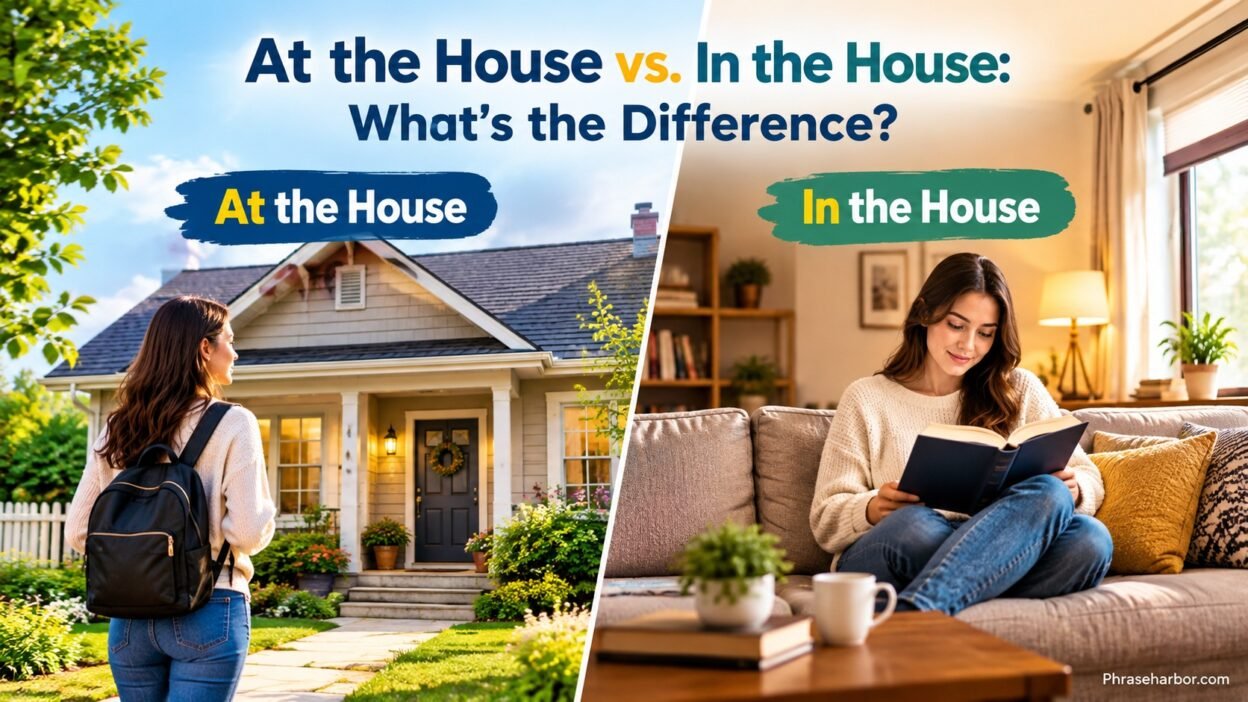
In simple English, At the House vs. In the House shows how at and in can seem similar while pointing to different places in a home. At the House and In the House may look identical, but their different meanings depend on the context.
At often gives a general location, meaning someone is near the property, perhaps on the porch, driveway, or yard, while in means being directly inside the building. The main difference is the amount of space the phrase covers. If someone says, “I’m at the house,” the person may be visiting the home without being inside.
“I’m in the house” implies being physically inside and surrounded by walls and rooms. From my experience explaining these forms, I’ve found that learners often confuse them because both can feel natural. However, noticing the structure makes choosing the right phrase easier and helps you understand the intended location.
Quick Answer
“At the house” refers to a house as a general location. “In the house” specifically indicates that someone or something is inside the house.
- At the house: focuses on the location.
- In the house: focuses on the interior.
- At home: usually refers to being at your own home or usual residence.
For example:
“Sarah is at the house.”
This tells you that Sarah is at that location. She could be inside the house, standing outside, or somewhere on the property.
“Sarah is in the house.”
This tells you something more specific: Sarah is inside the house.
The phrases can describe the same real-world situation, but they highlight different information.
Comparison Overview
| Phrase | Main meaning | What it emphasizes | Example |
| At the house | At or around a particular house | General location | “Mike is at the house.” |
| In the house | Inside a house | Interior location | “Mike is in the house.” |
| At home | At one’s home | Home as a place of residence | “Mike is at home.” |
| Inside the house | Physically within the building | Very specific interior position | “Mike is inside the house.” |
The easiest way to remember the distinction is to think about precision.
At often gives you a location without describing the exact position within that location. In places someone or something within the boundaries of a space.
Imagine a house as a point on a map. Saying “I’m at the house” identifies that point. Now imagine walking through the front door. Saying “I’m in the house” tells the listener that you’re within the building.
That difference might seem small, but English speakers use it naturally all the time.
Main Differences Between At the House vs. In the House
The most important difference between at the house vs. in the house is the relationship between the person or object and the building.
“At the House” Refers to a General Location
The preposition at commonly treats a place as a location or point rather than emphasizing its physical boundaries.
For example:
“I’ll meet you at the house.”
The sentence tells the listener where the meeting will happen. It doesn’t tell them exactly where the speaker will stand.
The person might wait:
- At the front door
- In the driveway
- On the porch
- In the yard
- Inside the house
- Near the house
All of these possibilities can fit the general idea of being at the house.
That’s why at the house can be useful when the precise indoor or outdoor position doesn’t matter.
“In the House” Means Inside the Building
The preposition in normally describes something located within an enclosed space.
For example:
“The children are in the house.”
This gives you more information than “The children are at the house.” The natural interpretation is that the children have entered the building and are somewhere inside it.
You could also say:
“My phone is in the house.”
Here, in clearly establishes the phone’s location as the interior of the house.
The distinction becomes even clearer when you contrast the inside with the outside:
“The dog is outside, but the children are in the house.”
The phrase in the house creates a clear boundary. The children occupy the interior while the dog doesn’t.
How “At” Works in “At the House”
English uses at for many places where the speaker cares more about the location than the exact physical position.
Consider these examples:
- “I’ll see you at the house.”
- “They’re waiting at the house.”
- “We stopped at the house.”
- “He’s working at the house today.”
- “She left her car at the house.”
In each sentence, the house functions as a recognizable location.
The same pattern appears elsewhere in English:
- at the office
- at school
- at the station
- at the airport
- at the store
- at the door
This doesn’t mean at always means “outside.” That’s an important misconception.
If someone says:
“I’m at the office.”
They could be sitting inside their office.
Likewise:
“I’m at the house.”
doesn’t automatically mean the person is standing outdoors.
The phrase simply doesn’t make the indoor-versus-outdoor distinction the main point.
How “In” Works in “In the House”
In focuses on containment or position within a space.
You can use it for physical objects:
“The keys are in the house.”
You can use it for people:
“There’s someone in the house.”
You can also use it for animals:
“The cat is in the house.”
The word in becomes especially useful when the listener needs to know whether something has crossed into the building.
Compare:
“John is at the house.”
with:
“John is in the house.”
The first sentence gives a broad location. The second gives a more specific physical location.
“In the House” Can Carry Extra Context
Depending on the situation, in the house can also emphasize that something is happening indoors.
For example:
“We have enough food in the house.”
This means the food is available inside the home.
Similarly:
“It’s quiet in the house tonight.”
Here, in the house establishes the interior as the setting for the condition being described.
At the House vs. In the House: Side-by-Side Examples
Seeing the phrases next to each other makes the distinction easier to understand.
| At the house | In the house |
| “Tom is at the house.” | “Tom is in the house.” |
| General location | Specific interior location |
| Doesn’t specify inside or outside | Normally means inside |
| Focuses on the house as a location | Focuses on the house as an enclosed space |
| Useful when exact position doesn’t matter | Useful when indoor position matters |
Consider this short scenario:
“Where’s Tom?”
Answer 1: “He’s at the house.”
Tom’s general whereabouts are the important information.
Answer 2: “He’s in the house.”
Now the speaker specifically tells you Tom is indoors.
The difference becomes even more useful when someone needs precise information.
“Is Tom at the house?”
This could mean, “Has Tom arrived at that location?”
But:
“Is Tom in the house?”
This more directly asks whether Tom is inside the building.
When Both “At the House” and “In the House” Are Correct
One of the biggest reasons learners struggle with this topic is that both phrases can sometimes be grammatically correct.
The correct choice depends on what the speaker wants to emphasize.
Imagine that Sarah has arrived at her friend’s property.
You could say:
“Sarah is at the house.”
This establishes her general location.
You could also say:
“Sarah is in the house.”
This tells us that she has gone inside.
Neither sentence is inherently wrong. They simply provide different information.
Case Study: Waiting for a Friend
Imagine you’re waiting for someone to arrive.
You say:
“I’ll wait at the house.”
The sentence doesn’t require you to wait indoors. You might wait on the porch or in the driveway.
Now imagine it’s raining heavily.
“I’ll wait in the house.”
This specifically tells the other person that you’ll stay indoors.
The weather changes the practical meaning of the choice. The grammar doesn’t change.
Case Study: Looking for Someone
Suppose a parent asks:
“Is Daniel at the house?”
The question may simply ask whether Daniel is there.
If the parent hears a noise and wants to know whether Daniel is indoors, they might ask:
“Is Daniel in the house?”
The second question has a narrower focus.
Case Study: A Package Delivery
Consider these two sentences:
“The package is at the house.”
This could mean the package has arrived at the property or location.
“The package is in the house.”
This tells you that the package is somewhere inside the building.
If someone needs to find the package, the second sentence provides more useful information.
At the House vs. At Home
Another important comparison is “at the house” vs. “at home.”
These phrases aren’t always interchangeable.
At home normally refers to someone’s own home or usual residence.
For example:
“I’m at home tonight.”
This tells the listener that you’re at your home.
By contrast:
“I’m at the house.”
usually refers to a particular house identified by the context. It could be your house, a friend’s house, a relative’s house, or another property.
Consider:
“I’m at home.”
The listener normally understands that you’re at your residence.
Now compare:
“I’m at my brother’s house.”
The location is more specific.
You could also say:
“I’m in my brother’s house.”
That version emphasizes that you’re physically inside his house.
Quick Comparison
| Expression | Typical meaning |
| I’m at home. | I’m at my own home. |
| I’m at the house. | I’m at a particular house or property. |
| I’m in the house. | I’m physically inside the house. |
| I’m inside the house. | I’m explicitly inside the building. |
Why “At” and “In” Aren’t Interchangeable
Prepositions often look simple, but they carry important spatial relationships.
At commonly identifies a location.
In commonly identifies an enclosed space.
That pattern explains many everyday expressions.
Compare:
- at the office → location
- in the office → inside the office
- at the store → location
- in the store → inside the store
- at the airport → location
- in the airport → inside the airport
- at the restaurant → location
- in the restaurant → inside the restaurant
The distinction isn’t absolute in every expression. English prepositions depend heavily on convention and context. Still, the location-versus-interior distinction provides a reliable starting point.
Read More: Unorganized vs Disorganized: Which Word Should You Use?
Common Mistakes With At the House vs. In the House
Understanding the rule becomes much easier when you know which assumptions to avoid.
Mistake: Assuming “At the House” Means Outside
This isn’t necessarily true.
“I’m at the house.”
The speaker could be sitting in the living room.
The phrase simply doesn’t specify the exact position.
If you need to make the indoor location clear, use:
“I’m in the house.”
Mistake: Assuming “In the House” Always Means “At Home”
It doesn’t.
Someone can be in the house without being at their own home.
For example:
“The guests are in the house.”
They could be visiting someone else’s home.
Mistake: Treating “At the House” and “In the House” as Perfect Synonyms
They overlap in some situations, but they aren’t identical.
If someone says:
“There’s a man at the house.”
You know he’s associated with that location.
If they say:
“There’s a man in the house.”
You understand that he’s inside.
That extra detail can matter enormously in certain contexts.
Mistake: Forgetting the Role of Context
English speakers don’t choose prepositions by memorizing one rigid translation.
Context matters.
If you’re arranging a meeting, at the house may be the natural choice:
“Let’s meet at the house.”
If you’re describing where someone is during a storm, in the house may be more useful:
“Everyone is in the house.”
The intended meaning determines the best phrase.
At the House vs. In the House in Everyday Situations
The distinction becomes easier when you apply it to ordinary conversations.
Visiting Someone
“We’re at Lisa’s house.”
This describes your general location.
“We’re in Lisa’s house.”
This tells the listener you’re inside her home.
Waiting for Someone
“I’ll wait at the house.”
Your exact waiting spot isn’t important.
“I’ll wait in the house.”
You specifically intend to wait indoors.
Talking About an Object
“Your shoes are at the house.”
The shoes are associated with that location.
“Your shoes are in the house.”
The shoes are inside the building.
Describing an Event
“The party is at their house.”
This identifies the house as the venue.
“Everyone is in the house.”
This identifies where the people currently are.
Notice the difference. The first sentence focuses on where the event is located. The second focuses on where the people are physically positioned.
A Practical Rule for Choosing the Right Phrase
When you’re unsure which expression to use, ask yourself one question:
Do I want to identify the general location or emphasize the interior?
If you want the general location, choose at.
“He’s at the house.”
If you want to emphasize that someone or something is inside, choose in.
“He’s in the house.”
If you’re talking about your own residence, at home may be the most natural choice.
“I’m at home.”
This simple test handles most everyday situations.
FAQs:
Is “at the house” grammatically correct?
Yes, at the house is grammatically correct. It usually refers to being at or around the home as a location, without saying that you’re physically inside the building.
Is “in the house” grammatically correct?
Yes, in the house is also correct. It specifically suggests that someone or something is physically inside the house, within its rooms or interior space.
What is the main difference between “at the house” and “in the house”?
The main difference is location. At the house gives a broader idea of being at the property, while in the house means being inside the building.
Can “at the house” mean outside?
Yes. Someone can be at the house while standing in the yard, on the porch, or in the driveway. The phrase doesn’t necessarily mean the person has entered the house.
Which should I use: “at the house” or “in the house”?
Use at the house when you mean the home or property as a general location. Use in the house when you want to make it clear that someone is physically inside.
Conclusion:
Understanding At the House and In the House becomes easier when you focus on the intended location. At the house refers more broadly to the home or property, while in the house points directly to the interior. Once you notice this small difference, you can choose the phrase naturally and communicate your meaning more clearly.