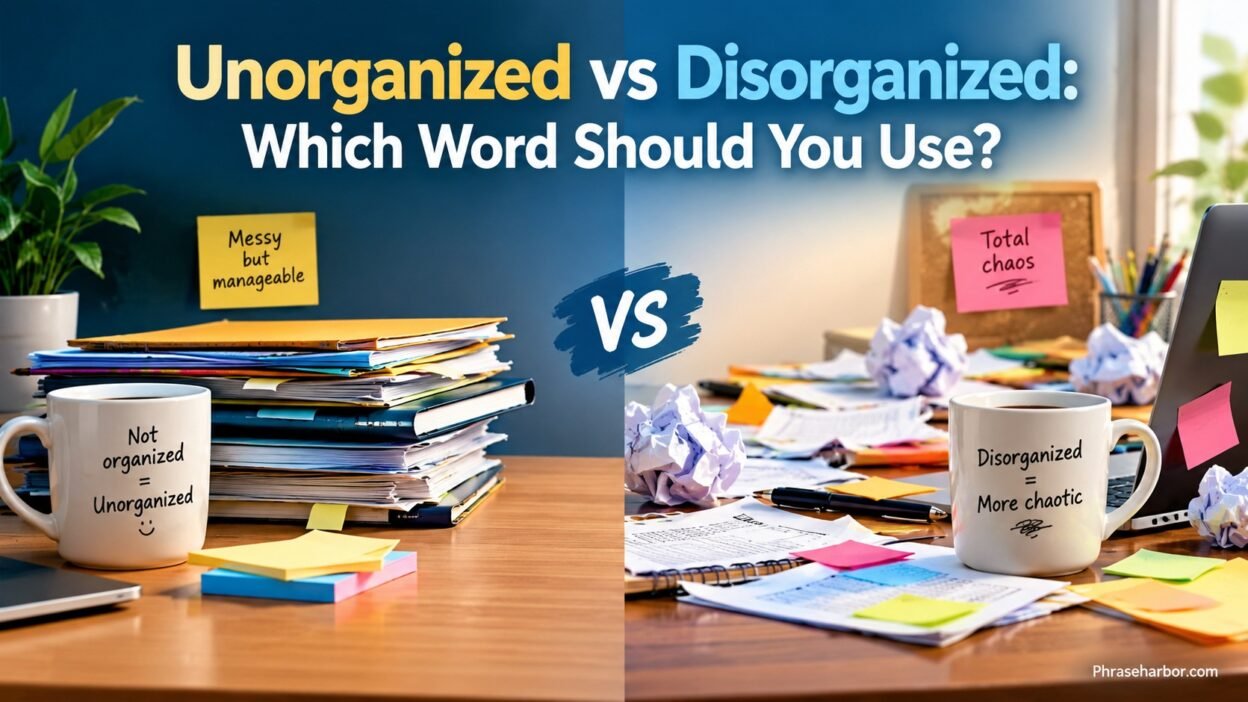
Unorganized vs Disorganized may seem similar, but their meaning, tone, and context can change how a sentence sounds. Unorganized often describes something not formally planned, arranged, or officially structured, such as an unorganized event, group, project, or schedule without a clear system, planning, or leadership plan.
Disorganized, however, points to visible chaos, disorder, or a lack of order and structure. A messy desk, cluttered desk, scattered files, broken notes, or confusing writing patterns can feel disorganized because they’re difficult to follow.
In my editing work, I’ve noticed writers, students, professionals, and English learners use these words interchangeably, yet a closer look reveals a slightly different distinction. A manager may call a filing system unorganized because its arrangement isn’t planned, while a struggling team may seem disorganized because its work shows visible disorder and weak structure.
Quick Answer
Unorganized and disorganized are both correct words, but they often carry slightly different emphasis.
- Unorganized usually emphasizes that something hasn’t been organized, arranged, or structured.
- Disorganized usually emphasizes poor organization, disorder, confusion, or ineffective planning.
- Disorganized is generally more natural when describing a person’s habits, time management, planning, or ability to stay organized.
- Unorganized works particularly well for unsorted material, raw data, newly formed groups, or things that simply haven’t been arranged yet.
- Neither word automatically tells you whether something was previously organized.
- The distinction between “never organized” and “previously organized” is a useful tendency, not an absolute grammar rule.
A simple way to remember the difference is:
Unorganized = organization is absent.
Disorganized = organization is poor, ineffective, or disorderly.
That isn’t a perfect rule for every sentence. Still, it gives you a reliable starting point.
Comparison Overview
| Point of comparison | Unorganized | Disorganized |
| Basic idea | Not organized or arranged | Poorly organized or lacking effective order |
| Common emphasis | Absence of organization | Disorder or ineffective organization |
| Can describe people? | Yes, but less natural in many contexts | Yes, very commonly |
| Can describe data? | Yes | Yes |
| Can describe plans? | Yes | Yes |
| Can describe a messy system? | Yes | Yes, often more natural |
| Can imply confusion? | Sometimes | Often |
| Can imply poor planning? | Sometimes | Strongly |
| Can describe something not yet sorted? | Very naturally | Sometimes |
| Labor-related meaning | Can describe workers without formal organization | Not normally used in this sense |
| Tone | Often more neutral | Often more negative |
| Always means “never organized”? | No | No |
| Always means “previously organized”? | No | No |
The most important point is the last two rows. English doesn’t always divide these words as neatly as grammar explanations suggest.
Main Differences Between Unorganized vs Disorganized
The difference between unorganized vs disorganized becomes clearer when you look at the type of problem each word highlights.
Unorganized emphasizes a lack of organization
When you call something unorganized, you’re often saying that someone hasn’t arranged it yet.
Imagine a folder containing 2,000 photographs. Nobody has sorted them by date, location, event, or subject.
You could say:
The photographs are unorganized.
The sentence doesn’t necessarily criticize the photographs or the person who collected them. It simply describes their current state.
The same idea works with:
- unorganized notes
- unorganized data
- unorganized files
- unorganized records
- an unorganized collection
- an unorganized group
In each case, the focus can be on the absence of an organizing structure.
Disorganized emphasizes ineffective organization
Disorganized often goes one step further. It suggests that order is lacking in a way that creates problems.
For example:
The company’s records are disorganized.
That sentence may suggest that employees can’t locate documents, files sit in inconsistent folders, naming systems vary, and important information gets lost.
Here, the problem isn’t merely that nobody has organized the records. The organization itself is ineffective.
This is why disorganized works especially well with:
- people
- schedules
- meetings
- projects
- businesses
- workplaces
- processes
- plans
- systems
- events
What Does “Unorganized” Mean?
Unorganized generally means that something lacks organization or has not been organized.
The word can describe a temporary condition. Something may be unorganized now but perfectly organized tomorrow.
For example:
The survey responses are still unorganized.
That sentence tells us that the responses haven’t been sorted or categorized yet. It doesn’t tell us that the sorting process is bad.
Oxford Learner’s Dictionaries includes “not having been organized” as a meaning of unorganized and gives unorganized data as an example.
Examples of unorganized
Here are some natural examples:
- The research notes are still unorganized.
- We have an unorganized collection of old photographs.
- The raw data remains unorganized.
- The documents are unorganized because the project just started.
- The students submitted their unorganized notes for review.
Notice something about these examples: the word doesn’t necessarily blame anyone.
The notes might be unorganized because the research is still underway. The photographs might be unorganized because nobody has created an album yet. The data might be unorganized because analysts haven’t processed it.
“Unorganized” can be relatively neutral
This is one of the most useful differences between the two words.
Suppose someone hands you 500 survey responses in one large spreadsheet. The information isn’t categorized yet.
You might say:
The data is unorganized.
That sounds fairly descriptive.
Now imagine that the spreadsheet contains duplicate entries, inconsistent labels, missing categories, random formatting, and contradictory file names.
You might say:
The data is disorganized.
The second sentence suggests a quality problem, not merely unfinished organization.
That distinction isn’t absolute. Still, it reflects a common difference in emphasis.
Another meaning of “unorganized”
Unorganized also has a specific meaning that has nothing to do with messy desks or untidy files.
It can refer to people or workers who aren’t organized into a formal group or represented by an organization such as a labor union.
For example:
Many workers in the industry remained unorganized.
This is a distinct institutional meaning. Oxford lists this sense separately.
That meaning is worth remembering because replacing unorganized with disorganized would completely change the intended idea.
What Does “Disorganized” Mean?
Disorganized commonly describes something that lacks effective order, planning, or structure.
It can describe a physical environment, but its use extends much further.
Someone can be disorganized without having a particularly messy desk. They might simply struggle to manage deadlines, remember appointments, prioritize tasks, or maintain a consistent system.
Oxford defines disorganized around poor planning and difficulty organizing effectively. Its examples include both situations and people.
Examples of disorganized
- He’s disorganized and frequently misses deadlines.
- The meeting was disorganized from beginning to end.
- The project became disorganized after the manager left.
- Our filing system is completely disorganized.
- Her schedule is too disorganized to manage effectively.
- The report is disorganized and difficult to follow.
These examples share an important feature: the lack of organization causes friction or confusion.
Why “disorganized” often sounds stronger
Compare these sentences:
My desk is unorganized.
This could mean you haven’t arranged it yet.
Now compare:
My desk is disorganized.
This more readily suggests clutter, misplaced objects, inconsistent piles, or an arrangement that makes work harder.
The difference isn’t a hard grammatical boundary. Context matters.
However, when someone describes a person’s organizational habits, disorganized is usually the more idiomatic choice.
Unorganized vs Disorganized: Examples in Real Context
The easiest way to understand the distinction is to compare situations where either word could appear.
Files and documents
Unorganized:
The files are unorganized because we haven’t sorted them by project yet.
Here, the problem is simply that sorting hasn’t happened.
Disorganized:
The company’s file system is disorganized because employees save documents in different folders.
Now the problem lies in the system itself.
A person’s work habits
Sarah is disorganized and regularly forgets deadlines.
This is much more natural than:
Sarah is unorganized and regularly forgets deadlines.
The second sentence is understandable, but disorganized fits better because you’re describing a habit or personal tendency.
Raw data
The raw data is unorganized.
This works naturally when the data hasn’t been categorized or structured.
But consider:
The database is disorganized.
That suggests the database has a poor structure or creates difficulties for users.
A meeting
The meeting was disorganized.
This sounds completely natural.
It could mean that people arrived without preparation, speakers talked over each other, the agenda changed repeatedly, or nobody knew what should happen next.
You could technically say:
The meeting was unorganized.
But disorganized usually communicates the intended criticism more clearly.
A newly formed group
The volunteers were still unorganized when the emergency response began.
This can emphasize that the group hadn’t established leadership, roles, procedures, or coordination.
By contrast:
The volunteer response was disorganized.
This suggests that the response existed but operated poorly.
Again, context determines the precise meaning.
Is “Unorganized” a Word?
Yes. Unorganized is a legitimate English word.
It isn’t an incorrect alternative invented by people who don’t know the “right” word.
Dictionaries recognize it as an adjective with multiple meanings. In ordinary usage, it can describe something that hasn’t been organized. It can also overlap with disorganized.
The idea that “unorganized is wrong and disorganized is correct” is therefore false.
What is true is that disorganized is often the more natural word in certain contexts, especially when discussing people’s habits, poor planning, confusing systems, or disorder.
That is a usage preference, not a grammatical prohibition.
Is “Disorganized” a Word?
Yes. Disorganized is also a standard English adjective.
It’s commonly used for people, processes, plans, meetings, workplaces, schedules, and systems.
For example:
- a disorganized employee
- a disorganized office
- a disorganized schedule
- a disorganized meeting
- a disorganized project
- a disorganized report
- a disorganized process
Its meaning generally centers on poor or ineffective organization.
Is an Unorganized Person or Disorganized Person Better?
When you’re talking about someone’s habits, disorganized person is usually the better choice.
Consider:
James is disorganized.
A reader immediately understands that James may have trouble planning, keeping track of tasks, maintaining order, or meeting deadlines.
Now consider:
James is unorganized.
The meaning remains understandable, but it doesn’t sound as natural to many speakers in this context.
Why the difference matters
Words don’t exist in isolation. Native usage creates patterns around them.
English speakers commonly pair disorganized with behaviors such as:
- missing deadlines
- losing things
- forgetting appointments
- poor planning
- clutter
- inconsistent routines
- difficulty prioritizing tasks
That’s why “disorganized person” is usually the stronger choice.
Read More: Booze vs Boos: What’s the Difference?
Does “Disorganized” Mean Something Was Previously Organized?
Not necessarily.
This is one of the biggest misconceptions in discussions about unorganized vs disorganized.
You may encounter the explanation that:
- unorganized = never organized
- disorganized = organized before but later became chaotic
That distinction sounds logical. Unfortunately, it goes too far.
A meeting can be disorganized from the very beginning.
A company can launch with a disorganized process.
A newly created team can be disorganized before it ever develops a functioning system.
In other words, disorganized doesn’t require proof that an organized state existed beforehand.
The word describes the current quality of the organization. It doesn’t necessarily provide a history of how that condition developed.
That distinction makes the traditional “un- versus dis-” explanation much less reliable than it first appears.
Can “Unorganized” Mean “Disorganized”?
Yes, in some contexts.
This overlap is important because it prevents you from treating the words as perfect opposites.
Oxford’s entry for unorganized includes disorganized among its related meanings.
For example:
The office is unorganized.
A reader may understand this as meaning that the office is messy or lacks order.
However:
The office is disorganized.
usually gives a stronger impression that the office’s organization is ineffective.
Both can work. The second often sounds more idiomatic when you’re criticizing the state of the workplace.
When Should You Use “Unorganized”?
Choose unorganized when your sentence focuses on the absence of organization.
It works particularly well when something:
- hasn’t been sorted
- hasn’t been categorized
- hasn’t been arranged
- hasn’t been structured
- lacks a formal organization
- is still waiting to be organized
Good examples
The photographs are unorganized, so we’ll sort them by year.
The research data is still unorganized.
The students submitted an unorganized collection of notes.
The group was unorganized because nobody had assigned roles.
In each case, the word can describe a condition without necessarily judging the quality of someone’s organizational skills.
When Should You Use “Disorganized”?
Choose disorganized when you want to emphasize disorder, poor planning, or ineffective organization.
It works especially well when describing:
- people
- schedules
- meetings
- businesses
- projects
- systems
- processes
- reports
- events
- workplaces
Good examples
The manager is disorganized and often misses important deadlines.
The conference became disorganized after the schedule changed.
The company’s records are disorganized.
The report is disorganized and difficult to read.
His daily routine is disorganized.
In these examples, organization isn’t merely absent. The lack of effective organization creates a practical problem.
FAQs:
1. Is “unorganized” or “disorganized” correct?
Both unorganized and disorganized are correct English words. Unorganized often means something lacks a formal plan or structure, while disorganized usually suggests visible disorder, confusion, or poor arrangement.
2. What is the main difference between unorganized and disorganized?
Unorganized generally describes something that hasn’t been properly planned or arranged. Disorganized usually describes something that has disorder, confusion, or a weak structure that makes it difficult to manage or follow.
3. Can I use unorganized and disorganized interchangeably?
Sometimes, yes, because their meanings overlap. However, they aren’t always interchangeable. Use unorganized when the focus is on a lack of formal organization, and disorganized when the focus is on confusion or disorder.
4. Are “unorganised” and “disorganised” correct?
Yes. Unorganised and disorganised are standard British English spellings. American English generally uses unorganized and disorganized.
5. Should I describe a person as unorganized or disorganized?
Both can describe a person, but disorganized is more common when someone regularly struggles to manage tasks, belongings, schedules, or responsibilities. Unorganized can sound less direct and may simply suggest a lack of formal organization.
Conclusion:
Understanding unorganized vs disorganized becomes easier when you focus on the type of problem being described. Unorganized usually points to something lacking a formal plan, arrangement, or structure, while disorganized suggests confusion, disorder, or difficulty following an existing structure. Choosing the right word can make your writing clearer, more precise, and more professional.
In everyday communication, workplace writing, academic assignments, and formal documents, context should guide your choice. When you mean “not formally arranged,” unorganized is often suitable. When you mean “messy, confusing, or poorly ordered,” disorganized is usually the better choice.