When you’re writing an email, article, text message, or professional document, a small spelling question can cause an unexpected pause: Is it “of course” or “ofcourse”?
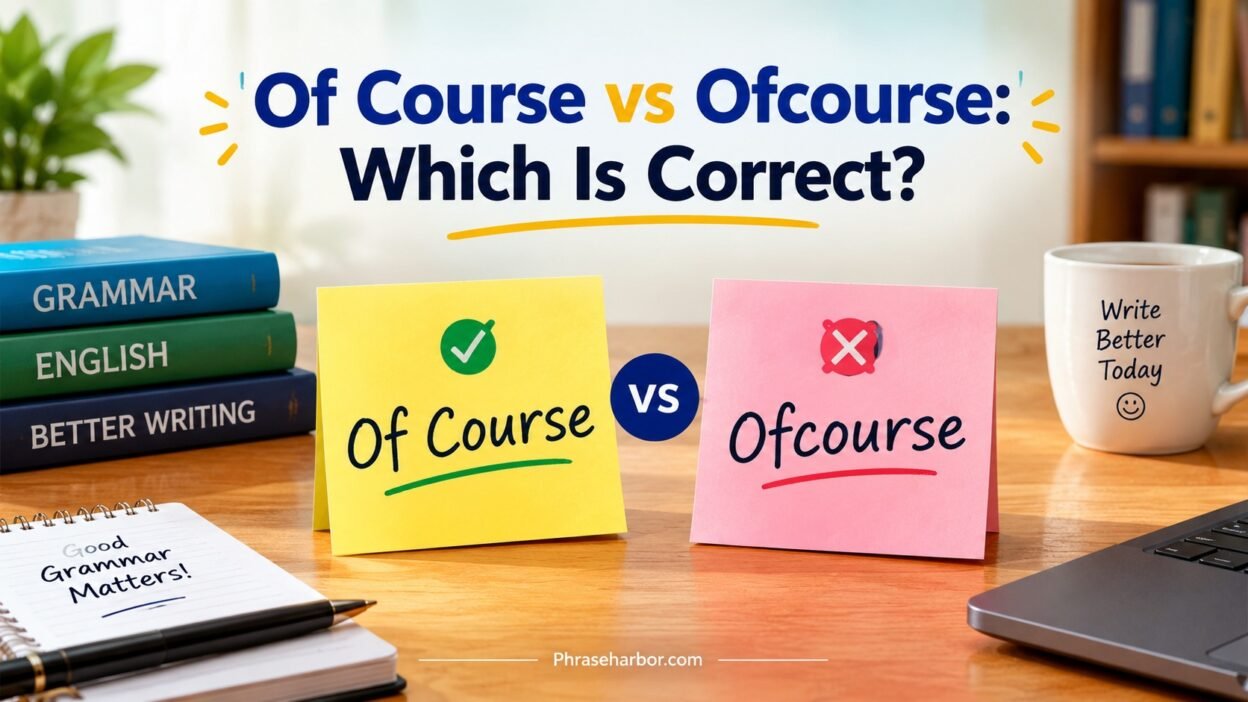
The answer is straightforward. “Of course” is the correct standard English spelling. It consists of two separate words. “Ofcourse” is not the standard spelling of the expression and should be treated as a misspelling.
The confusion makes sense because people often pronounce of course quickly, making the two words sound almost connected. Fast typing can also cause writers to leave out the space. However, familiar-looking spellings aren’t necessarily correct spellings.
The phrase itself has several uses. It can express certainty, agreement, permission, or something that seems natural or expected. Its punctuation can also change depending on where it appears in a sentence.
Quick Answer
“Of course” is correct. “Ofcourse” is incorrect in standard English.
Use of course when you mean:
- certainly
- naturally
- yes
- as expected
- without doubt
- willingly or readily, depending on context
Examples
- Of course, I can help you.
- Of course she knows the answer.
- “Can I come with you?” “Of course.”
- The project will, of course, take several weeks.
By contrast:
- Ofcourse, I can help you.
- Ofcourse she knows the answer.
- I will ofcourse send the document.
The missing space makes ofcourse nonstandard.
There is another expression worth separating from this one: off course. That is a legitimate two-word phrase with a completely different meaning.
For example:
The aircraft moved off course because of severe weather.
Here, off course means that something has moved away from its intended direction.
Comparison Overview
| Expression | Correct? | Meaning | Example |
| of course | Yes | Certainly, naturally, or as expected | Of course, I’ll help. |
| ofcourse | No | Nonstandard spelling of of course | Ofcourse, I’ll help. |
| off course | Yes | Away from an intended route or direction | The plane went off course. |
| offcourse | No | Incorrect spelling | The plane went offcourse. |
The important distinction is simple: “of course” and “off course” are both valid expressions, but they don’t mean the same thing. “Ofcourse” and “offcourse” are not standard spellings.
Main Differences Between Of Course and Ofcourse
The biggest difference is the space.
Of course
Of course is the standard English expression. It is written as two words.
It can communicate certainty:
Of course, that’s correct.
It can express agreement:
“Would you like some coffee?”
“Of course.”
It can indicate that something seems natural or expected:
Of course she was tired after working all night.
It can also express willingness:
Of course I’ll help you move.
Ofcourse
Ofcourse combines the two words incorrectly.
You may see it in:
- social media posts
- comments
- informal messages
- search queries
- typed conversations
- user-generated websites
Its appearance in online writing doesn’t make it an accepted alternative spelling.
A useful rule is:
If you mean “certainly,” write “of course,” with a space.
What Does “Of Course” Mean?
Of course is a common English expression whose meaning depends partly on context.
At its core, it often communicates that something is certain, expected, obvious, or readily accepted.
However, the phrase can carry different shades of meaning.
“Of Course” Can Mean “Certainly”
This is probably its most familiar use.
Of course, I’ll attend the meeting.
Here, the speaker is confidently agreeing to attend.
Another example:
Of course we should check the figures before publishing them.
The phrase signals that the speaker considers the suggestion reasonable or expected.
“Of Course” Can Mean “Yes”
In conversation, of course can work as a positive response.
“Can I use your laptop?”
“Of course.”
The answer doesn’t simply communicate yes. It can also make the response sound welcoming or reassuring.
Compare:
- Yes.
- Of course.
- Certainly.
All three can indicate agreement, but their tone differs.
Yes is neutral.
Of course can sound warmer or more natural in casual conversation.
Certainly often sounds more formal or deliberate.
“Of Course” Can Mean “Naturally”
Consider this sentence:
Of course, plants need water to grow.
The speaker presents the statement as something expected or obvious.
However, context matters. In some situations, of course can sound dismissive if the writer assumes everyone should already know something.
For example:
Of course, everyone knows how the system works.
That sentence could unintentionally make a reader feel that their question is foolish.
A better approach in informative writing is to avoid assuming that a fact is obvious when the audience may genuinely need an explanation.
Why Is “Of Course” Written as Two Words?
The expression of course has an established two-word spelling in standard English.
The word of is a preposition. Course is a noun. Together, they form a familiar expression whose meaning goes beyond simply interpreting each word independently.
This is important because English spelling doesn’t always follow sound.
When people speak quickly, of course may sound almost like one continuous unit. That doesn’t mean the written form becomes one word.
English has many expressions that sound compressed during ordinary speech while retaining separate written forms.
For example:
- a lot
- at all
- of course
- in fact
- at least
Speech naturally connects sounds. Writing preserves conventional word boundaries.
Why the Space Matters
A space isn’t merely visual decoration. It tells the reader where one word ends and another begins.
Compare:
of course → standard expression
ofcourse → nonstandard spelling
The pronunciation may remain understandable either way, but standard written English requires the established form.
Is “Ofcourse” Ever Correct?
For ordinary English writing, no.
If you’re using ofcourse to mean certainly or naturally, write of course instead.
Incorrect and Correct Examples
| Incorrect | Correct |
| Ofcourse I’ll call you. | Of course I’ll call you. |
| Ofcourse, you’re right. | Of course, you’re right. |
| She will ofcourse attend. | She will of course attend. |
| Ofcourse we can change it. | Of course we can change it. |
There may be isolated situations where a particular string such as ofcourse appears as a username, brand name, domain name, product name, or other proper name. Those cases don’t change the standard spelling of the English expression.
For normal prose, essays, reports, emails, and articles, use of course.
Why Do People Write “Ofcourse”?
The mistake has several practical causes. None of them makes the spelling standard.
Fast Pronunciation
In natural speech, people often pronounce words closely together.
When someone says:
Of course I’ll be there.
the phrase can sound almost like a single sound group.
Someone learning English may therefore assume that it should also appear as one written word.
That assumption is understandable but incorrect.
Fast Typing
Typing quickly creates another common problem: spaces disappear.
This happens with many words and phrases. A writer may type ofcourse without noticing the missing space.
If the text isn’t proofread, the mistake can remain.
Familiarity With Compound Words
English contains thousands of compound words.
Consider:
- notebook
- bedroom
- website
- football
- sunlight
Because English frequently combines words into compounds, writers may assume that familiar expressions can also be closed up.
But English doesn’t allow writers to combine words simply because the meaning feels connected.
Of course remains two words.
Repeated Exposure Online
A spelling mistake can become visually familiar when you encounter it repeatedly.
That creates an interesting trap.
Something can look right because you’ve seen it often, even though dictionaries and standard usage don’t recognize it as the correct form.
Online frequency and standard correctness aren’t the same thing.
How to Use “Of Course” Correctly
Correct spelling is only part of the story. You also need to understand how the expression behaves in a sentence.
“Of Course” at the Beginning of a Sentence
When of course introduces a sentence, a comma commonly follows it when the phrase functions as an introductory or parenthetical expression.
Of course, we can discuss the proposal tomorrow.
Another example:
Of course, the final decision depends on the available evidence.
The comma creates a small pause between the introductory expression and the main statement.
“Of Course” in the Middle of a Sentence
The expression can also appear in the middle of a sentence.
When it functions as an aside, writers often set it off with commas.
The results will, of course, depend on the sample size.
Here, removing of course doesn’t destroy the basic grammatical structure:
The results will depend on the sample size.
That helps show why commas can make sense in this construction.
“Of Course” at the End of a Sentence
The expression can appear at the end as well.
I’d be happy to help, of course.
The comma can signal that the phrase functions as an afterthought or parenthetical addition.
However, punctuation isn’t a mechanical rule where of course automatically requires a comma every time.
Its placement and grammatical function matter.
“Of Course” as a Standalone Response
In conversation, of course can stand alone.
“Could you send me the report?”
“Of course.”
This is one reason the expression appears so frequently in everyday English.
It can provide a quick affirmative response without requiring a complete sentence.
Of Course and Punctuation
One of the most common follow-up questions is whether of course always needs a comma.
It doesn’t.
The comma depends on how the expression functions within the sentence.
Introductory Use
Of course, I’ll send the report tonight.
Here, the comma separates the introductory expression from the main clause.
Parenthetical Use
She will, of course, need additional time.
The phrase sits inside the sentence as an aside.
Final Use
I’ll send it tonight, of course.
The comma helps distinguish the final parenthetical phrase.
When a Comma May Not Be Necessary
Consider:
I knew of course that the deadline had changed.
Some styles may prefer commas around of course because it functions parenthetically:
I knew, of course, that the deadline had changed.
The exact punctuation can depend on the writer’s intended rhythm, grammatical analysis, and style guide.
The important point is this:
Don’t confuse spelling with punctuation.
The spelling remains of course regardless of whether a comma appears.
Of Course vs Off Course
This is the most important comparison after of course vs ofcourse because off course is actually correct in a different context.
What “Of Course” Means
Of course commonly means:
- certainly
- naturally
- yes
- as expected
- without doubt
Example:
Of course, I’ll help you finish the project.
What “Off Course” Means
Off course means that something has moved away from its intended direction, route, or course.
For example:
The ship drifted off course during the storm.
Here, the phrase has nothing to do with certainly or naturally.
It describes a change in direction.
Another Example
The discussion went off course.
This sentence can mean that a discussion moved away from its intended subject.
That use extends the physical idea of leaving a planned route into a figurative one.
The Difference in One Table
| Phrase | Meaning | Example |
| of course | certainly or naturally | Of course, I remember. |
| off course | away from the intended direction | The boat went off course. |
This distinction is worth remembering because replacing of with off completely changes the meaning.
Read More: Checkup vs Check-Up: Which Is Correct in American English?
Common “Of Course” Mistakes
Understanding the most frequent errors makes the rule easier to apply.
Writing “Ofcourse”
This is the main mistake.
Ofcourse, I’ll be there.
Of course, I’ll be there.
The correction simply restores the missing space.
Writing “Offcourse”
This creates a different problem.
Offcourse, I’ll help you.
If the intended meaning is certainly, the correct expression is:
Of course, I’ll help you.
Confusing “Of Course” With “Off Course”
Consider these two sentences:
Of course, the driver knew the route.
The driver went off course.
The first expresses certainty or expectation.
The second describes movement away from the planned route.
Adding Commas Automatically
Some writers learn that of course often appears with commas and then add them everywhere.
That’s unnecessary.
Compare:
Of course, she agreed.
with:
She agreed, of course.
The expression can move around the sentence. Its punctuation should reflect its grammatical role.
Using “Of Course” Too Often
Correct spelling doesn’t guarantee good writing.
Consider:
Of course, we need a plan. Of course, we need resources. Of course, we need a deadline. Of course, we need to review the results.
Every sentence is technically understandable, but the repetition quickly becomes heavy.
Better writing varies the structure:
We need a clear plan, adequate resources, and a realistic deadline. Most importantly, we should review the results before making a final decision.
Use of course when it adds meaning, tone, or emphasis.
Of Course in Formal and Informal Writing
Another useful question is whether of course sounds too casual for professional writing.
Generally, it doesn’t.
It’s a standard English expression that can appear in many settings.
Formal Writing
You might see:
The results will, of course, depend on the quality of the available data.
There’s nothing inherently informal about the phrase.
Still, writers should consider tone. In highly analytical writing, saying something is of course true can sometimes sound as though the writer expects readers to accept it without evidence.
Academic Writing
Academic writers should use of course carefully.
For example:
Of course, climate patterns vary across regions.
If that statement forms part of an argument, the writer still needs appropriate evidence when the claim requires support.
The phrase doesn’t turn an assertion into a fact.
That’s a useful distinction: “of course” signals the writer’s attitude toward a statement. It doesn’t provide evidence for the statement.
Professional Emails
In workplace communication, of course can sound friendly and cooperative.
Of course, I’ll send the revised document by Friday.
It can soften a simple agreement without becoming overly formal.
Text Messages
The same spelling rule applies to informal communication.
Of course!
is correct.
Ofcourse!
is still a spelling mistake.
Being informal changes tone and punctuation more easily than it changes standard spelling.
FAQs:
Is “ofcourse” one word?
No. Ofcourse is not the standard spelling of the expression. The correct form is of course, written as two words.
Is “of course” grammatically correct?
Yes. Of course is a standard English expression. It can function in several ways depending on context, including expressing certainty, agreement, expectation, or willingness.
Can I write “ofcourse” in texting?
You can encounter it in informal messages, but it remains a nonstandard spelling. If you want to write correctly, use of course.
Is “off course” correct?
Yes. Off course is correct when something has moved away from its intended direction, route, or course.
The plane went off course.
Is “offcourse” correct?
No. When you mean away from an intended route, write off course as two words.
Conclusion:
The of course vs ofcourse question has a simple answer: “of course” is the correct spelling. It should always be written as two words when you mean certainly, naturally, yes, or as expected.
“Ofcourse” is a misspelling, even though it appears frequently in casual online writing. Meanwhile, “off course” is a legitimate phrase with a different meaning. It describes something that has moved away from its intended route, direction, or plan.