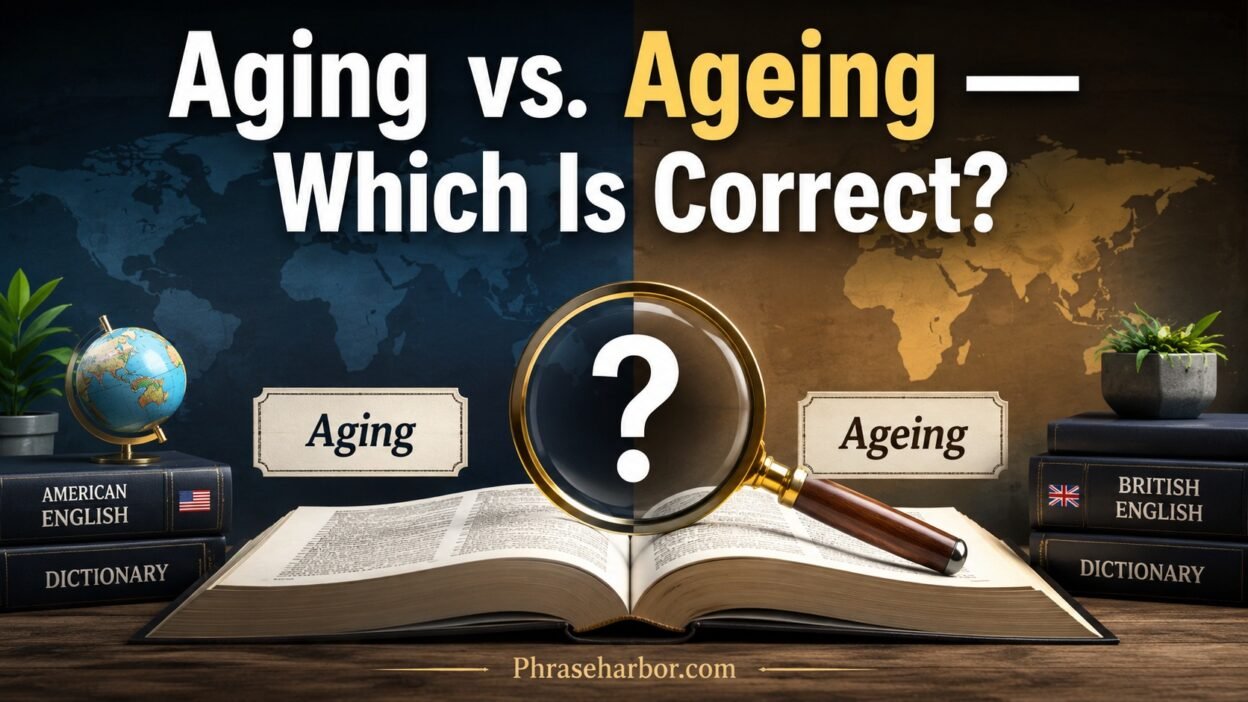
Aging vs. Ageing may seem like a simple spelling difference, but writers, readers, and learners can feel confused about ageing or aging. Both spellings mean exactly the same and describe the process of growing older or becoming aged.
The difference depends on region, audience, context, and writing style. American English favors and sticks with aging, while British English uses ageing as the standard form. In the US, it is the preferred spelling; in the UK, people use ageing. Both forms are correct, and the right choice follows regional preference and spelling rules.
As nouns, verbs, and adjectives, their meaning stays unchanged. From my experience with professional writing, a single letter counts, especially when a spell check underlines one version and leads to second-guessing, even though it is valid in the right setting.
Quick Answer:
Aging and ageing are two regional spellings of the same word.
- Aging is the standard spelling in American English.
- Ageing is the standard spelling in British English.
- Aging is generally preferred in Canadian English.
- Both forms refer to the process of growing older or becoming older over time.
- The two spellings normally have the same pronunciation and meaning.
- Writers should follow the spelling convention used by their target audience or style guide.
For example:
American English: The country has an aging population.
British English: The country has an ageing population.
Neither sentence is incorrect. The difference comes from the English variety being used.
Comparison Overview
| Feature | Aging | Ageing |
| Primary variety | American English | British English |
| Canadian usage | Preferred | Accepted |
| Basic meaning | Growing older | Growing older |
| Pronunciation | Generally the same | Generally the same |
| Used as a noun | Yes | Yes |
| Used as an adjective | Yes | Yes |
| Example | healthy aging | healthy ageing |
| Population example | aging population | ageing population |
| Best choice for U.S. readers | Yes | Usually no |
| Best choice for UK readers | Usually no | Yes |
The easiest rule is straightforward:
Writing for an American audience? Use “aging.” Writing for a British audience? Use “ageing.”
Main Differences Between Aging vs. Ageing
The main difference between aging vs. ageing is spelling rather than meaning.
Regional spelling
The strongest distinction is geographical.
American English generally writes:
- aging
- aged
- aging population
- healthy aging
- anti-aging
British English generally writes:
- ageing
- aged
- ageing population
- healthy ageing
- anti-ageing
Notice that aged does not change between the two varieties. The spelling difference mainly appears in the -ing form.
Meaning
There is normally no meaningful difference in what aging and ageing describe.
Both can refer to the natural process through which people become older. They can also describe changes in animals, materials, products, buildings, infrastructure, and other things over time.
For example:
- The aging population is creating new healthcare demands.
- The ageing population is creating new healthcare demands.
The underlying meaning remains the same.
Spelling convention
The difference reflects broader differences between American and British spelling practices.
English spelling developed through centuries of use rather than from one perfectly consistent system. British and American English eventually developed different preferences for several words and word endings.
Aging vs. ageing is one example of those regional conventions.
What Does Aging or Ageing Mean?
At its core, aging or ageing describes the process of becoming older.
When discussing people, the term can refer to the biological, psychological, and social changes associated with growing older. In other contexts, it can describe gradual deterioration, development, maturation, or changes caused by time.
Aging and ageing as a noun
As a noun, the word describes the process itself.
Examples include:
- Aging is a natural part of human life.
- Researchers study ageing to understand changes associated with older adulthood.
- Healthy aging involves physical, mental, and social factors.
- Material ageing can affect the strength and performance of a product.
The context determines what kind of change the writer means.
In medicine and public health, for example, aging often refers to changes that occur across the human lifespan. In engineering, aging can refer to gradual changes in materials or equipment.
Aging and ageing as an adjective
The word can also describe a person, group, object, or system that is becoming older.
Consider these examples:
- an aging population
- an ageing population
- an aging building
- an ageing building
- aging infrastructure
- ageing infrastructure
- aging equipment
- ageing equipment
Again, the regional spelling changes but the basic meaning does not.
Why Are There Two Spellings?
The difference comes from the development of separate spelling traditions in English.
British and American English share the same linguistic foundation. However, they don’t always follow identical spelling conventions.
American English often favors shorter spellings in certain words. British English sometimes retains letters that American usage drops.
That doesn’t mean American English has one universal rule that removes the final e before every suffix. English spelling is more complicated than that. Individual words developed their own conventions, and dictionaries record those conventions.
With ageing, British English retains the e:
age + ing → ageing
American English commonly uses:
age + ing → aging
The difference becomes particularly noticeable in professional phrases such as healthy aging, aging population, and anti-aging.
Aging vs. Ageing in American English
If you’re writing for readers in the United States, aging is the spelling to choose.
American dictionaries and usage references recognize aging as the standard U.S. form.
Here are several natural American English examples:
- The United States has an aging population.
- Healthy aging is an important public health goal.
- The company needs to replace its aging computer systems.
- Scientists continue to study the biological mechanisms of aging.
- The building’s aging infrastructure requires significant repairs.
Notice how naturally aging appears in established American phrases.
Common American English expressions
Some expressions you’ll frequently encounter include:
- aging population
- healthy aging
- successful aging
- aging process
- signs of aging
- anti-aging products
- aging infrastructure
- aging workforce
- aging equipment
If your website, publication, or business primarily serves U.S. readers, consistently using aging will generally look more natural.
Ageing vs. Aging in British English
British English generally uses ageing.
A British publication might write:
- The UK has an ageing population.
- Healthy ageing can involve many aspects of wellbeing.
- The government is responding to an ageing workforce.
- The building suffers from ageing infrastructure.
- Researchers are studying the effects of ageing.
For British readers, ageing is the conventional spelling.
That doesn’t make aging incomprehensible. British readers understand the American spelling easily. However, a publication that otherwise follows British spelling may choose ageing to maintain a consistent house style.
Aging vs. Ageing in Canadian English
Canadian English deserves special attention because it doesn’t fit neatly into a simple “American versus British” rule.
Canada’s Language Portal identifies aging as the preferred spelling in Canadian English, while ageing is also accepted.
That means Canadian writers may encounter both forms.
For a Canadian publication, the best approach is to follow its established editorial style. If no house style exists, aging is generally the safer preferred form.
This is a useful reminder that English spelling isn’t divided into only two perfectly sealed categories.
Aging vs. Ageing in Australia and Other English Varieties
English-speaking countries outside the United States and United Kingdom can have their own preferences.
British spelling conventions influence many Commonwealth varieties of English. However, actual usage can vary by country, institution, industry, and publication.
For that reason, don’t assume that every country outside North America automatically requires ageing.
If you’re writing for a specific national audience, check a reputable dictionary, government style guide, publisher’s guidelines, or organizational house style.
The same principle applies to international publications.
When an official style guide exists, follow it.
Aging vs. Ageing: Examples in Sentences
Seeing the two forms side by side makes the distinction easier to remember.
Talking about people
American English:
She is concerned about the visible signs of aging.
British English:
She is concerned about the visible signs of ageing.
Talking about populations
American English:
An aging population can change demand for healthcare and social services.
British English:
An ageing population can change demand for healthcare and social services.
Talking about equipment
American English:
The factory is replacing its aging equipment.
British English:
The factory is replacing its ageing equipment.
Talking about infrastructure
American English:
The city needs to invest in its aging infrastructure.
British English:
The city needs to invest in its ageing infrastructure.
Talking about health
American English:
Regular physical activity can support healthy aging.
British English:
Regular physical activity can support healthy ageing.
The pattern remains consistent. Change the spelling according to the regional variety, not the meaning.
Common Phrases With Aging and Ageing
Some combinations appear frequently in health, government, economics, technology, and everyday writing.
| American English | British English |
| aging population | ageing population |
| healthy aging | healthy ageing |
| aging process | ageing process |
| signs of aging | signs of ageing |
| aging workforce | ageing workforce |
| aging infrastructure | ageing infrastructure |
| aging equipment | ageing equipment |
| anti-aging | anti-ageing |
These aren’t different concepts. They’re regional spelling versions of the same expressions.
Healthy aging vs. healthy ageing
The phrase healthy aging is especially common in American medical and public-health writing.
It generally refers to supporting health, function, independence, and quality of life as people grow older.
British publications generally write healthy ageing instead.
The difference is purely orthographic:
healthy aging = American English
healthy ageing = British English
The underlying concept doesn’t change.
Aging Population vs. Ageing Population
Aging population and ageing population are among the most common phrases where this spelling difference appears.
An aging or ageing population generally refers to a population in which older age groups make up an increasing share of the total population.
Population aging can have major economic and social consequences.
Why population aging matters
When a population gets older, governments and organizations may need to adapt areas such as:
- healthcare services
- pension systems
- retirement policy
- housing
- transportation
- long-term care
- workforce planning
- social services
- accessibility
- community infrastructure
The spelling changes by region. The demographic concept doesn’t.
For example:
The aging population is increasing demand for long-term care.
and
The ageing population is increasing demand for long-term care.
Both statements can be grammatically correct when used within the appropriate regional spelling system.
Read More: Tortuous vs. Torturous Meaning, Difference, and Examples
Is Aging or Ageing More Correct?
Neither spelling is universally “more correct.”
That question assumes that English has one global spelling standard. It doesn’t.
Instead, English has several established varieties with their own conventions.
Use “aging” when:
- You’re writing American English.
- Your audience is primarily in the United States.
- Your organization’s style guide specifies American spelling.
- You’re following a publication that uses American English.
Use “ageing” when:
- You’re writing British English.
- Your publication follows British spelling.
- Your organization specifically requires British conventions.
- Your target audience expects British English.
Follow the style guide when:
You’re writing for a university, journal, newspaper, government agency, or major organization.
A style guide can override general regional preferences.
For example, a publisher might have specific rules for British or American spelling. In that situation, the publisher’s requirements matter more than personal preference.
Should You Use Aging or Ageing in Formal Writing?
Formal writing doesn’t make one spelling automatically superior.
The key is consistency.
Academic writing
Academic writers should follow the style requirements of their institution, journal, or publisher.
If an American university requires American English, use aging.
If a British journal follows British English, use ageing.
Don’t alternate between them simply because both forms are familiar.
Business writing
Businesses should generally match the language conventions of their target market.
A U.S. healthcare company might write:
Our research focuses on healthy aging.
A British healthcare organization might write:
Our research focuses on healthy ageing.
Neither sounds unusual within its respective English variety.
Website content
Website publishers should choose a consistent editorial style.
If the primary audience lives in the United States, aging will generally be the natural choice.
If the site targets British readers, ageing will usually fit better.
For websites serving international audiences, consistency becomes even more important.
Common Mistakes With Aging vs. Ageing
Understanding the distinction is easy. Applying it consistently is where writers sometimes stumble.
Mistake: Saying “ageing” is wrong
This is incorrect.
Ageing is the standard British spelling.
Calling it a spelling mistake ignores established British English usage.
Mistake: Saying “aging” is wrong
That’s also incorrect.
Aging is the standard American spelling and is also preferred in Canadian English.
Mistake: Treating the words as different in meaning
In ordinary usage, aging and ageing don’t represent two separate concepts.
They’re primarily regional spelling variants.
Mistake: Mixing the spellings
Consider this sentence:
The aging population is placing pressure on services designed to support ageing adults.
The sentence isn’t necessarily grammatically wrong. However, unless there’s a deliberate editorial reason for mixing varieties, the inconsistency can look careless.
A U.S. publication would normally choose:
The aging population is placing pressure on services designed to support aging adults.
A British publication would normally choose:
The ageing population is placing pressure on services designed to support ageing adults.
Mistake: Assuming one spelling works everywhere
English is a global language. Regional conventions matter.
A spelling that looks perfectly normal in New York may look unusual in London. The reverse can also happen.
What About “Ageism”?
The word ageism can cause another spelling question.
Unlike aging/ageing, it generally isn’t written with a separate British -e- variant.
Ageism refers to prejudice, stereotyping, or discrimination based on age.
For example:
Workplace ageism can affect hiring, promotion, and employment opportunities.
The spelling ageism is used in both American and British English.
This is important because you shouldn’t assume that every word related to age follows the same spelling pattern as aging and ageing.
FAQs:
Is ageing correct?
Yes, ageing is correct in British English and is commonly used in the UK and other regions that follow British spelling conventions.
Why is aging spelled without an e?
In American English, aging is the standard spelling. Although many words keep the letter “e” before adding -ing, aging follows the preferred American spelling rule.
Which spelling should I use: aging or ageing?
Choose aging for American audiences and ageing for British audiences. The best choice depends on your audience and the spelling style you are following.
Can I use aging and ageing in the same article?
It is better not to mix them in the same article unless you have a specific reason. Pick one spelling and use it consistently throughout your writing.
Do aging and ageing have different meanings?
No. Aging and ageing have exactly the same meaning. Both refer to the process of growing older or becoming older over time.
Conclusion:
The difference between Aging vs. Ageing is simply a matter of regional spelling, not meaning. Aging is standard in American English, while ageing is preferred in British English. Once you know your audience and choose the spelling style that fits, the decision becomes easy. The most important thing is to stay consistent and use the same form throughout your writing.