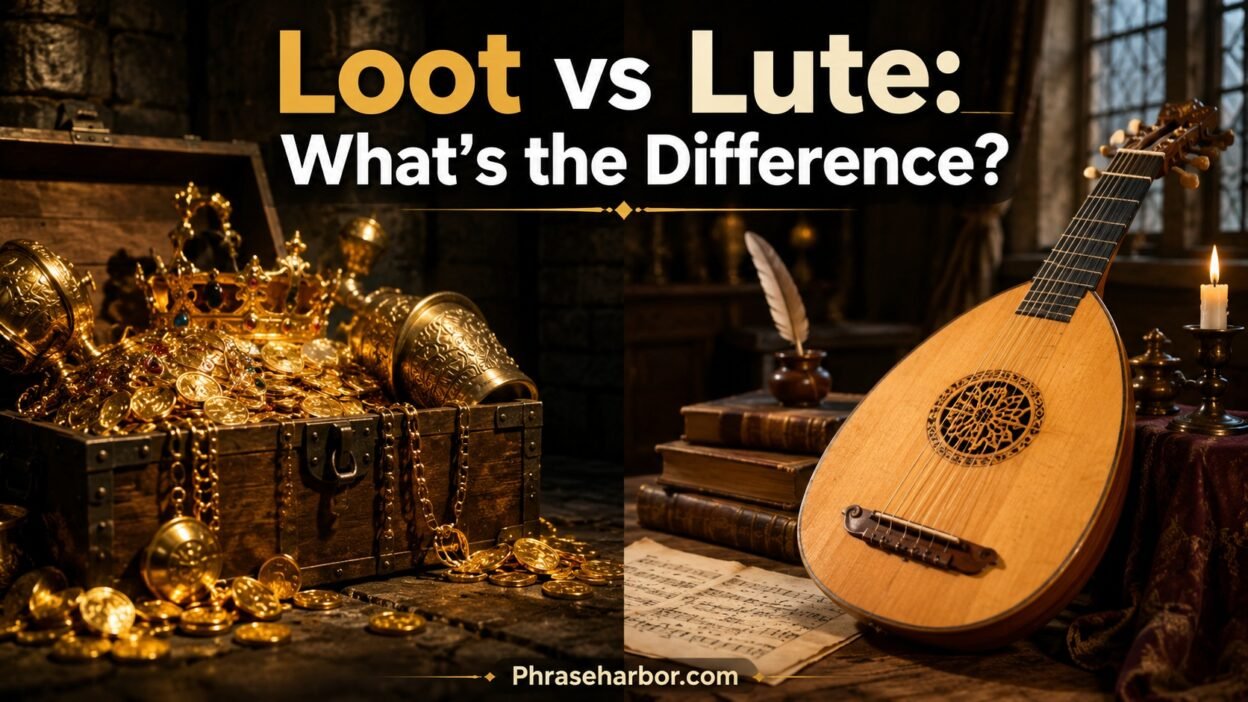
Loot vs Lute These two words sound exactly the same in standard English, yet their meanings couldn’t be more different. Loot usually refers to valuable goods that someone steals or takes by force. In modern gaming, it can also mean items or rewards that players collect. Lute, on the other hand, is a traditional stringed musical instrument with a rounded body and strings played with the fingers.
The confusion is easy to understand. When you hear either word in conversation, you can’t tell which spelling the speaker means. Both loot and lute are pronounced /luːt/ in standard English. Cambridge Dictionary lists the same pronunciation for both words. The spelling only becomes clear from the context.
Quick Answer
Loot and lute are homophones. They have the same pronunciation but different spellings and meanings.
- Loot means valuable goods taken through theft, force, or seizure. It can also describe rewards or items collected in a video game.
- Lute means a traditional plucked stringed musical instrument with a rounded body and neck.
- Loot can work as both a noun and a verb.
- Lute is mainly used as a noun when discussing music.
- Both words are pronounced /luːt/.
- Loot relates to valuables, stealing, rewards, or gaming.
- Lute relates to music, strings, instruments, and musical history.
Here is the easiest rule to remember:
Loot is collected. Lute is played.
For example, The player collected rare loot uses loot because the sentence describes game rewards. Meanwhile, The musician played a lute uses lute because the sentence refers to a musical instrument.
Comparison Overview
The following table makes the Loot vs Lute distinction easy to see at a glance:
| Feature | Loot | Lute |
| Meaning | Stolen, seized, or collected valuables | A traditional stringed musical instrument |
| Main part of speech | Noun and verb | Mainly noun |
| Pronunciation | /luːt/ | /luːt/ |
| Sound | Same as lute | Same as loot |
| Homophone | Yes | Yes |
| Common context | Theft, war, games, rewards | Music and musical history |
| Example | They divided the loot. | She played the lute. |
| Modern gaming use | Very common | Not related |
| Musical meaning | None | Main meaning |
The biggest point is that pronunciation doesn’t help you distinguish these words. You have to use context.
If someone says, “I found some rare loot,” you know the speaker means valuable items or rewards. If someone says, “I found an old lute,” the surrounding subject tells you that the word refers to an instrument.
Main Differences Between Loot vs Lute
The central difference between loot vs lute comes down to meaning and usage.
Loot belongs to the vocabulary of stealing, conflict, possessions, and gaming. Lute belongs to the vocabulary of music, instruments, performance, and history.
Although they sound identical, they occupy completely different semantic worlds.
Loot Means Stolen or Collected Valuables
As a noun, loot refers to money, valuable objects, or other goods taken from someone or somewhere, particularly through theft, force, or conflict. Cambridge Dictionary also recognizes the modern gaming sense in which loot means rewards or items gained by defeating enemies or completing activities.
Consider these examples:
- The thieves escaped with the loot.
- Police recovered some of the stolen loot.
- The soldiers carried away valuable loot.
- The player found rare loot inside the chest.
- The team returned to collect the loot.
The exact situation changes, but the basic idea remains similar: loot is something valuable that has been obtained or taken.
Lute Means a Musical Instrument
A lute is a traditional stringed instrument with a rounded back, a flat front, strings, and usually frets. Players generally pluck its strings with their fingers. Cambridge Dictionary describes the lute in these terms and gives its pronunciation as /luːt/.
Examples include:
- The musician played the lute beautifully.
- The museum displayed an ancient-style lute.
- She learned several Renaissance songs on the lute.
- The composer wrote music for voice and lute.
- He carefully tuned each string on his lute.
So, if the sentence involves music, strings, or a musician, lute is the appropriate spelling.
What Does “Loot” Mean?
The word loot has a few related uses, but they all center on things being taken or obtained.
Loot as a Noun
As a noun, loot means valuable things that have been stolen or seized. The word often appears in discussions of theft, war, riots, raids, or other situations involving the unlawful taking of property.
For example:
The thieves hid the loot beneath the floorboards.
Here, loot means the valuable property the thieves stole.
Another example:
Investigators recovered most of the stolen loot.
In this sentence, the word refers to property that had previously been taken illegally.
The noun is often treated as an uncountable noun when it refers generally to stolen valuables. You usually say some loot rather than some loots.
Loot as a Verb
Loot also works as a verb. It means to steal goods or valuables, especially from shops, homes, buildings, or other places during disorder or conflict.
Cambridge Dictionary defines the verb as stealing from shops and houses, particularly during violent events.
Examples:
- Criminals looted several stores.
- The group tried to loot the warehouse.
- Rioters looted shops during the unrest.
- The invaders looted the town.
- Authorities worked to prevent people from looting businesses.
Notice how the grammar changes:
- Loot = the thing that was taken.
- Loot = the action of taking it.
That makes the word unusually flexible.
Loot in Video Games
Gaming has given loot an important modern meaning.
In video games, loot usually refers to items a player receives or discovers during gameplay. These might include weapons, armor, currency, tools, equipment, collectibles, or other rewards.
For example:
- The boss dropped legendary loot.
- We found better loot in the dungeon.
- The chest contained rare loot.
- Players can collect loot after completing missions.
- The character lost all his loot after being defeated.
This meaning doesn’t necessarily involve theft. In gaming, loot has become a broad term for valuable or useful items acquired during play.
That distinction matters because a sentence such as “I collected the loot” could describe a perfectly normal gaming activity rather than a real-world crime.
Common Expressions With Loot
You may encounter loot in several combinations:
- Stolen loot
- Valuable loot
- War loot
- Looted goods
- Loot chest
- Loot drop
- Loot box
- Rare loot
- Legendary loot
- Collect loot
The context tells you whether the word refers to stolen property or game rewards.
What Does “Lute” Mean?
The word lute has a much narrower everyday meaning.
Lute as a Musical Instrument
A lute is a plucked string instrument associated with several musical traditions. The traditional European lute has a rounded body, a neck, strings, and a fretted fingerboard.
Its distinctive shape separates it from familiar modern instruments such as the standard guitar.
The lute played an important role in European music, particularly during the Renaissance and into the early modern period. Musicians used it for solo performances, accompaniment, and ensemble music.
Examples:
- The musician performed a Renaissance piece on the lute.
- The singer accompanied himself on the lute.
- The museum’s collection includes a beautifully decorated lute.
- She spent years studying historical lute techniques.
The word can also appear in related expressions such as lute player, lute music, lute string, lute song, and lute tablature.
The Lute’s Musical Role
The lute wasn’t simply a decorative instrument. It served several practical musical roles.
A skilled player could use it to perform melodies, chords, accompaniment, and more complex musical lines. Its ability to support both solo and accompanying roles helped make it valuable to composers and performers.
During the Renaissance, musicians wrote extensive repertoires for the instrument. Lute music also became closely connected with vocal performance.
The instrument’s historical importance helps explain why lute frequently appears in discussions of early European music.
Lute as a Technical Verb
There is also a less common technical use of lute as a verb. In technical contexts, to lute can mean to seal or join something with a material used as a sealant.
This meaning is far less common in everyday English than the musical noun.
For ordinary writing, however, the musical meaning is the one you’re most likely to encounter.
Loot vs Lute Pronunciation
One of the most interesting parts of Loot vs Lute is that the words are pronounced the same.
Both are generally pronounced:
/luːt/
Cambridge Dictionary gives /luːt/ for both the US and UK pronunciation of loot and lute.
They rhyme with words such as:
- boot
- root
- shoot
- suit
- fruit
This means you can’t reliably identify the spelling just by hearing someone say the word.
Why the Pronunciation Causes Confusion
Imagine someone says:
“The musician played a loot.”
You may immediately understand what the speaker means. However, the spelling should be lute.
Now consider:
“The player found rare lute.”
If the sentence refers to game rewards, the correct spelling is loot.
The sound doesn’t change. Only the meaning and spelling do.
That’s why Loot vs Lute is a classic homophone problem.
Are Loot and Lute Homophones?
Yes. Loot and lute are homophones.
A homophone is a word that sounds the same as another word but has a different spelling and meaning.
Some familiar examples include:
| Homophone Pair | Meaning 1 | Meaning 2 |
| right / write | Correct or opposite of left | Put words on paper |
| sea / see | Large body of salt water | Use your eyes |
| flower / flour | Part of a plant | Baking ingredient |
| pair / pear | Two things | Type of fruit |
| loot / lute | Stolen or collected valuables | Musical instrument |
The interesting thing about loot and lute is that their meanings are especially far apart.
One concerns possessions and taking. The other concerns music and performance.
Loot vs Lute Examples in Sentences
Seeing the words in complete sentences makes the distinction much easier.
Examples With “Loot”
- The thieves divided the loot after leaving the building.
- Police recovered the stolen loot from an abandoned vehicle.
- The pirates searched the ship for valuable loot.
- The player collected rare loot after defeating the boss.
- We found useful loot inside the hidden chest.
- The criminals planned to loot several stores.
- The museum recovered artifacts that had been looted decades earlier.
- The game rewards players with better loot as they progress.
- The soldiers returned with valuable loot.
- The team rushed toward the chest to claim its loot.
Examples With “Lute”
- The musician played the lute during the historical performance.
- She studied Renaissance music and learned to play the lute.
- The museum displayed an ornate lute behind glass.
- He carefully tuned the strings of his lute.
- The composer wrote a piece for voice and lute.
- The performer carried a wooden lute onto the stage.
- The class learned about the history of the lute.
- The musician’s fingers moved quickly across the lute strings.
- Renaissance paintings often depict musicians holding a lute.
- The recording features traditional lute accompaniment.
The pattern is clear: loot belongs to valuables and acquisition, while lute belongs to music.
Read More: Appal vs Appall: Difference, Meaning, and Usage
Loot vs Lute: Common Mistakes
Because the words sound identical, spelling mistakes are common.
Mistake 1: Using “Lute” for Stolen Goods
Incorrect:
The robbers divided the lute.
Correct:
The robbers divided the loot.
The sentence concerns stolen valuables. Therefore, loot is correct.
Mistake 2: Using “Loot” for a Musical Instrument
Incorrect:
The musician picked up his loot.
Correct:
The musician picked up his lute.
The object is a musical instrument, so the correct spelling is lute.
Mistake 3: Confusing Gaming Loot With Music
Incorrect:
The character collected rare lute after defeating the enemy.
Correct:
The character collected rare loot after defeating the enemy.
Gaming uses loot for rewards or items. It has nothing to do with the musical instrument.
Mistake 4: Assuming “U” Always Sounds Different
English spelling doesn’t always give you a predictable pronunciation.
The u in lute produces the same /uː/ sound represented by oo in loot.
This is one reason English spelling can feel tricky. Different letter combinations can produce the same sound.
How to Remember Loot vs Lute
A simple memory trick can save you from making the mistake again.
Remember: Loot Is Taken
Connect loot with:
stealing → valuables → rewards → gaming
For example:
The player collected the loot.
You can imagine a character opening a treasure chest and collecting gold, weapons, and equipment.
Remember: Lute Is Played
Connect lute with:
music → strings → musician → instrument
For example:
The musician played the lute.
Think of a historical musician sitting with a rounded stringed instrument.
The Fastest Memory Rule
Use this:
Loot = valuables.
Lute = instrument.
Or even shorter:
Loot is collected. Lute is played.
That distinction works in almost every ordinary situation.
Loot vs Lute in Gaming
Modern gaming has made loot much more familiar to many readers.
In games, loot can include almost anything valuable that a character obtains through gameplay. A defeated enemy might drop an item. A treasure chest might contain equipment. Completing a mission might award currency or useful gear.
The word appears in several common gaming expressions.
| Gaming Term | Meaning |
| Loot drop | An item or reward that appears after an event |
| Loot chest | A container holding game rewards |
| Loot table | A system determining which items can appear |
| Rare loot | Uncommon or valuable game items |
| Loot box | A virtual container containing randomized rewards |
| Looting | Collecting items from defeated enemies or locations |
This modern sense is important because you might encounter loot far more often online than in discussions of historical warfare.
For example:
The dungeon has better loot than the starting area.
Here, loot simply means useful or valuable game items.
There is no connection to the lute instrument.
Lute in Music and History
The lute has a long musical history and belongs to a broad family of plucked string instruments.
The instrument became especially important in European music during the Renaissance. Lute players performed both instrumental pieces and accompaniments for singers.
Its design typically includes a rounded body and a neck. Traditional lutes can have multiple strings arranged in courses, depending on the particular historical type and period.
The term lute can also refer more broadly to related instruments in different traditions. Cambridge Dictionary, for example, notes comparisons with instruments such as the oud and pipa.
That broader musical history makes the word useful in writing about:
- Renaissance music
- Early European music
- Historical instruments
- String instruments
- Classical performance
- Musicology
- Early modern culture
Lute vs Modern Guitar
The lute and guitar share some broad characteristics because both are plucked string instruments. However, they’re not the same instrument.
A guitar typically has a flatter body and a different neck and construction. The traditional lute has a characteristic rounded back.
So if a historical text describes a musician playing a rounded, plucked string instrument, lute may be the intended word.
FAQs:
Is “loot” or “lute” correct?
Both are correct words, but they mean different things. Loot refers to stolen, seized, or collected valuables. Lute usually refers to a traditional stringed musical instrument.
Are loot and lute pronounced the same?
Yes. Both are generally pronounced /luːt/ in standard English. Cambridge Dictionary gives the same pronunciation for both words.
Are loot and lute homophones?
Yes. Loot and lute are homophones because they have the same pronunciation but different spellings and meanings.
What does loot mean?
Loot means valuable goods that have been stolen or seized. In modern video games, it can also mean items or rewards collected during gameplay.
Is loot a verb?
Yes. Loot can function as a verb meaning to steal valuable goods, particularly from a place during disorder or conflict.
Conclusion:
The difference between loot vs lute becomes simple once you focus on meaning rather than sound. Loot relates to valuable things that are stolen, seized, or collected. It can function as both a noun and a verb. In modern gaming, it commonly describes rewards and items obtained during play.
Lute refers primarily to a traditional stringed musical instrument. It has a rounded body and is played by plucking its strings. The instrument has an important place in the history of European music, particularly Renaissance music.