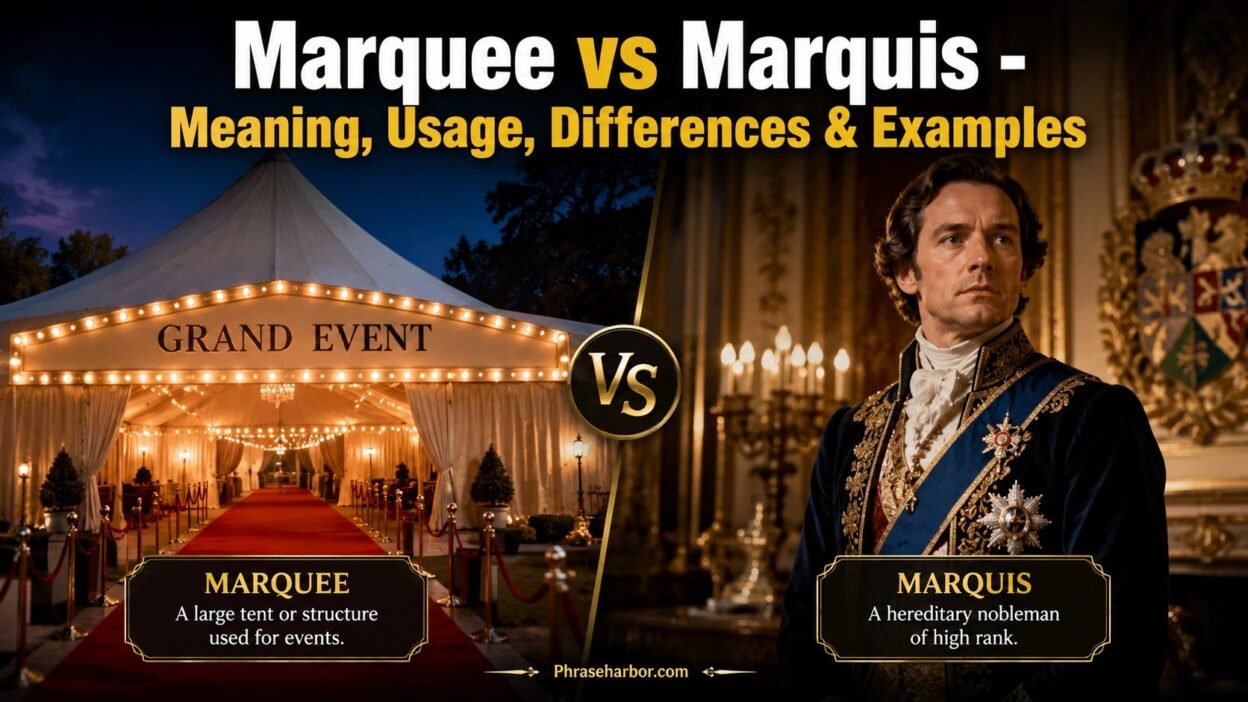
Marquee vs Marquis can be confusing because the two words look and sound quite similar. However, they have completely different meanings and appear in very different situations. Choosing the wrong one can change the meaning of a sentence entirely.
Marquee usually refers to a large tent or temporary covered structure used for events. It can also mean a theater sign or something especially prominent, such as a major sports player or headline event. Marquis, on the other hand, refers to a nobleman who holds a particular aristocratic title.
For example, you might write, “The wedding reception was held inside a large marquee.” If you’re describing a member of the European nobility, you might write, “The marquis inherited the family estate.” The words may look like close relatives, but their everyday meanings are miles apart.
Quick Answer
The simplest way to understand marquee vs marquis is to focus on what each word describes.
- Marquee means a large tent, covered structure, theater sign, or prominent feature.
- Marquis means a nobleman who holds a rank in the aristocracy.
- Marquee can function as both a noun and an adjective.
- Marquis is primarily a noun and title.
- In British English, marquess is the traditional spelling for the male aristocratic title, while marquis is also used in other English and European contexts.
- Marquee is common in modern conversations about events, entertainment, sports, and business.
- Marquis is much more likely to appear in historical, aristocratic, genealogical, or literary contexts.
The easiest memory trick
Think of marquee when you see a tent, theater sign, or major attraction.
Think of marquis when you’re talking about a nobleman or aristocratic title.
Here are two examples:
The guests gathered beneath the marquee during the wedding.
The marquis arrived at the estate before sunset.
The first sentence describes a structure. The second describes a person with a noble title.
Comparison Overview
| Feature | Marquee | Marquis |
| Main meaning | Large tent, canopy, theater sign, or prominent feature | Nobleman holding an aristocratic title |
| Part of speech | Noun and adjective | Noun |
| Common context | Events, theaters, sports, entertainment, business | Nobility, history, genealogy, literature |
| Example | The guests entered the wedding marquee. | The marquis visited his estate. |
| Modern usage | Very common | Less common |
| British-related usage | Common noun | Marquess is the traditional British title spelling |
| Pronunciation | Usually mar-KEE | Usually MAR-kwis |
| Related words | tent, canopy, sign, headline, attraction | marquess, marchioness, nobleman, aristocrat |
The most important point is simple: marquee and marquis are not interchangeable.
If you’re talking about an event tent, a theater sign, or something high-profile, marquee is generally the right word. If you’re referring to a nobleman with an aristocratic rank, marquis or marquess may be appropriate depending on the historical or linguistic context.
Main Differences Between Marquee vs Marquis
The difference between marquee vs marquis goes beyond spelling. Their meanings, grammatical roles, pronunciation, and contexts are different.
Marquee Refers to a Structure or Something Prominent
The noun marquee commonly describes a large tent or temporary structure. Event organizers often use marquees for weddings, festivals, receptions, exhibitions, and outdoor celebrations.
For example:
- The wedding guests waited inside the marquee.
- A large marquee covered the outdoor dining area.
- The festival organizers installed several marquees.
- The exhibition featured a separate marquee for food vendors.
The word can also refer to a canopy or projecting structure over an entrance.
Another familiar use appears outside theaters. A theater’s marquee traditionally displays the name of the theater, movie, show, or performers. In American English, this meaning remains especially recognizable.
For example:
The actor’s name appeared in bright letters on the theater marquee.
Over time, marquee developed a figurative meaning as well. Today, businesses, sports organizations, and entertainment companies often use it to describe something high-profile, important, or especially attractive.
You might hear phrases such as:
- marquee player
- marquee event
- marquee attraction
- marquee matchup
- marquee name
- marquee performer
In these expressions, marquee doesn’t mean a physical tent. Instead, it suggests that something is a major draw.
Marquis Refers to a Nobleman
The noun marquis has a completely different meaning.
A marquis is a male nobleman who holds the rank traditionally positioned below a duke and above an earl in the British peerage hierarchy. In systems using the title, it represents a high level of aristocratic status.
The title has deep European historical roots and has appeared in various forms across different countries and periods.
For example:
The marquis hosted a formal dinner at his country estate.
Here, marquis refers to the person rather than a building, event, or object.
The word can also appear as part of a person’s formal title. Historical writing may refer to someone as the Marquis of Westminster, for example.
Unlike marquee, the word marquis doesn’t normally describe something that is important or popular. You shouldn’t write, “The concert was the marquis event of the year.” That would be incorrect if you mean a major or headline event.
The correct phrase would be:
The concert was the marquee event of the year.
Marquee Can Be an Adjective
One reason marquee vs marquis causes confusion is that marquee has expanded beyond its original noun uses.
In modern English, especially in American media and sports writing, marquee can work as an adjective meaning prominent, major, prestigious, or highly anticipated.
Consider these examples:
- The team signed a marquee player.
- The championship became the network’s marquee event.
- The festival attracted several marquee performers.
- The company announced a marquee partnership.
- The museum’s marquee exhibition opened in June.
The adjective often suggests that something serves as a major attraction or headline feature.
Marquis Is a Title, Not a Synonym for Marquee
A marquis is a person holding a noble title. It doesn’t mean “important,” “famous,” or “headline.”
This distinction makes the words easy to separate once you understand their functions.
| If you’re describing… | Use |
| A large event tent | Marquee |
| A theater sign | Marquee |
| A major sports player | Marquee |
| A headline event | Marquee |
| A nobleman | Marquis |
| A historical aristocratic title | Marquis |
| A British noble title traditionally spelled differently | Marquess |
What Does Marquee Mean?
Marquee has several related meanings in modern English. Its literal and figurative uses are worth understanding because both appear frequently in American writing.
Marquee as a Large Tent
A marquee can be a large tent or temporary covered structure designed to accommodate people.
These structures are common at outdoor events where organizers need shelter, seating, dining areas, or entertainment space.
For example:
The organizers placed tables and chairs beneath the enormous marquee.
A marquee might serve as a dining area at a wedding or as a covered space at a festival. Its exact design can vary considerably.
The plural is marquees.
Marquee as a Theater Sign
In American English, marquee also commonly refers to the sign or structure outside a theater.
Traditionally, theater marquees displayed the name of a production or movie. Modern electronic signs continue that tradition.
For example:
The movie’s title appeared across the theater marquee.
This meaning is especially useful when discussing cinemas, theaters, Broadway productions, concerts, and entertainment venues.
Marquee as Something Prominent
The figurative use of marquee has become widespread.
When journalists describe someone or something as marquee, they usually mean that it attracts attention because of its importance, reputation, popularity, or status.
For example:
The tournament featured several marquee players from around the world.
Here, marquee suggests that the players are major attractions.
Similarly:
The championship game was the week’s marquee event.
The game isn’t literally a tent. It’s the event expected to receive significant attention.
What Does Marquis Mean?
Marquis is a noun connected with aristocratic titles.
Traditionally, a marquis ranks below a duke and above an earl in the British peerage hierarchy. The equivalent title in some other European systems has different historical details and traditions.
The word often appears in historical documents, biographies, novels, period dramas, and discussions of European nobility.
Marquis and the British Peerage
In the traditional British peerage, the ranks are commonly presented as:
- Duke
- Marquess
- Earl
- Viscount
- Baron
The important detail here is spelling. Marquess is the standard British spelling for the title.
Marquis is also a recognized word and appears particularly in French-influenced contexts and historical names. English usage varies depending on the title, person, country, and historical period.
That means it’s better not to treat marquis and marquess as simple spelling mistakes for one another.
Marquis vs Marquess
The distinction can be summarized like this:
| Word | General use |
| Marquis | Noble title used in various European and English contexts |
| Marquess | Traditional British spelling of the male title |
| Marchioness | Female title associated with a marquess or marquis |
For British historical writing, marquess is generally the expected spelling for the rank.
For example:
The Marquess of Salisbury held a prominent position in British political history.
Meanwhile, marquis appears in names and titles influenced by French or other continental traditions.
Marquee vs Marquis: Pronunciation
Pronunciation provides another useful clue.
In American English, marquee is generally pronounced roughly like:
mar-KEE
The ending sounds like “key.”
Marquis is generally pronounced roughly like:
MAR-kwis
The final part sounds like “kwis.”
This difference becomes clearer when you hear the words aloud.
- Marquee: mar-KEE
- Marquis: MAR-kwis
Although the spelling looks similar, the pronunciation is not identical.
Marquee vs Marquis: Word Origins
The two words also developed through different historical pathways.
Marquee entered English through French and is connected historically with words associated with a marquise, a noblewoman or the tent associated with her. Over time, English developed the word’s familiar meanings involving tents, canopies, and theater signs.
Marquis, meanwhile, comes from the French title marquis, which traces back to the concept of a ruler or nobleman associated with a march, a border territory.
The historical relationship is important because it explains why the words can look deceptively similar. Their histories overlap in European language and aristocratic culture, but their modern English meanings have diverged sharply.
Read More: In vs. Within: Usage, Differences, and Examples
Marquee vs Marquis Examples in Sentences
Seeing the words in realistic sentences makes the difference much easier to remember.
Examples Using Marquee as a Noun
- The wedding reception took place inside a spacious marquee.
- Guests gathered beneath the marquee to escape the rain.
- The festival organizers decorated the main marquee with flowers.
- The theater’s marquee displayed the name of the new musical.
- A large marquee covered the outdoor dining area.
- The company rented a marquee for its annual celebration.
In every example, marquee refers to a physical structure or sign.
Examples Using Marquee as an Adjective
- The championship was the network’s marquee event.
- The club signed a marquee player during the summer.
- The festival attracted several marquee performers.
- The stadium hosted a marquee matchup on Saturday.
- The museum announced its marquee exhibition for the spring.
- The company hired a marquee name for its advertising campaign.
Here, marquee means something like major, prominent, or headline-worthy.
Examples Using Marquis
- The marquis hosted guests at his country estate.
- The young marquis inherited the family title.
- The novel follows a fictional marquis and his family.
- The marquis attended the royal ceremony.
- Historical records describe the marquis as an influential landowner.
- The estate once belonged to a wealthy marquis.
In each sentence, marquis identifies a person holding a noble title.
Common Mistakes With Marquee and Marquis
Because these words resemble each other, spelling mistakes are easy to make. The good news is that the context usually reveals the correct choice.
Mistake: Using Marquis for a Major Event
Incorrect:
The championship was the marquis event of the season.
Correct:
The championship was the marquee event of the season.
The correct word is marquee because the sentence describes a major or headline event.
Mistake: Using Marquee for a Nobleman
Incorrect:
The marquee inherited his family’s estate.
Correct:
The marquis inherited his family’s estate.
The sentence refers to a nobleman, so marquis is appropriate.
Mistake: Treating Marquis and Marquess as Completely Unrelated
Another common mistake is assuming marquis and marquess have completely different meanings.
They are closely related forms of the same aristocratic title. However, their spelling depends on linguistic and historical context.
For British peerage, marquess is the standard spelling.
Mistake: Assuming Similar Spelling Means Similar Meaning
English contains many words that look or sound alike without sharing the same modern meaning.
Marquee vs marquis is a good example. Once you focus on the context rather than the spelling, the distinction becomes much easier.
Marquee vs Marquis in Different Contexts
Context provides the fastest way to choose the correct word.
| Situation | Correct Word | Example |
| Wedding tent | Marquee | The guests ate dinner inside the marquee. |
| Festival tent | Marquee | The main marquee hosted live music. |
| Theater sign | Marquee | The film’s title appeared on the marquee. |
| Major athlete | Marquee | The club signed a marquee player. |
| Major event | Marquee | The final became the tournament’s marquee event. |
| Nobleman | Marquis | The marquis arrived at the estate. |
| Aristocratic title | Marquis/Marquess | The title belonged to an old noble family. |
A Simple Context Test
Before choosing between these words, ask one question:
“Am I talking about a tent, sign, prominent feature, or nobleman?”
If you’re talking about a tent, sign, or prominent attraction, choose marquee.
If you’re talking about a nobleman, choose marquis or marquess, depending on the relevant title and tradition.
This simple test works in most everyday situations.
FAQs:
Is marquee the same as marquis?
No. Marquee and marquis have different meanings. Marquee can mean a large tent, theater sign, or prominent feature. Marquis refers to a nobleman holding an aristocratic title.
What is the main difference between marquee and marquis?
The main difference is their meaning. Marquee relates to a structure, sign, or prominent attraction, while marquis refers to a nobleman or title of nobility.
Is a marquee a tent?
Yes. A marquee can mean a large tent or temporary covered structure used for events such as weddings, festivals, receptions, and exhibitions.
What does marquee mean in sports?
In sports, marquee usually means high-profile, prominent, or especially important. A marquee player is a major attraction, while a marquee matchup is a highly anticipated contest.
Is a marquis a nobleman?
Yes. A marquis is traditionally a male nobleman holding a rank associated with the European aristocracy. In the traditional British hierarchy, the corresponding title is spelled marquess and ranks below a duke and above an earl.
Conclusion:
The difference between marquee vs marquis becomes straightforward once you connect each word with its meaning. Marquee is the word for a large tent, covered event structure, theater sign, or prominent feature. In modern English, it can also work as an adjective for something major or high-profile. That’s why you can have a marquee tent, a theater marquee, a marquee player, or a marquee event.
Marquis refers to a nobleman holding an aristocratic title. In British usage, the corresponding title is traditionally spelled marquess. The word belongs mainly to historical, aristocratic, genealogical, and literary contexts.