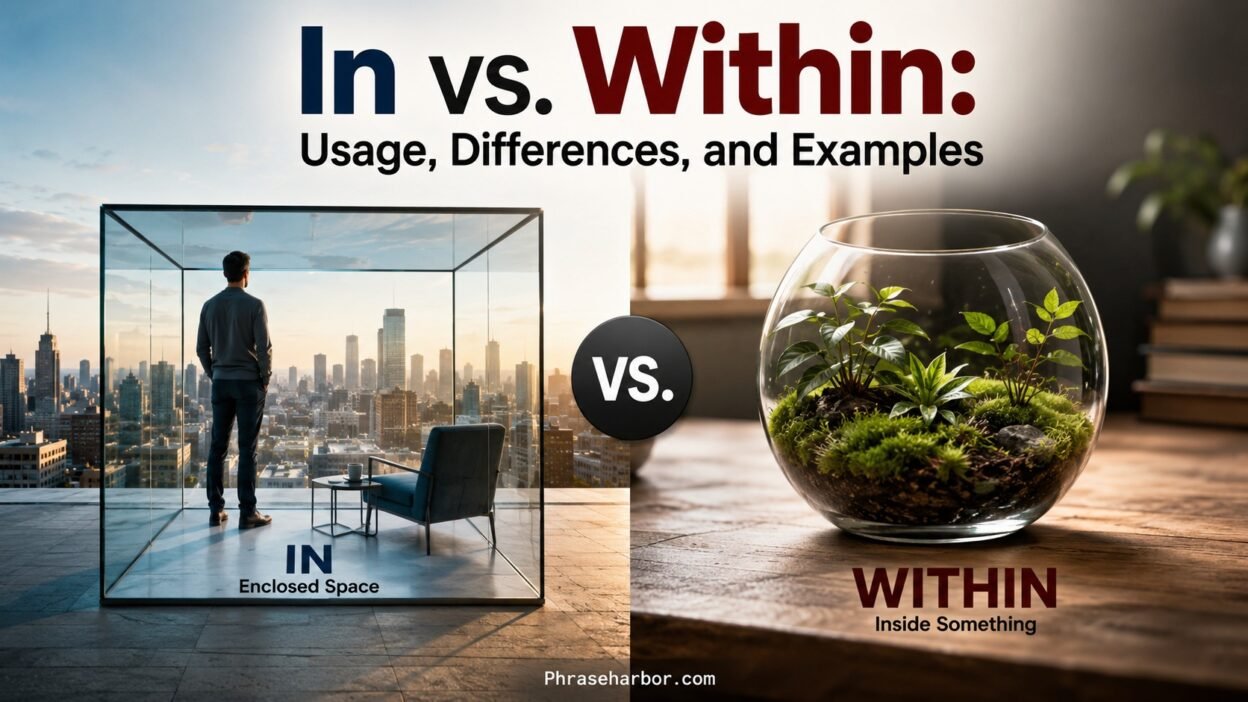
Choosing between in and within can seem easy until both words appear to fit the same sentence. The confusion usually comes from situations involving time, place, limits, boundaries, and deadlines. For example, “I’ll finish the work in two hours” and “I’ll finish the work within two hours” are both grammatical, but they don’t communicate exactly the same idea.
The key is to focus on the meaning rather than treating one word as a replacement for the other. In often identifies a time, place, condition, or situation. Within usually draws attention to a boundary, limit, range, or maximum period. Once you understand that small difference, choosing the right word becomes much easier.
Quick Answer
In and within can overlap, especially when talking about time, but they aren’t always interchangeable.
- In often means inside a place, during a period, or after a certain amount of time.
- Within usually means inside a defined boundary or before a specified period ends.
- In two hours commonly points to a time two hours from now.
- Within two hours means at any point before two hours have passed.
- In the room simply identifies location.
- Within the building emphasizes the building as a defined boundary.
- In 2026 is correct for a year.
- Within 30 days establishes a maximum time limit.
A useful rule is simple: in describes where or when something is, while within often emphasizes the limit surrounding it.
Think of “in” as identifying a place or period and “within” as drawing a boundary around it.
Comparison Overview
The easiest way to understand in vs. within is to compare their most common functions.
| Use | In | Within |
| Inside a room | Yes | Yes, but more boundary-focused |
| Inside a city | Yes | Yes, especially with defined limits |
| Months and years | Yes | No |
| Seasons | Yes | No |
| Parts of the day | Yes | No |
| A period from now | Yes | Yes |
| Maximum time limit | Sometimes | Yes |
| Rules and restrictions | Less common | Very common |
| Defined range | Less common | Very common |
| Physical boundaries | Common | Common |
| States and conditions | Very common | Limited |
| Fixed expressions | Very common | Very common |
The distinction becomes especially clear when you look at time. If someone says, “The train will arrive in 20 minutes,” they normally mean the expected arrival is 20 minutes from now. If they say, “The train will arrive within 20 minutes,” they give a time limit. The train could arrive sooner.
That difference may look small, but it can matter in instructions, schedules, customer service, contracts, and everyday conversations.
Main Differences Between In and Within
The main difference between in and within comes down to boundaries and meaning.
In has a broad range of uses. You can use it for locations, periods, conditions, activities, states, and future time. Within has a narrower sense. It often tells you that something stays inside a particular limit or happens before that limit expires.
Consider these examples:
- “She lives in New York.”
- “The property is within the city limits.”
Both sentences describe location. However, the second sentence emphasizes a defined boundary.
The same pattern appears with time:
- “I’ll call you in an hour.”
- “I’ll call you within an hour.”
The first sentence often suggests a call one hour from now. The second promises that the call will happen sometime during the next hour.
So, while the two prepositions sometimes overlap, their focus differs.
What Does “In” Mean?
In is one of the most frequently used prepositions in English. It can describe physical location, time, condition, participation, and many other relationships.
Its meaning depends heavily on the noun or phrase that follows it.
In for Time
Use in with many broad periods of time.
Examples include:
- in January
- in 2026
- in summer
- in the morning
- in the afternoon
- in the evening
- in the 1990s
You can also use in to express a future period:
“The meeting starts in three hours.”
Here, in three hours means three hours from the present moment.
Another example:
“The package should arrive in five days.”
The sentence usually presents five days as the expected point or duration before arrival.
In for Location
Use in when something exists inside a place, area, container, or physical space.
Examples:
- The keys are in the drawer.
- She is in the kitchen.
- They live in Texas.
- There are several books in the bag.
- He works in an office.
In these examples, in simply establishes location. It doesn’t necessarily emphasize a formal boundary.
In for Situations and Conditions
English also uses in with abstract conditions and situations.
Common examples include:
- in trouble
- in danger
- in love
- in pain
- in doubt
- in need
- in shock
- in control
For example:
“The company is in trouble after losing several major clients.”
Here, in doesn’t describe physical location. It describes a state or condition.
In for Activities and States
You can also use in to describe involvement in an activity or state.
Examples include:
- in progress
- in business
- in class
- in practice
- in agreement
- in discussion
For example:
“The project is still in progress.”
The phrase means the project has started but hasn’t finished.
What Does “Within” Mean?
Within generally focuses on something being inside a particular limit, boundary, range, or period.
It can describe physical space, time, rules, organizations, and abstract limits.
Within for Time Limits
This is one of the most important uses of within.
“Please reply within 48 hours.”
The sentence doesn’t necessarily mean you should reply exactly 48 hours from now. Instead, it establishes a maximum period. Any reply before that point satisfies the instruction.
For example, if an email arrives at 9:00 a.m. on Monday, a reply sent at:
- 10:00 a.m. Monday → within 48 hours
- 6:00 p.m. Monday → within 48 hours
- 8:30 a.m. Tuesday → within 48 hours
- 8:59 a.m. Wednesday → within 48 hours
- 9:30 a.m. Wednesday → outside the 48-hour period
The exact calculation can depend on the context and stated deadline, but the core idea remains the same: within establishes a limit.
Within for Physical Boundaries
Within can identify something located inside a defined area.
Examples:
- within the building
- within the walls
- within the city limits
- within the property
- within the boundary
- within the designated area
Compare these two sentences:
“There are three restaurants in the building.”
“Smoking isn’t allowed within the building.”
The first sentence simply identifies location. The second uses within to establish the building as a boundary for a rule.
Within for Rules and Limits
Within works naturally with restrictions.
Examples include:
- within the law
- within the rules
- within the guidelines
- within the budget
- within limits
- within the permitted range
- within company policy
For example:
“The team completed the project within the budget.”
The sentence means the project didn’t exceed the financial limit.
You wouldn’t normally replace within with in here without changing the meaning or making the sentence unnatural.
Within for Organizations and Systems
You can use within to describe something happening inside an organization, department, structure, or system.
Examples:
- within the company
- within the department
- within the organization
- within the community
- within the system
- within the industry
For example:
“The new policy created concerns within the organization.”
Here, within emphasizes that the concerns exist inside the boundaries of the organization.
In vs. Within for Time
Time is where in vs. within causes some of the most common confusion.
Both expressions can describe future time, but their emphasis differs.
| Sentence | Typical meaning |
| I’ll finish it in two hours. | I expect to finish it two hours from now. |
| I’ll finish it within two hours. | I’ll finish it sometime before two hours pass. |
| She’ll arrive in 30 minutes. | Her expected arrival is 30 minutes from now. |
| She’ll arrive within 30 minutes. | She’ll arrive anytime during the next 30 minutes. |
| We’ll respond in three days. | The response is expected around three days from now. |
| We’ll respond within three days. | The response will come no later than three days from now. |
“In Two Hours” vs. “Within Two Hours”
Imagine you’re waiting for a repair technician.
The technician says:
“I’ll be there in two hours.”
You’d normally understand this as an expected arrival around two hours from now.
Now imagine the technician says:
“I’ll be there within two hours.”
That gives you a maximum waiting period. The technician could arrive after 30 minutes, one hour, or one hour and 45 minutes.
The practical difference is precision versus flexibility.
In often points toward the expected time. Within gives a window.
“In a Week” vs. “Within a Week”
Consider:
“The results will be available in a week.”
This commonly suggests that the results will be available about one week from now.
Now compare:
“The results will be available within a week.”
This means the results should become available at some point during the next seven days.
Neither sentence is automatically wrong. The speaker simply emphasizes a different aspect of time.
In vs. Within for Place
The difference becomes easier to spot when you think about boundaries.
Using “In” for General Location
Use in when you simply want to say where something is.
“My brother lives in Chicago.”
“The documents are in the office.”
“She left her phone in the car.”
These sentences don’t need to emphasize a formal boundary.
Using “Within” for Defined Areas
Use within when the area itself functions as a boundary.
“The airport lies within the city limits.”
“Only authorized employees may enter areas within the facility.”
“The search must remain within the designated zone.”
The word within creates a stronger sense of containment.
A helpful mental image is a circle on a map. Everything inside that circle falls within the boundary.
Read More: There Has Been vs. There Have Been: What’s the Difference?
In vs. Within for Limits and Boundaries
Within is especially useful when something must remain below, inside, or under a specific limit.
Consider these common expressions:
- within budget
- within reach
- within limits
- within range
- within reason
- within capacity
- within guidelines
- within legal limits
For example:
“The designer completed the project within budget.”
This means the final cost stayed inside the allowed financial limit.
Another example:
“The store is within walking distance.”
This doesn’t merely mean the store exists in a place. It describes its distance as falling inside a practical range that someone can reasonably walk.
Why “Within” Works So Well Here
The concept is almost mathematical.
Suppose a company sets a travel budget of $1,000. A trip costing $850 falls within the budget. A trip costing $1,200 goes beyond it.
Likewise, if a speed limit is 60 mph, driving at 50 mph remains within the legal limit.
This is why within naturally pairs with words involving measurable boundaries.
In vs. Within in Formal and Professional English
Both words appear frequently in professional writing, but within often appears when a document establishes a rule, deadline, or limit.
Workplace Examples
- Please submit the form within five business days.
- All expenses must remain within the approved budget.
- The issue should be resolved within the department before escalation.
- Employees must operate within company policy.
Meanwhile, in remains common for ordinary descriptions:
- The meeting is in Room 204.
- She works in the finance department.
- The report will be ready in two days.
Professional writing often relies on the distinction because deadlines and restrictions need precise wording.
In vs. Within in Common Everyday Expressions
Some phrases have become established patterns in English. You shouldn’t replace their prepositions simply because another word seems similar.
Common Expressions With “In”
- in advance
- in time
- in the meantime
- in detail
- in progress
- in need
- in fact
- in general
- in public
- in person
For example:
“Please let us know in advance.”
Here, in advance is the established expression.
Common Expressions With “Within”
- within reach
- within reason
- within limits
- within walking distance
- within a few days
- within the next hour
- within budget
- within range
- within the law
These expressions often carry the idea of a boundary or acceptable range.
In vs. Within: When Both Are Grammatically Possible
Sometimes both words are grammatically correct. That’s where context becomes important.
Consider:
“The manager will respond in three days.”
This suggests an expected response around three days from now.
Now:
“The manager will respond within three days.”
This creates a deadline. The manager may respond sooner.
The same principle applies to many workplace and service situations.
Example: Customer Support
Imagine a support team tells a customer:
“We’ll contact you in 24 hours.”
The customer may reasonably expect contact around the 24-hour mark.
If the team says:
“We’ll contact you within 24 hours.”
The customer understands that contact should happen before the 24-hour period expires.
That small change can affect expectations.
Example: Medical Appointment Scheduling
Suppose a clinic says:
“Your appointment reminder will arrive in two days.”
That suggests an expected timing.
If it says:
“Your appointment reminder will arrive within two days.”
The clinic promises delivery no later than the end of that period.
The surrounding context determines exactly how people interpret these statements.
FAQs:
Is “within” the same as “in”?
Not always. In generally refers to being inside something or happening during a period of time, while within often emphasizes limits, boundaries, or a specific timeframe. For example, “I’ll finish it in two days” and “I’ll finish it within two days” have slightly different meanings.
Which is more formal: “in” or “within”?
Within is generally more formal and precise than in. It is common in business, legal, and professional writing, especially when discussing deadlines or boundaries. In is more common in everyday conversation.
Can I use “within” for time?
Yes. Within is often used to mean before a particular time limit expires. For example, “Please reply within 24 hours” means the reply should arrive at any point before the 24-hour period ends.
When should I use “in” instead of “within”?
Use in when referring generally to a location, situation, or amount of time. For example, “She lives in London” or “The meeting starts in ten minutes.” It doesn’t always emphasize a boundary like within does.
Is “within 10 days” the same as “in 10 days”?
No. Within 10 days means at any time before the ten-day limit ends. In 10 days usually means exactly ten days from now. This difference is important when discussing deadlines.
Conclusion:
The difference between In vs. Within mainly comes down to general meaning versus limits and boundaries. Use in for general locations, situations, and periods of time. Choose within when you want to emphasize that something happens inside a specific boundary, distance, area, or deadline.
Understanding this small distinction can make your writing clearer and more precise. When in doubt, remember: in is broader and more common, while within highlights a limit or defined boundary.